
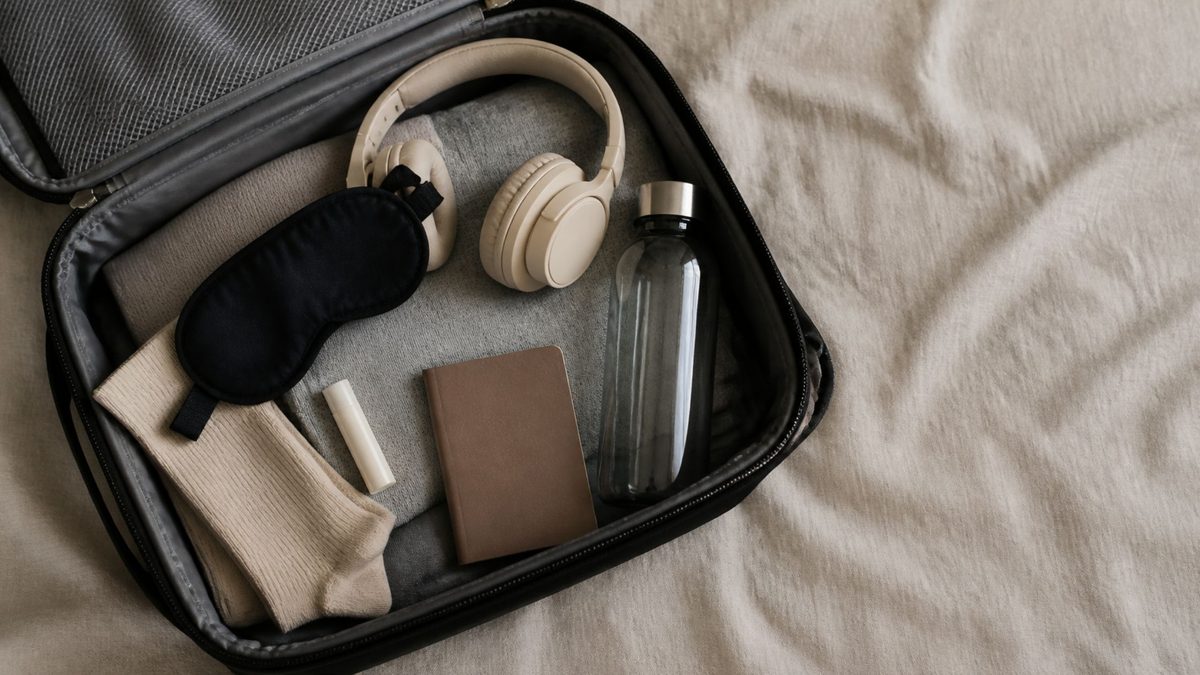
Short answer: the long flight essentials with the best case behind them are compression socks, an empty water bottle, noise-cancelling headphones or good earplugs, an eye mask, warm layers, lip balm and moisturizer, and your medications in your carry-on. Each one fixes a specific problem with the cabin: legs that don't move, air at 10–20% humidity, engine noise around 80 dB, and light at the wrong time. A Cochrane review found compression stockings cut symptomless blood clots in the legs from about 2–3 in 100 passengers to about 2–3 in 1,000 on flights of 5+ hours. "Immune boosters," a nightcap and blue light glasses don't earn their space.
Most packing lists for long flights read like shopping lists. This one starts from the cabin. A long-haul flight does four things to your body: you sit still for hours, the air is very dry, it's loud all the time, and you're crossing time zones. Everything below either fixes one of those or it doesn't make the cut.
The 15 long flight essentials worth packing
1. Compression socks
This is the one item on the list with high-certainty evidence. A 2021 Cochrane review pooled nine randomized trials with 2,637 passengers on flights of at least five hours. A symptomless clot in a deep leg vein (DVT) showed up in 47 people who didn't wear stockings and 3 who did. That's a drop from a few tens per thousand passengers to two or three per thousand. Stockings also reduced ankle swelling. No one in the trials had a symptomatic clot, so the review can't say how many serious events they prevent. Choose below-knee socks with graduated compression (often labeled 15–30 mmHg) and put them on before boarding. If your ankles swell on every flight, our article on why your ankles swell when you fly explains the mechanics.
2. An empty refillable water bottle
Cabin air on long flights runs at roughly 10–20% humidity. You lose a little extra water through breathing and skin, but not as much as many people think. The bigger problem is that people drink less on planes because the cups are small and the aisle is blocked. Bring an empty bottle through security and fill it at the gate. Our article on whether flying dehydrates you has the numbers.
3. Noise-cancelling headphones
Jet cabins sit around 80 dB for most of the flight, mostly as low-frequency engine and air noise. That's exactly what active noise cancelling handles best. In an Australian study, 83 minutes of reproduced cabin noise at 80 dB hurt recognition memory, and noise-cancelling headphones that removed about 20 dB reduced that effect. They also let you listen to films at a lower volume, which matters over 10+ hours. If you're worried about hearing, our explainer on whether noise cancelling damages hearing covers it (short version: it doesn't, and it usually protects it).
4. Foam earplugs (as backup or for sleep)
Cheap, light and good at higher frequencies like voices and babies. Many people sleep better in earplugs than in over-ear headphones, which press on the head when you lean against a window. Pack a few pairs; they get lost.
5. An eye mask
Light is the strongest signal to your body clock. A good mask lets you sleep when the destination clock says night, even if the cabin lights are on. Contoured masks that don't press on the eyes are more comfortable for long sleeps. Our jet lag calculator tells you when to sleep and when to stay awake on the plane.
6. Warm layers you can take off
Cabins swing from warm at boarding to cold at night. A hoodie or light down jacket, plus warm socks, means you're not relying on a thin airline blanket. Layers beat one heavy coat because you can adjust them in your seat.
7. Lip balm and a small moisturizer
Dry air dries out lips and skin quickly. A balm and a small tube of unscented moisturizer (under 100 ml) are the cheapest comfort upgrade on this list.
8. Saline nasal spray
Dry air also dries the inside of your nose, which can make breathing feel stuffy and is uncomfortable. A saline spray keeps it moist. If you're flying with a cold, a decongestant spray before descent can help with ear pain. See why your ears hurt on a plane.
9. A neck pillow, if it fits how you sleep
The classic U-shaped pillow helps some people and not others. It mostly stops your head from dropping sideways. If your head falls forward when you doze, a pillow that wraps the front or a scarf-style support works better. Try it at home in a chair before you fly. Our guide on how to sleep on a plane covers seat choice and position.
10. Comfortable shoes you can slip off, plus socks
Feet swell on long flights. Shoes that are snug at boarding can be painful at landing. Slip-ons or loosely laced trainers make it easy to take them off and put them back on.
11. Snacks with protein and fiber
Meal times on long flights rarely match your body clock or your hunger. Nuts, a sandwich, fruit or a protein bar let you eat on destination time. Keep fresh fruit and meat for the flight only, because many countries don't allow them through customs.
12. Medications and a copy of prescriptions in your carry-on
Checked bags get delayed. Keep a few days of any regular medication in your carry-on, in original packaging where possible, and a copy of the prescription for anything controlled.
13. A power bank and the right cable
Not every seat has working power. A power bank in your carry-on (airlines don't allow them in checked bags, and most cap capacity at about 100 Wh without approval) keeps your phone and headphones alive.
14. Downloaded entertainment
Seatback screens fail, and in-flight Wi-Fi is slow or expensive. Download films, podcasts or books before you leave home.
15. A small toiletry kit
Toothbrush, toothpaste, deodorant and a pack of wipes. Brushing your teeth and washing your face before landing helps a surprising amount with how you feel when you get off the plane. Keep liquids under 100 ml per container for security.
6 long flight "essentials" that aren't
1. "Immune booster" tablets
Products like Airborne are marketed for travel. In 2008 Airborne settled claims from the US Federal Trade Commission and a class action over its cold-prevention marketing, for about $30 million in total. There's no good evidence that vitamin blends taken before a flight prevent colds. Washing your hands and not touching your face does more.
2. A nightcap
Alcohol helps you fall asleep but makes the second half of sleep lighter and more broken. On a plane, where sleep is already poor, that's a bad trade. Our article on how alcohol affects sleep has the details.
3. Sleeping pills you've never tried
Strong sleep medicines on a first try, at altitude, in a cramped seat, can leave you groggy and unsteady and keep you from moving your legs. If you want to use a medicine, test it at home first and talk to your doctor. Melatonin is a different case: for some travelers, especially flying east, it can help shift the body clock.
4. Blue light glasses
They're often sold for screens on long flights. A 2023 Cochrane review found they probably don't reduce eye strain from screens and had too little evidence on sleep. See do blue light glasses work. An eye mask does more for sleep.
5. Electrolyte packets (for most people)
Unless you're ill or the flight follows a long hot day, water and normal food are enough. Electrolyte drinks aren't harmful, but they're not an essential.
6. "Anti-jet-lag" pills
Homeopathic jet lag tablets have no evidence behind them. What does help is timing light, sleep and meals to the destination.
Quick reference: what each item fixes
| Cabin problem | What helps | Evidence |
|---|---|---|
| Sitting still for hours | Compression socks, walking the aisle, calf raises in your seat | High for socks (Cochrane) |
| Dry air (10–20% humidity) | Water bottle, lip balm, moisturizer, saline spray | Comfort; drinking enough matters most |
| ~80 dB noise | Noise-cancelling headphones, earplugs | Moderate (lab studies) |
| Body clock | Eye mask, timed sleep, melatonin for some | Moderate |
| Swelling feet | Loose shoes, socks, moving | Comfort |
Questions people ask
What should I bring on a 12-hour flight? Compression socks, an empty water bottle, noise-cancelling headphones or earplugs, an eye mask, warm layers, lip balm, snacks, medications, a power bank and downloaded entertainment. That covers sitting still, dry air, noise and sleep.
Are compression socks worth it on long flights? Yes, for most people on flights over 4–5 hours. A Cochrane review found they cut symptomless leg clots from a few tens per thousand passengers to about two or three per thousand, and reduced ankle swelling.
Do noise-cancelling headphones help on flights? Yes. Cabin noise is about 80 dB and mostly low-frequency, which noise cancelling handles well. In one study, headphones cutting about 20 dB reduced the effect of cabin noise on memory.
What helps you sleep on a long flight? An eye mask, earplugs or noise-cancelling headphones, warm layers, a window seat and timing sleep to the destination's night. Skip alcohol.
How do I stay hydrated on a long flight? Bring an empty bottle, fill it after security and sip regularly. Coffee and tea count toward fluids at normal amounts.
What should I wear on a long-haul flight? Loose, layered clothes, compression socks and shoes that are easy to slip off. Cabins can be both warm and cold on the same flight.
What is the most important thing to bring on a long flight? Your medications and documents. After that, compression socks have the strongest health evidence of anything you can pack.
Should I take melatonin on a long flight? It can help shift your body clock, mainly on eastbound flights crossing 5+ time zones. Timing matters more than dose. Check with your doctor if you take other medicines.
How do I avoid blood clots on a long flight? Wear compression socks, walk the aisle every hour or two when it's safe, do calf raises and ankle circles in your seat, and drink normally. People with a history of clots should ask their doctor about extra protection.
Can I bring a water bottle through airport security? An empty one, yes. Liquid limits apply only to what is inside it, so fill it at a fountain or café after security.
This article is general information, not medical advice. If you've had a blood clot, are pregnant, recently had surgery or have a heart or lung condition, ask your doctor before a long flight.
References
- Clarke MJ, Broderick C, Hopewell S, Juszczak E, Eisinga A. Compression stockings for preventing deep vein thrombosis in airline passengers. Cochrane Database of Systematic Reviews 2021;4:CD004002. doi:10.1002/14651858.CD004002.pub4
- Molesworth BRC, Burgess M, Koh A. The fatiguing effects of in-cabin aircraft noise on cognitive performance (presentation). Australian Society of Air Safety Investigators. asasi.org
- Singh S, Keller PR, Busija L, et al. Blue-light filtering spectacle lenses for visual performance, sleep, and macular health in adults. Cochrane Database of Systematic Reviews 2023;8:CD013244. doi:10.1002/14651858.CD013244.pub2
- Herxheimer A, Petrie KJ. Melatonin for the prevention and treatment of jet lag. Cochrane Database of Systematic Reviews 2002;(2):CD001520. doi:10.1002/14651858.CD001520
- Federal Trade Commission. Makers of Airborne settle FTC charges of deceptive advertising; agree to pay up to $30 million (press release, August 14, 2008). ftc.gov
The weekly readout
One email each Thursday: what we tested, which claim collapsed under a closer look, and the one number worth paying attention to.