
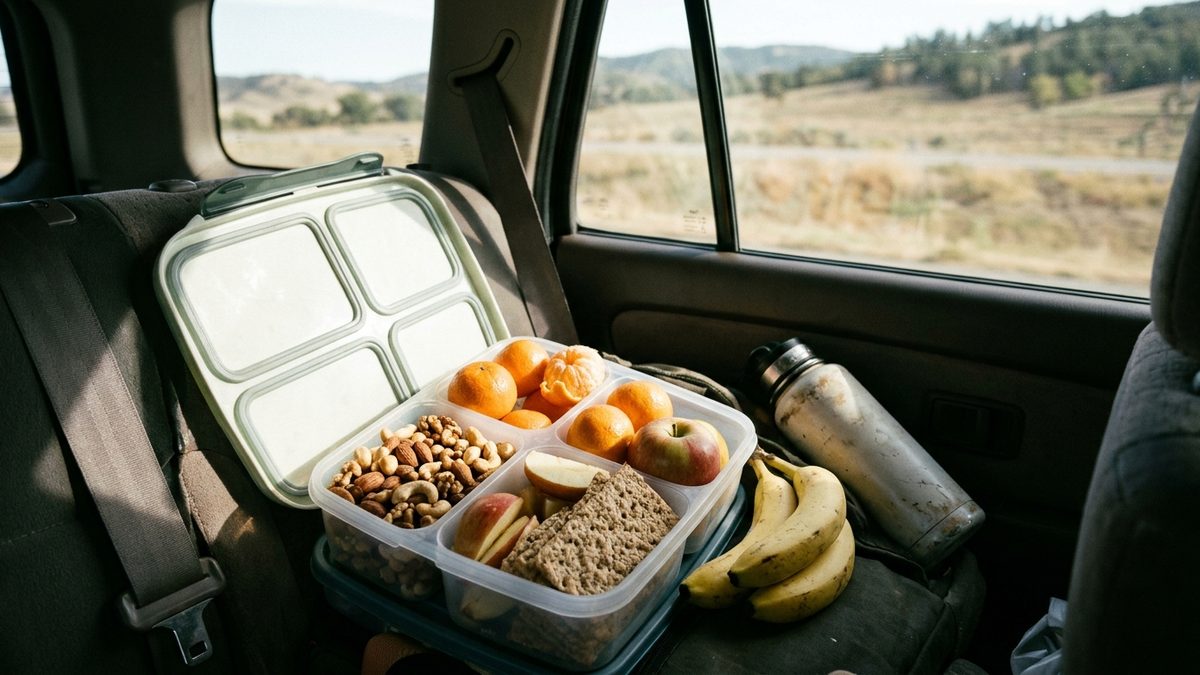
Short answer: the best road trip snacks are nuts, trail mix, whole fruit (apples, bananas, clementines, grapes), jerky, whole-grain crackers, popcorn, granola bars, peanut butter pretzels, roasted chickpeas and dried fruit, none of which need a cooler, plus cheese sticks, hard-boiled eggs, yogurt, hummus with vegetables, sandwiches and cut fruit if you bring one. The rule that matters: perishable food shouldn't sit above 40°F (4°C) for more than two hours, or one hour when it's hotter than 90°F (32°C). Keep the cooler in the air-conditioned cabin, and give the driver food that needs one hand and no attention.
What makes a good road trip snack
- It survives the car. No melting, no leaking, no spoiling.
- It's clean to eat. Few crumbs, nothing sticky, no cutlery.
- It has some protein or fiber, not just sugar.
- It's easy for the driver. Small snacks spread over the drive are simpler to manage at the wheel than one big meal.
For the rest of the packing list, see our road trip essentials.
No cooler needed
1. Mixed nuts
Almonds, cashews, peanuts, pistachios. An ounce of almonds has 6 g of protein and 3.5 g of fiber. Portion into small bags.
2. Trail mix
Nuts, seeds and dried fruit. Skip chocolate pieces in summer.
3. Apples
Sturdy, and a medium apple has about 5 g of fiber. Whole fruit doesn't need the cooler.
4. Bananas
Come in their own wrapper. Bruise easily, so keep them on top.
5. Clementines
Easy to peel, no knife, and the smell wakes everyone up. Bring a bag for the peel.
6. Jerky
About 9 g of protein per ounce, and it keeps without a fridge.
7. Whole-grain crackers
Good with nut butter squeeze packs.
8. Popcorn
Messy for the driver, fine for passengers. Not for children under 4.
9. Granola or cereal bars
Check the label for sugar. Avoid chocolate coatings in heat.
10. Peanut butter pretzels or roasted chickpeas
Crunchy and salty, and nothing to melt.
With a cooler
11. Cheese sticks or cubes
Individually wrapped string cheese is the easiest.
12. Hard-boiled eggs
Peel them at home. Filling and cheap.
13. Yogurt tubes or drinkable yogurt
Freeze them the night before so they help keep the cooler cold.
14. Hummus with carrots, cucumber and peppers
Single-serve hummus pots avoid a spill.
15. Sandwiches or wraps
Nut butter and jam needs no cooler. Anything with meat, cheese, egg or mayonnaise does.
16. Grapes
Wash and take off the stems. Cut them into small pieces for young children: whole grapes are a choking hazard.
17. Cut melon, berries or pineapple
In a sealed tub. Once fruit is cut, it counts as perishable.
18. Edamame
Shelled, lightly salted. Half a cup has about 9 g of protein and 4 g of fiber.
19. Turkey and cheese roll-ups
Protein without bread crumbs.
20. Cold pasta or grain salad
For a proper lunch stop. Bring forks.
At a glance
| Snack | Cooler? | Driver-friendly? | Why |
|---|---|---|---|
| Mixed nuts | No | Yes | Protein and fiber |
| Trail mix | No | Yes | Energy-dense |
| Apples | No | Yes | Durable |
| Bananas | No | Yes | Own wrapper |
| Clementines | No | Passenger peels | Refreshing |
| Jerky | No | Yes | High protein |
| Crackers | No | Yes | Filling |
| Popcorn | No | No | Messy |
| Granola bars | No | Yes | Convenient |
| Pretzels, chickpeas | No | Yes | Crunch |
| Cheese sticks | Yes | Yes | Protein |
| Hard-boiled eggs | Yes | No | Filling |
| Frozen yogurt tubes | Yes | Yes | Help keep the cooler cold |
| Hummus and vegetables | Yes | No | Fiber |
| Sandwiches | Depends | At a stop | A real meal |
| Grapes | Yes | Yes | Easy to share |
| Cut fruit | Yes | No | Perishable once cut |
| Edamame | Yes | No | Protein and fiber |
| Turkey roll-ups | Yes | Yes | Protein |
| Pasta salad | Yes | At a stop | A real meal |
The food-safety rule
The USDA calls 40°F to 140°F (4°C to 60°C) the danger zone, because bacteria multiply fastest in that range. Bacteria can double in as little as 20 minutes there. Perishable food shouldn't be left out of refrigeration for more than two hours, or one hour above 90°F.
In practice:
- Keep the cooler in the air-conditioned cabin, not in a hot trunk, and out of direct sun.
- Pack it full. A full cooler holds its temperature longer than a partly filled one. Frozen water bottles work as extra ice.
- Use two coolers: one for drinks, which gets opened often, and one for food, which stays shut.
- When in doubt, throw it out.
More detail in how long leftovers are good for.
Snacks for the driver
The driver's food should need one hand and no eyes: nuts in a cup in the cup holder, a peeled clementine handed over in segments, a cheese stick, a bar already unwrapped. Anything that drips, needs unwrapping or has to be assembled waits for a stop.
Food doesn't fix tiredness. NHTSA estimated that 91,000 police-reported crashes in 2017 involved drowsy drivers. Its advice if you start to feel sleepy: drink one to two cups of coffee and take a 20-minute nap in a safe place. That helps for a short period only, and coffee or energy drinks alone may not be enough. See how long caffeine lasts.
Drinks
Water for everyone, within reach. Our article on how long it takes to rehydrate explains what to drink if you've fallen behind.
6 snacks to leave at home
- Chocolate in summer. It melts into the seats.
- Anything with mayonnaise, meat or dairy without a cooler. Two hours goes fast.
- Greasy crisps and cheese puffs. Orange fingers on every surface.
- Yogurt pots that need a spoon for the driver.
- Strong-smelling food. Tuna, egg salad and some cheeses in a closed car.
- Whole nuts, popcorn, whole grapes and hard sweets for young children. The CDC lists all four as choking hazards, and the American Academy of Pediatrics advises keeping such foods from children until at least age 4.
Questions people ask
What are the best snacks for a road trip? Nuts, fruit, jerky, crackers, bars and popcorn without a cooler; cheese, eggs, yogurt, hummus and sandwiches with one.
What snacks don't need a cooler? Nuts, trail mix, whole apples, bananas, clementines, jerky, crackers, popcorn, granola bars, pretzels, roasted chickpeas, dried fruit and nut butter sandwiches.
How do you keep food cold on a road trip? Use a full cooler with ice packs or frozen water bottles, keep it in the cabin out of the sun, and open it as little as possible.
How long can food stay in a hot car? Perishable food: no more than two hours, or one hour above 90°F (32°C).
What are healthy road trip snacks? Ones with some protein and fiber: nuts, fruit, vegetables with hummus, eggs, cheese, edamame and plain popcorn.
What should the driver eat? Small, one-handed snacks such as nuts, cheese sticks and fruit segments.
What are good road trip snacks for kids? Clementine segments, bananas and yogurt tubes. For children under 4, avoid whole nuts, popcorn, whole grapes and hard sweets, and cut food into small pieces.
How much food should I pack? There's no rule. A workable plan is one snack per person for every couple of hours of driving, a proper meal for each full day, and plenty of water.
What snacks don't make a mess in the car? Nuts, jerky, cheese sticks, grapes, apple slices and bars. Avoid crumbly pastries, powdered snacks and anything with sauce.
Is it cheaper to bring your own snacks? Usually, since you're buying at supermarket prices and not on the road.
This article is general information. Follow food-safety guidance for the conditions you're travelling in, and never leave children or pets in a parked car.
References
- USDA Food Safety and Inspection Service. How Temperatures Affect Food. fsis.usda.gov
- National Highway Traffic Safety Administration. Drowsy Driving. nhtsa.gov
- Centers for Disease Control and Prevention. Choking Hazards. cdc.gov
- American Academy of Pediatrics. Choking Prevention. healthychildren.org
- Partnership for Food Safety Education. On the Road Again: Traveling and Picnics. fightbac.org
The weekly readout
One email each Thursday: what we tested, which claim collapsed under a closer look, and the one number worth paying attention to.