
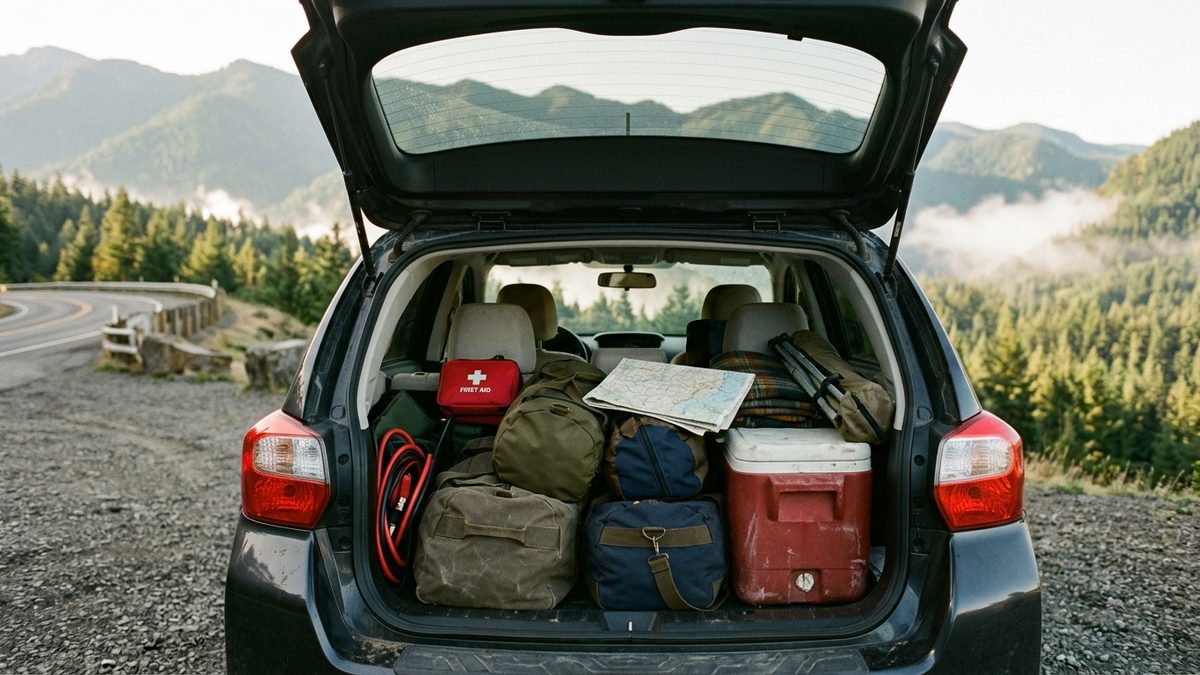
Short answer: the road trip essentials that matter most are a rested driver, a car emergency kit (jumper cables, reflective triangles or flares, flashlight, first aid kit, blanket, phone charger, paper map), a checked spare tire with a jack, water, and food that keeps. The US government's Ready.gov list covers the emergency kit. Sleep is on the list because it's the biggest controllable risk: in a study of 6,845 drivers involved in crashes, those who had slept less than four hours in the previous 24 had 15 times the odds of being responsible for the crash compared with drivers who slept seven to nine hours.
Most packing lists for road trips are shopping lists. This one is ordered by what's likely to go wrong: a sleepy driver, a breakdown, bad weather, then boredom and hunger. If you're flying part of the way, our list of long flight essentials covers that leg.
Safety: the items that matter most
1. A full night of sleep before you leave
It weighs nothing and it's the most protective thing on the list. The AAA Foundation's Brian Tefft analysed in-depth investigations of crashes in the US and found the odds of being the culpable driver rose with every hour of lost sleep: 1.3 times after six hours, 1.9 after five, 2.9 after four, and 15.1 after less than four. NHTSA estimated 91,000 police-reported drowsy-driving crashes in 2017, with about 50,000 injuries and nearly 800 deaths, and says the real numbers are likely higher because drowsiness is hard to detect after a crash.
Don't start a long drive after a short night, and don't plan to drive through the hours when you'd normally be asleep.
2. A second driver, or a plan for stops
Swap regularly if you can. If you're alone, plan your stops in advance. The CDC's advice for long trips is to walk around every one to two hours.
3. Caffeine and 20 minutes
When you're sleepy and can't swap, NHTSA's advice is to drink one to two cups of coffee and take a 20-minute nap in a safe place, such as a lighted rest stop. It says studies show this improves alertness, but only for short periods. The combination of caffeine with a short nap is what a 1997 study of sleepy drivers tested. See how long caffeine lasts for timing.
4. Phone mount and car charger
A mount keeps navigation at eye level and your hands off the phone. A car charger is on Ready.gov's emergency list for good reason: a dead phone turns a breakdown into a problem.
5. Offline maps and a paper map
Download the route for offline use before you leave. Ready.gov also lists a paper map. Mobile coverage disappears in exactly the places where you're most likely to need it.
The car emergency kit
Ready.gov recommends keeping these in the car in case you're stranded.
6. Jumper cables or a jump starter
A lithium jump starter means you don't need a second car.
7. Reflective triangles or flares
So other drivers can see you. Place them well behind the car.
8. Flashlight with spare batteries
A headlamp is better. It leaves both hands free to change a tire.
9. First aid kit
Plasters, gauze, antiseptic wipes, pain relief, any personal medication, and antihistamines.
10. Blanket
For a winter breakdown, or a passenger who's cold while the driver isn't.
11. Spare tire, jack and tire pressure gauge
Check that the spare is inflated and that the jack and wheel wrench are actually in the car. Many newer cars have only a sealant kit. Check tire pressure when the tires are cold, before you set off, and use the figure on the sticker inside the driver's door.
12. Water for the car and for you
Enough for everyone, more in hot weather, plus extra if you're crossing empty country.
13. In winter: ice scraper, and cat litter or sand
Both are on Ready.gov's list. Litter or sand under a spinning wheel gives traction on ice. Add a small shovel if you're driving in snow.
Food and drink
14. A cooler with ice packs
Perishable food shouldn't sit between 40°F and 140°F (4°C and 60°C) for more than two hours, or one hour above 90°F (32°C), according to the USDA. Keep sandwiches, dairy and cut fruit in the cooler, and keep the cooler in the air-conditioned cabin, not the trunk. Our guide to how long leftovers are good for has the full rules.
15. Snacks that don't need a cooler
Nuts, whole fruit, crackers, jerky, cereal bars. More ideas in our list of road trip snacks.
16. Refillable water bottles
One per person, within reach.
Comfort and health
17. Sunglasses and sunscreen
For glare and low sun, and for the stops.
18. A reason to get out every two hours
The CDC notes that travel longer than about four hours, whether by air, car, bus or train, can raise the risk of blood clots. The overall risk is very small, and most people affected have other risk factors. Its advice is to move your legs often and walk around every one to two hours.
19. Motion sickness remedies, wipes and a bin bag
If anyone in the car gets carsick: front seat, eyes on the horizon, fresh air, no reading. Bring whatever remedy works for them, plus wet wipes, tissues and a bag for rubbish.
20. Audio, downloaded
Podcasts, audiobooks and playlists saved to the phone, so they keep playing where there's no signal.
The checklist
| Category | Pack |
|---|---|
| Before you go | 7+ hours of sleep, tire pressure and spare checked, route downloaded |
| Emergency kit | Jumper cables or jump starter, triangles or flares, flashlight, first aid kit, blanket, paper map |
| Winter extras | Ice scraper, cat litter or sand, small shovel |
| Tech | Phone mount, car charger, cable, power bank |
| Food and drink | Cooler with ice packs, dry snacks, water bottles, extra water |
| Comfort | Sunglasses, sunscreen, wipes, tissues, bin bag, motion sickness remedy |
| Documents | License, registration, insurance, roadside assistance number |
7 things you can skip
- A neck pillow for the driver. It's for passengers. Anything that makes the driver more comfortable dozing is the wrong idea.
- Energy drinks by the case. NHTSA says coffee or energy drinks alone may not be enough: they raise alertness only for a short time.
- A trunk full of "just in case" clothes. They bury the things you need.
- A separate GPS unit. A phone with offline maps and a paper backup covers it.
- Perishable food without a cooler. After two hours in a warm car, it's a risk, not a saving.
- A rooftop cargo box you don't need. Use one only if the load doesn't fit inside.
- Screens in the driver's view. Anything playing video within the driver's sight is a distraction.
Questions people ask
What should you bring on a road trip? A rested driver, an emergency kit (jumper cables, triangles or flares, flashlight, first aid kit, blanket), a checked spare, water, snacks, a phone mount and charger, offline and paper maps, sunglasses and your documents.
What should be in a car emergency kit? Ready.gov lists jumper cables, flares or a reflective triangle, an ice scraper, a car phone charger, a blanket, a map, and cat litter or sand for traction.
How often should you stop on a road trip? The CDC advises walking around every one to two hours on long trips, to keep blood moving in the legs. That rhythm suits a tired driver too.
How many hours can you safely drive in a day? The sources used here give no fixed limit for private drivers. Sleep is the better guide: the odds of causing a crash rise with every hour of sleep lost the night before.
What food is best for a road trip? Food that keeps at room temperature (nuts, fruit, crackers, jerky) plus anything perishable in a cooler with ice packs.
How long can food stay in a hot car? Perishable food shouldn't be left out for more than two hours, or one hour if it's above 90°F (32°C).
How do I stay awake while driving? Sleep well the night before. If you get sleepy, NHTSA's advice is to pull over somewhere safe, drink one to two cups of coffee and nap for 20 minutes.
Do I need a paper map? It's a cheap backup. Phones lose signal and batteries die. Ready.gov includes a map in its car kit.
What should I check on my car before a road trip? Ready.gov's list for a mechanic includes antifreeze, battery, brakes, lights, oil, and wipers and washer fluid. Add tire pressure, tread and the spare.
What do I need for a winter road trip? Add an ice scraper, a blanket for each person, cat litter or sand, a small shovel, extra water and food, and keep the tank full, as Ready.gov advises.
This article is general information. Check your vehicle manual and local laws, and follow official guidance for the conditions you'll be driving in.
References
- Tefft BC. Acute sleep deprivation and culpable motor vehicle crash involvement. Sleep 2018;41(10):zsy144. doi:10.1093/sleep/zsy144
- Reyner LA, Horne JA. Suppression of sleepiness in drivers: combination of caffeine with a short nap. Psychophysiology 1997;34(6):721–725. doi:10.1111/j.1469-8986.1997.tb02148.x
- Ready.gov (US Department of Homeland Security). Car Safety. ready.gov
- National Highway Traffic Safety Administration. Drowsy Driving. nhtsa.gov
- Centers for Disease Control and Prevention. Travel and Blood Clots. cdc.gov
- USDA Food Safety and Inspection Service. How Temperatures Affect Food. fsis.usda.gov
The weekly readout
One email each Thursday: what we tested, which claim collapsed under a closer look, and the one number worth paying attention to.