

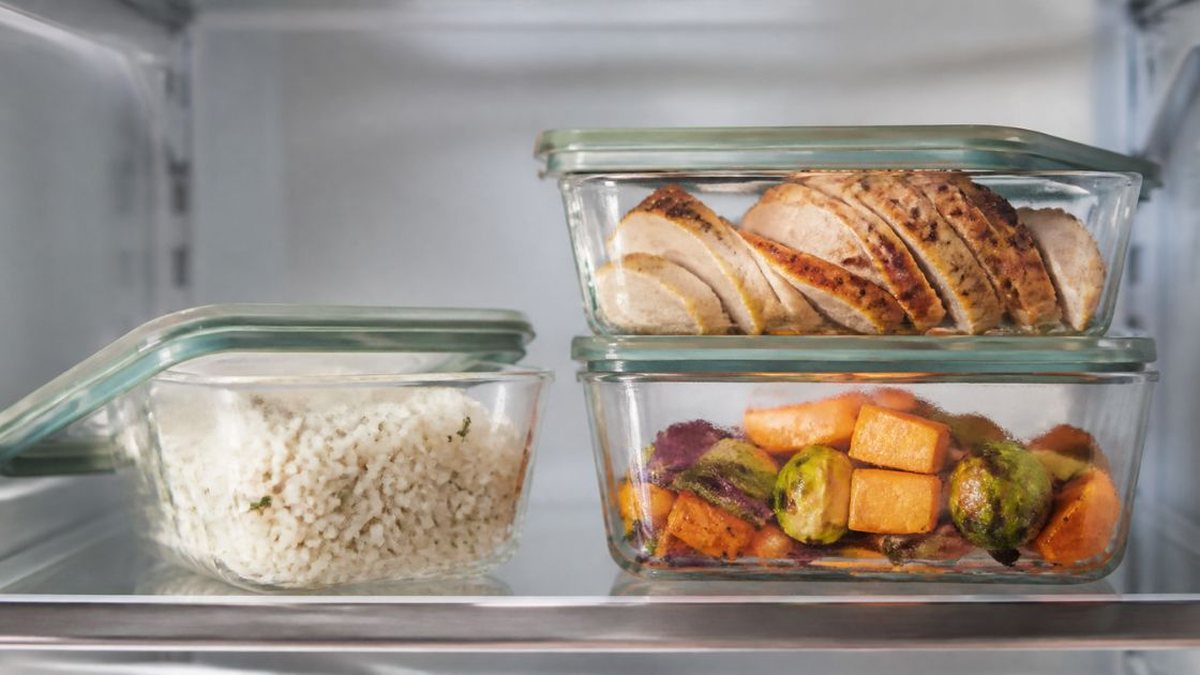
Short answer: how long leftovers are good for depends on where they are. The USDA's answer for a home fridge is 3 to 4 days, or 3 to 4 months in the freezer, provided the food went into the fridge within 2 hours of cooking (1 hour above 90°F [32°C]) and the fridge runs at 40°F (4°C) or below. Reheat to 165°F (74°C). The FDA lets restaurants keep the same food for 7 days, under conditions most kitchens at home never check.
That gap, 4 days against 7, is the useful part of the question. The count of days is not really the variable. Temperature is.
Where the 3-to-4-day number comes from
The USDA's Food Safety and Inspection Service (FSIS) states the rule plainly: leftovers can be kept in the refrigerator for 3 to 4 days or frozen for 3 to 4 months. They must be refrigerated within 2 hours of cooking, or of coming off a warming appliance, and within 1 hour if the temperature is over 90°F, "such as at an outdoor picnic during summer". FoodSafety.gov, the federal consumer site, uses the same 3-to-4-day figure for cooked meat, poultry, soups, stews and pizza, and adds the two temperatures the numbers assume: a fridge at 40°F (4°C) or below and a freezer at 0°F (-18°C) or below.
None of the federal consumer pages opened for this article explain how 3 to 4 days was derived. One FSIS page gives a partial reason: its guidance on mold says to use leftovers within 3 to 4 days "so mold doesn't have a chance to grow". Mold is the visible problem. The invisible one is bacteria, and FSIS describes the range where they matter most: between 40°F and 140°F (4°C to 60°C), where bacteria can multiply quickly, "doubling in number in as little as 20 minutes".
The rest is an inference. A consumer rule has to work in kitchens where nobody knows how long the stew sat on the stove or how warm the fridge really is, and a short limit leaves room for that. The commercial rule, below, makes the point concrete.
How long are leftovers good for, food by food
The federal chart is short on cooked foods, which surprises people. It has no separate row for cooked rice, pasta, stuffing or gravy; for those, the general leftovers rule of 3 to 4 days applies, and FSIS's Thanksgiving guidance covers stuffing and gravy explicitly.
| Food | Refrigerator, 40°F (4°C) | Freezer, 0°F (-18°C) | Source |
|---|---|---|---|
| Leftover cooked meat or poultry | 3–4 days | 2–6 months | FoodSafety.gov |
| Chicken nuggets or patties | 3–4 days | 1–3 months | FoodSafety.gov |
| Pizza | 3–4 days | 1–2 months | FoodSafety.gov |
| Soups and stews, with vegetables or meat | 3–4 days | 2–3 months | FoodSafety.gov |
| Casseroles with eggs, after baking | 3–4 days | 2–3 months | FoodSafety.gov |
| Quiche with filling, after baking | 3–5 days | 2–3 months | FoodSafety.gov |
| Egg, chicken, ham, tuna or macaroni salad | 3–4 days | Does not freeze well | FoodSafety.gov |
| Hard-cooked eggs | 1 week | Do not freeze | FoodSafety.gov |
| Deli meat, opened or deli-sliced | 3–5 days | 1–2 months | FoodSafety.gov |
| Cooked turkey, plain slices or pieces | 3–4 days | About 4 months | FSIS Thanksgiving guidance |
| Cooked turkey covered in broth or gravy | 3–4 days | About 6 months | FSIS Thanksgiving guidance |
| Stuffing, gravy, cooked poultry dishes | 3–4 days | 4–6 months | FSIS Thanksgiving guidance |
| Any leftovers, general rule | 3–4 days | 3–4 months | FSIS leftovers page |
Two notes on reading it. First, the freezer column is about quality, not safety. FoodSafety.gov says freezer times are for quality only and that food kept continuously at 0°F or below stays safe indefinitely; past the listed months it gets dry, icy and dull, not dangerous. Second, the fridge column is about safety, and it is not extended by freezing. FSIS says thawed leftovers should be used within 3 to 4 days, which most people read as a fresh clock. The cautious reading is to count the days the food spent in the fridge before it was frozen as well.
The rule restaurants follow: 7 days
The FDA Food Code is the model that US states and localities adopt to regulate restaurants, cafeterias and grocery delis. Its section 3-501.17 covers what it calls ready-to-eat, time/temperature control for safety food: cooked dishes, cut meats, prepared salads. The FDA's own explainer on the section says such food may be "held at a temperature of 5°C (41°F) or less for a maximum of 7 days", and states the reason directly: the limits "are intended to help control for growth of Listeria monocytogenes."
A South Carolina inspection fact sheet adds the counting rule: the day the food is prepared or opened is day 1, so the discard date is day 1 plus 6. The same sheet notes that Listeria "continues to grow even at refrigerated temperatures". That is the core of the matter. Most food-poisoning bacteria barely grow in a properly cold fridge; Listeria does grow, slowly, and a week is the period the Food Code accepts for food kept at 41°F.
The FDA published a new full edition, the 2026 Food Code, on September 30, 2026. Its summary of changes lists no change to the codified text of 3-501.17 or to the cooling rule below, only an amendment to the background notes on date marking.
| USDA FSIS (home) | FDA Food Code (restaurants, retail) | Health Canada (home) | |
|---|---|---|---|
| Fridge limit for leftovers | 3–4 days | 7 days, day of preparation counted as day 1 | 2–3 days |
| Fridge temperature assumed | 40°F (4°C) or below | 41°F (5°C) or below | Keep food out of 4°C to 60°C (40°F to 140°F) |
| Time out before refrigerating | 2 hours; 1 hour above 90°F | Cooling timed: 135°F to 70°F in 2 hours, to 41°F within 6 hours total | 2 hours at room temperature |
| Reheating | 165°F (74°C); sauces, soups and gravy to a rolling boil | Not covered in this article | 74°C (165°F) |
| Who checks | Nobody | Labeled dates, temperature logs, inspectors | Nobody |
| Stated reason for the limit | Not given; mold cited on one page | Control of Listeria growth | Not given |
The restaurant gets 7 days not because its food is different but because the system around it is: a dated container, cooling with deadlines, a fridge an inspector can check. A home kitchen keeps the food and drops the controls.
The Canadian number is shorter still
Health Canada tells people to eat refrigerated leftovers within 2 to 3 days or freeze them, and adds a sentence worth repeating: "Never rely on your nose, eyes or taste buds to judge the safety of food." Readers who have seen "2 to 4 days" quoted elsewhere should note that the current page, modified in April 2025, says 2 to 3.
Why your nose is not a test
FSIS separates bacteria in food into two families. Spoilage bacteria "do not cause illness but do cause foods to deteriorate"; they are what produce an off odor, slime and sourness. Pathogenic bacteria are the ones that cause foodborne illness. The FSIS pages opened for this article tie smell, color and texture changes to the first family only. Nothing in them says the second family announces itself.
So the two can diverge in both directions. A pot of chili can smell fine on day 6 with Listeria quietly growing in it, and a perfectly safe dish can smell stale on day 2. The smell test answers "is this pleasant to eat", which is a real question, but not the safety one. If something is visibly moldy, FSIS says to discard cooked leftovers, casseroles and cooked grains, because moisture lets mold reach below the surface, and adds a practical point: do not sniff it, since that can cause respiratory trouble.
What actually matters more than the day count
How fast the food cooled
FSIS calls improper cooling of cooked foods "one of the most common causes of foodborne illness". The Food Code's cooling rule, as summarized by the Oregon Health Authority, is two-stage: from 135°F (57°C) to 70°F (21°C) within the first 2 hours, then to 41°F (5°C) or below within a total of 6 hours. The reason is the spore-forming bacteria, Clostridium perfringens and Bacillus cereus. Cooking kills most bacteria but not their spores, which can germinate and multiply while a large pot cools slowly through the danger zone.
At home, the practical version is FSIS's: divide large amounts into shallow containers. The Oregon sheet's commercial guidance is a layer of two inches or less, with space between containers, because stacking traps heat. A stockpot of soup cools far more slowly than four shallow tubs of the same soup.
How cold the fridge really is
Every number above assumes 40°F (4°C), and published measurements suggest many fridges miss it. In a survey of 766 households in England, published in 2018, researchers logged fridge temperatures for a week and found a mean of 5.3°C (about 41.5°F) across 671 refrigerators; 174 of them, about a quarter, ran above 5°C for the entire week. US data are older: in a nationally representative web survey of 2,060 adults published in 2007, 70.4% of respondents outside the older-adult group kept their fridge at the recommended 40°F or below, so roughly 3 in 10 did not, and only 11% owned a fridge thermometer before the survey. Two reviews of the published studies, in 2008 and 2017, reached the same conclusion: many refrigerators around the world run warmer than recommended.
A fridge thermometer costs little and settles the question. If yours reads 44°F (7°C), no day count printed anywhere applies to it.
How hot it is when you eat it
FSIS says to reheat leftovers to 165°F (74°C) measured with a food thermometer, and to bring sauces, soups and gravies to a rolling boil. Reheating kills most bacteria but not every toxin they leave behind, which is why rice gets its own section below. Reheating does not rescue a dish that sat on the counter overnight.
Leftover rice and Bacillus cereus
Rice has a reputation, and the CDC's record supports it. In an MMWR report on an outbreak at two Virginia day care centers in 1993, the CDC wrote that "fried rice is a leading cause of B. cereus emetic-type food poisoning in the United States." The mechanism is the one described above. B. cereus spores survive cooking; if the cooked rice is then held at room temperature, the bacteria multiply. The vomiting form of the illness is caused by a toxin the CDC describes as highly stable, one that survives high temperatures, including brief stir-frying.
In that outbreak the rice had been cooled at room temperature before being refrigerated, then fried and held unrefrigerated. The CDC's recommendation was that the practice of cooling rice, or any food, at room temperature be discontinued, and that food be kept below 41°F (5°C) or above 140°F (60°C).
At home: get cooked rice into the fridge in a shallow container promptly rather than leaving the pot on the stove. The federal chart has no rice-specific day count, so the general 3-to-4-day rule applies. Rice that sat out for hours is not rescued by a hot wok.
Turkey and holiday leftovers
Thanksgiving falls on November 26 this year, and the CDC's page on Clostridium perfringens explains why holiday meals deserve extra care. It estimates almost 900,000 people get C. perfringens food poisoning in the US every year, and says most outbreaks happen in November and December, many linked to holiday foods such as turkey and roast beef. The common vehicles are poultry, meat and gravy: large amounts, cooked ahead, left out while people eat.
FSIS's guidance for cooked holiday dinners covers the particular risks of a whole bird:
- Two hours from the oven. Perishable food should not sit out of the fridge for more than 2 hours. If dinner runs long, keep the turkey at 140°F (60°C) or above in the oven rather than on the table.
- Cut it down before storing. A whole carcass cools slowly. FSIS says to slice the breast meat; legs and wings can stay whole. Then refrigerate or freeze the pieces promptly in shallow containers.
- 3 to 4 days for cooked turkey, stuffing, gravy and other cooked dishes in the fridge.
- Freeze what will not be eaten by the weekend. Plain turkey keeps its quality for about 4 months frozen, turkey in broth or gravy for about 6 months, stuffing and gravy for 4 to 6 months.
- Reheat to 165°F or until hot and steaming, and bring gravy to a rolling boil.
The day count makes Thanksgiving leftovers easy to plan. Turkey refrigerated on Thursday evening is inside the USDA window through Sunday or Monday. Anything meant for later in the following week belongs in the freezer by Sunday. The same applies to bulk buys: a warehouse club membership only saves money on food eaten or frozen in time.
Who should be stricter
The CDC lists people 65 and older and children under 5 among those at increased risk of food poisoning. For Listeria in particular, which the CDC estimates infects about 1,250 people and kills 172 in the US each year, it names pregnant women, newborns, adults 65 or older and people with weakened immune systems as the groups for whom infection can be especially harmful. Its risk page says pregnant women are 10 times more likely to get Listeria than the general population.
The CDC's Listeria advice for these groups is to heat deli meats and hot dogs to 165°F or until steaming hot. Applied to leftovers, the sensible version is the short end of every range and reheating until steaming.
A short routine that covers most of it
Within 2 hours, into shallow containers. Divide large batches; Health Canada's wording is uncovered, shallow containers. Glass containers that go from fridge to microwave save a transfer and are one of the easier swaps if you are trying to cut plastic waste at home.
Label the date. It is what the Food Code makes restaurants do, and it is the only reliable way to know which day a container is on.
Check the fridge once. A thermometer on the middle shelf, aiming for 40°F (4°C) or below. If it runs warm, turn it down before blaming the leftovers. A colder setting uses some extra electricity; if the cost matters, the method for working out what an appliance costs to run applies to fridges too.
Freeze on day 2 or 3, not day 4. The freezer stops the clock; it does not reset it.
Reheat to 165°F (74°C). Soups, sauces and gravy to a rolling boil.
When in doubt, throw it out. Neither smell nor appearance can confirm safety.
After a bad night, people tend to blame whatever they ate last, which is one reason the question of how long food takes to digest comes up. The water in the soup stock is rarely the issue: US tap water usually meets federal limits.
Questions people ask
How long are leftovers good for in the fridge? Three to four days, according to the USDA, if the food went into the fridge within 2 hours of cooking and the fridge holds 40°F (4°C) or below. Health Canada advises a shorter 2 to 3 days. Hard-cooked eggs are an exception at one week. Freeze anything you will not eat in time.
Are leftovers OK after 5 days? They are outside the USDA's home guidance of 3 to 4 days, so the agency's answer is to discard them. They may well not make you sick, but nothing about their look or smell can tell you. People in higher-risk groups, including pregnant women and adults over 65, should stick to the shorter limit.
Can I eat 7-day-old leftovers? Not by USDA home guidance. The 7-day figure comes from the FDA Food Code, which lets restaurants hold ready-to-eat food that long at 41°F (5°C) or below, with dated labels and timed cooling, to control Listeria. A home fridge with unknown temperatures and undated containers does not meet those conditions.
What is the 2-2-4 rule for leftovers? An informal mnemonic, not a USDA rule: refrigerate within 2 hours, store in containers about 2 inches deep, and eat within 4 days. Each part matches official advice: FSIS's 2-hour limit and shallow containers, the 2-inch layer used in commercial cooling guidance, and the upper end of the 3-to-4-day window.
What is the 2-2-2 rule for leftovers? Another informal memory aid, and versions vary; a common one is 2 hours to refrigerate, 2 days in the fridge, 2 months in the freezer. It is stricter than the USDA's 3 to 4 days and close to Health Canada's 2 to 3. It is not an official rule, but it errs on the safe side.
How long are leftovers good for in the freezer? The USDA says 3 to 4 months for leftovers in general, with food-specific ranges from 1 to 6 months. Those are quality limits. FoodSafety.gov says food kept continuously at 0°F (-18°C) stays safe indefinitely. After thawing, FSIS says to use leftovers within 3 to 4 days.
How long can leftovers sit out unrefrigerated? No more than 2 hours, or 1 hour if the air is above 90°F (32°C), according to FSIS. Between 40°F and 140°F bacteria can double in as little as 20 minutes. Health Canada says to throw away cooked food left at room temperature for more than two hours.
Is meat still good after 7 days in the fridge? Cooked meat and poultry are good for 3 to 4 days in a home fridge, per FoodSafety.gov, so 7 days is well past the federal home guidance. Opened deli meat is listed at 3 to 5 days and opened hot dogs at one week. If cooked meat will not be eaten soon, freeze it early.
Is leftover rice dangerous? It can be if it cools slowly. Bacillus cereus spores survive cooking, multiply in rice held at room temperature, and can make a toxin that the CDC says survives high temperatures. The CDC calls fried rice a leading cause of this food poisoning. Refrigerate rice promptly in shallow containers and use it within 3 to 4 days.
How long is leftover turkey good for? Three to four days in the fridge, according to FSIS, and the same for stuffing and gravy. Slice the breast meat before storing so it cools quickly. Frozen, plain turkey keeps its quality about 4 months, or about 6 months covered in broth or gravy. Reheat to 165°F (74°C).
This article summarizes US and Canadian government food-safety guidance for general information and is not medical advice. Guidance is revised from time to time, and local food codes differ from the FDA model. Anyone who is pregnant, over 65, caring for a young child or immunocompromised should follow the stricter end of each range and ask a clinician about specific concerns.
References
- U.S. Department of Agriculture, Food Safety and Inspection Service. Leftovers and Food Safety. fsis.usda.gov
- U.S. Department of Health and Human Services. Cold Food Storage Chart. foodsafety.gov
- U.S. Department of Agriculture, Food Safety and Inspection Service. How Temperatures Affect Food. fsis.usda.gov
- U.S. Department of Agriculture, Food Safety and Inspection Service. Turkey Basics: Handling Cooked Dinners. fsis.usda.gov
- U.S. Department of Agriculture, Food Safety and Inspection Service. Molds on Food: Are They Dangerous? fsis.usda.gov
- U.S. Department of Agriculture, Food Safety and Inspection Service. Food Product Dating. fsis.usda.gov
- U.S. Food and Drug Administration, National Retail Food Team. Food Code Section 3-501.17: Ready-to-Eat, Time/Temperature Control for Safety Food, Date Marking. fda.gov
- U.S. Food and Drug Administration. Food Code 2026 (posted September 30, 2026) and Summary of Changes in the 2026 FDA Food Code. fda.gov
- South Carolina Department of Agriculture. Date Marking, retail food establishment fact sheet (2024). agriculture.sc.gov
- Oregon Health Authority. Cooling, Food Safety Fact Sheet 31. oregon.gov
- Centers for Disease Control and Prevention. About C. perfringens Food Poisoning. cdc.gov
- Centers for Disease Control and Prevention. About Listeria Infection. cdc.gov
- Centers for Disease Control and Prevention. People at Increased Risk for Food Poisoning. cdc.gov
- Centers for Disease Control and Prevention. Bacillus cereus food poisoning associated with fried rice at two child day care centers, Virginia, 1993. Morbidity and Mortality Weekly Report, 43(10), 177 (1994). cdc.gov
- Health Canada. Food safety tips for leftovers (modified April 10, 2025). canada.ca
- Biglia, A., Gemmell, A. J., Foster, H. J., & Evans, J. A. (2018). Temperature and energy performance of domestic cold appliances in households in England. International Journal of Refrigeration, 87, 172–184. doi:10.1016/j.ijrefrig.2017.10.022
- James, S. J., Evans, J., & James, C. (2008). A review of the performance of domestic refrigerators. Journal of Food Engineering, 87(1), 2–10. doi:10.1016/j.jfoodeng.2007.03.032
- James, C., Onarinde, B. A., & James, S. J. (2017). The use and performance of household refrigerators: A review. Comprehensive Reviews in Food Science and Food Safety, 16(1), 160–179. doi:10.1111/1541-4337.12242
- Kosa, K. M., Cates, S. C., Karns, S., Godwin, S. L., & Chambers, D. (2007). Consumer home refrigeration practices: Results of a web-based survey. Journal of Food Protection, 70(7), 1640–1649. doi:10.4315/0362-028X-70.7.1640
The weekly readout
One email each Thursday: what we tested, which claim collapsed under a closer look, and the one number worth paying attention to.