

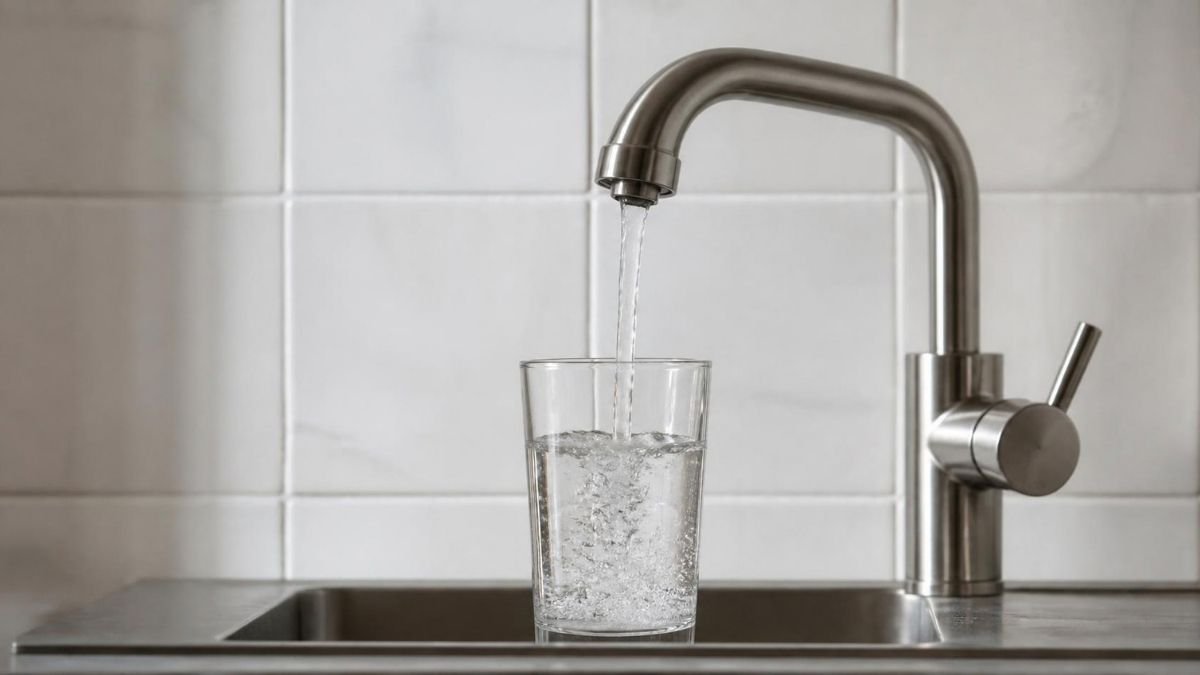
Short answer: for most people on a US public water system, yes, in the sense that matters legally: the water meets the enforceable limits the EPA sets under the Safe Drinking Water Act. It is not universal. A national study counted nearly 21 million people served by systems that broke a health-based standard in 2015. Lead is the main exception to the system-level picture, because it enters from the pipes of the individual building, most often in homes built before 1986. And about 43 million people, roughly 15% of the population, drink from private wells that no federal rule covers. The useful point is that this is checkable: the utility publishes an annual report, and a lab test for lead costs $20 to $100.
"Safe" in this article means "meets the federal standards". That is a narrower claim than "contains nothing", and the gap between the two is where most of the confusion, and most of the filter marketing, lives.
What "safe" means in US law
The EPA's National Primary Drinking Water Regulations are, in the agency's words, legally enforceable standards and treatment techniques that apply to public water systems. Each regulated contaminant has two numbers. The maximum contaminant level goal (MCLG) is the level at which no health effect is expected; it is not enforceable. The maximum contaminant level (MCL) is the enforceable limit, set as close to the goal as treatment technology and cost allow. For a few contaminants, lead among them, there is no MCL but a required treatment technique triggered by an "action level".
The EPA's table of regulated contaminants covers microbes, disinfectants and their by-products, inorganic and organic chemicals, and radionuclides, with PFAS limits added in 2024. A few that households ask about most:
| Contaminant | Health goal (MCLG) | Enforceable limit | Main source, per EPA |
|---|---|---|---|
| Lead | Zero | Action level 0.015 mg/L (15 ppb); 0.010 mg/L from November 1, 2027 | Corrosion of household plumbing |
| Arsenic | Zero | 0.010 mg/L (10 ppb) | Erosion of natural deposits; orchard and industrial runoff |
| Nitrate (as nitrogen) | 10 mg/L | 10 mg/L | Fertiliser runoff; septic tanks and sewage |
| Total coliform bacteria | Zero | No more than 5.0% of monthly samples positive | Naturally present in the environment; also in faeces |
| PFOA, PFOS | Zero | 4.0 parts per trillion each (2024 rule) | Industrial and consumer chemicals |
For lead, arsenic and the two best-known PFAS, the health goal is zero and the legal limit is not. Water can be fully compliant and still contain a detectable amount of something whose ideal level is none. The limits also move: the lead action level drops by a third in 2027, and the PFAS limits did not exist before 2024.
How often the system fails
The best national answer comes from Allaire, Wu and Lall, published in PNAS in 2018. They assembled a panel of 17,900 community water systems covering 1982 to 2015 and tracked health-related violations of the Safe Drinking Water Act. Their headline figure: in 2015, nearly 21 million people relied on community water systems that violated health-based quality standards.
Violations were substantially more common in rural areas than in urban ones, they clustered in hot spots (several in the Southwest), and the same places tended to violate repeatedly. Privately owned utilities and systems that buy their water from another supplier had better compliance.
Three cautions on reading that number. It is from 2015. A violation is not the same as illness; it means a limit or treatment requirement was missed. And it counts only what is monitored and reported, so it cannot see lead from an individual home's plumbing or any contaminant not regulated at the time. This article relies on the paper's abstract, so finer figures are left out.
The five problems worth knowing about
This table sorts contaminants by the question that matters at a kitchen sink: how would anyone know, and what deals with it.
| Contaminant | Where it comes from | How you would know | What removes it |
|---|---|---|---|
| Lead | Lead service lines, old solder and brass fittings in the building; not the treatment plant | Cannot be seen, tasted or smelled. Utility service-line records; a certified lab test | Replacing the lead line; a filter certified for lead reduction, or reverse osmosis. Not boiling |
| Germs (E. coli, Giardia, Cryptosporidium) | Faecal contamination of the source or the pipes; unprotected wells | A boil-water advisory from the utility; a coliform test for wells | Boiling; disinfection at the plant; reverse osmosis or distillation |
| Nitrate | Fertiliser, septic systems, manure; mainly a well and farm-country problem | Annual report for public systems; a lab test for wells | Distillation; reverse osmosis may reduce it. Not boiling |
| Arsenic | Natural rock and soil; regional | Annual report; a lab test for wells | Distillation; reverse osmosis may reduce it; a filter certified for arsenic |
| PFAS | Firefighting foam, industrial sites, consumer products | Utility monitoring results, which systems must begin publishing in 2027; a lab test | Granular activated carbon, ion exchange or reverse osmosis, certified under NSF/ANSI 53 or 58 |
Lead: the exception that comes from your own building
Lead rarely leaves the treatment plant in the water. It dissolves into it on the way, from lead service lines (the pipe between the water main and the house), which the EPA calls typically the most significant source, and from older solder and fittings. The agency says such pipes are more likely in older cities and in homes built before 1986.
The EPA's position on the health side is unambiguous: the goal is zero because "there is no safe level of exposure to lead". It estimates drinking water can make up 20% or more of a person's total lead exposure, and 40 to 60% for infants fed mostly on formula mixed with tap water. That is why the advice is aimed at households with babies, small children and pregnancies first.
The regulatory mechanism is easy to misread. The 15 ppb action level is not a line between safe and unsafe water at a given tap. It is a trigger: if more than 10% of sampled homes in a system exceed it, the utility must take further steps. A system can be in compliance while individual homes in it have elevated lead. The Lead and Copper Rule Improvements, the 2024 revision of the rule, lower the trigger to 10 ppb from November 1, 2027 and require utilities to identify and replace lead pipes.
PFAS: a new limit, already being revised
In 2024 the EPA set the first national limits for six PFAS: 4.0 parts per trillion each for PFOA and PFOS, 10 ppt each for PFHxS, PFNA and HFPO-DA (GenX), and a combined hazard index for mixtures. Under the rule as issued, systems must finish initial monitoring and begin publishing PFAS levels by 2027, and must meet the limits by 2029. The agency expected the rule to reduce exposure for about 100 million people.
The status has since shifted. In May 2025 the EPA announced it would keep the PFOA and PFOS limits. On May 18, 2026 it announced two proposed rules for public comment: one upholds those limits but would let systems request two more years, to 2031, to comply; the other would rescind the limits for PFHxS, PFNA, HFPO-DA and the mixture index. When checked on October 8, 2026, the EPA page (last updated May 18, 2026) still described both as proposals, and the Federal Register listed both as proposed rules, published May 20, 2026, with no final rule. Until that changes, the 2024 limits and dates stand.
Private wells: nobody is checking
Everything above applies to public water systems. The EPA is direct that the quality and safety of private well water is not regulated by the federal government under the Safe Drinking Water Act, and mostly not by state law either. The owner is the water utility. The agency puts the numbers at around 15% of the US population, over 43 million people, in more than 23 million households.
The EPA cites a US Geological Survey study of 2,100 private wells in which about one in five contained at least one contaminant above a human-health benchmark. The common ones are natural (arsenic, radionuclides), agricultural (nitrate) or microbial.
The CDC's guidance is to test a well at least once a year for total coliform bacteria, nitrates, total dissolved solids and pH, and to ask the local health department what else matters in the area. It also lists occasions for an extra test: flooding or land disturbance near the well, repairs to the system, a change in taste, colour or smell, a pregnancy in the household, or a child moving in.
Is bottled water safer than tap?
Not as a rule, and the regulations show why. Bottled water is a packaged food regulated by the FDA under 21 CFR 165.110, with its own table of allowable levels, identical to the EPA's for arsenic and nitrate.
| Tap water (public system) | Bottled water | |
|---|---|---|
| Regulator | EPA, Safe Drinking Water Act | FDA, 21 CFR 165.110 |
| Arsenic limit | 0.010 mg/L | 0.010 mg/L |
| Nitrate limit (as nitrogen) | 10 mg/L | 10 mg/L |
| Lead | Action level 0.015 mg/L, system-wide trigger | 0.005 mg/L allowable level |
| Public annual quality report | Required for community systems | Not required by this regulation |
The one place bottled water has the stricter number is lead: 5 ppb against a 15 ppb action level. For a household with a known lead problem and no filter yet, bottled water is a reasonable stopgap, and the CDC names it as the alternative during boil-water and do-not-drink advisories.
Beyond that, the case is weak. The same FDA rule requires bottled water drawn from a public supply to say "from a community water system" or "from a municipal source" on the label, unless it has been treated enough to be sold as "purified". Some bottled water is tap water with extra steps. It also arrives in plastic, which matters for anyone who has read about microplastics shed by tea bags or is trying to cut plastic waste at home.
What filter certifications mean
"Tested to NSF standards" and "certified to NSF/ANSI 53 for lead reduction" are different claims, and only the second names a contaminant and a third party.
| Standard | What it covers | What it does not tell you |
|---|---|---|
| NSF/ANSI 42 | Aesthetic impurities such as chlorine, taste and odour | Anything about health contaminants |
| NSF/ANSI 53 | Reduction of a contaminant with a health effect; the EPA points to it for PFAS | Which contaminant: a product is certified claim by claim |
| NSF/ANSI 58 | Reverse osmosis systems, for contaminants regulated by the EPA and Health Canada | That every regulated contaminant is covered |
| NSF/ANSI 401 | One or more of 15 emerging contaminants, such as some pharmaceuticals and chemicals not yet regulated | That all 15 are covered |
NSF's own caution is the important one: certification does not mean a system reduces every possible contaminant. A pitcher certified to standard 42 improves taste and makes no promise about lead. The check is to look up the exact model in a certifier's listing and read the contaminants named against it.
PFAS. The EPA says granular activated carbon, ion exchange and reverse osmosis can greatly reduce PFAS, and that standards 53 and 58 are the relevant certifications. It adds a caveat that most filter marketing omits: current certification standards do not yet indicate that a filter will bring PFAS down to the federal limits. A certified filter lowers exposure; it is not proof of reaching 4.0 ppt.
Microplastics. The evidence here is thinner than the advertising. Microplastics are not in the EPA's table of drinking water limits, and the NSF standards summary this article relied on does not mention them. Physically, fine membranes should stop particles: the CDC describes reverse osmosis as a very fine filter that removes bacteria and viruses, finer than other household filtration types. That is an inference, not a certified result, and a percentage claim on a box should be read with the test method in mind.
Hot water and boiling
Hot tap water. The EPA's advice is to use only cold water for drinking, cooking and making baby formula. The CDC gives the reason: water that comes out of the tap warm or hot can have higher levels of lead. Water for a kettle or a pan should start cold.
Boiling. Boiling kills the germs that make people sick, which is the point of a boil-water advisory. It does nothing for chemicals. The EPA states plainly that boiling does not remove lead, and the CDC says the same of chemical contamination generally: boiling water that contains harmful chemicals or toxins will not make it safe to use. Boiling is the right response to a microbial warning and the wrong response to a lead or nitrate result.
What is not worth doing
Treating an advocacy benchmark as a violation. Some non-governmental tap water databases compare utility results with their own health guidelines, not the legal limits. Exceeding such a guideline does not mean the utility broke the law or that the water is unsafe by the federal definition. It is fair to prefer stricter benchmarks. It is a mistake to read them as the legal standard.
Home test strips for lead or PFAS. Lead matters at parts per billion and PFAS at parts per trillion. A certified laboratory is the instrument for both.
A whole-house system bought before testing. The CDC's line is that if tap water does not contain harmful chemicals or germs, a home treatment system may not be needed. Buying equipment first means paying to remove things that may not be there while possibly missing the thing that is.
Changing how much you drink. How quickly the body rehydrates is the same for tap, filtered and bottled water.
What to actually do
Read the annual report. Every community water system must send customers a Consumer Confidence Report each year. It names the source, lists the regulated contaminants found, and explains any violation. Renters who never see a bill can find it on the utility's website. Look at three things: any violation, the lead result, and nitrate or arsenic if the area is known for them.
Find out about the service line. Ask the utility whether the address has a lead service line; if its records are incomplete, a plumber can tell. This matters most for homes built before 1986.
Test if there is a reason. An old house, a baby or pregnancy, or a lead line is a reason. A lead test from a state-certified lab runs $20 to $100.
Use cold water, and flush after long stagnation. Running the tap, a shower, or a load in the dishwasher or washing machine before drawing drinking water clears water that has sat in the pipes. The EPA suggests asking the utility how long to flush, since it depends on the pipework.
Buy a filter for a named problem. Chlorine taste: standard 42. Lead or PFAS: standard 53 or 58, with that contaminant listed for that model. Replace cartridges on schedule; damp, neglected surfaces grow things, as with mould around the house.
On a well, test every year. Coliform, nitrate, dissolved solids and pH at minimum, plus whatever the local health department flags.
Follow advisories literally. "Boil water" means germs, and boiling works. "Do not drink" means chemicals, and it does not.
Questions people ask
Is tap water safe to drink in the US? For most people on public systems, yes: it meets enforceable federal limits. A 2018 PNAS study found nearly 21 million people were served by systems with a health-based violation in 2015. Lead from a building's own plumbing and unregulated private wells are the main gaps in that picture.
Is tap water bad for you? Not in general. Water from a public system that meets federal standards is safe in the legal sense. The real exceptions are specific: lead in older homes, nitrate or arsenic in some wells and rural systems, and occasional microbial contamination, which utilities must announce with a boil-water advisory.
How do I know if my tap water is safe? Read the utility's annual Consumer Confidence Report for violations and detected contaminants, ask the utility whether the address has a lead service line, and if the home predates 1986 or houses an infant, have a certified lab test the water for lead, which typically costs $20 to $100.
Is bottled water safer than tap water? Not generally. The FDA's limits for bottled water match the EPA's for arsenic and nitrate. Bottled water has a stricter lead level, 5 parts per billion, so it is a sensible stopgap for a home with a lead problem. Some bottled water is sourced from municipal supplies.
Should I filter my tap water? Only for a reason. A carbon filter certified to NSF/ANSI 42 improves chlorine taste. For lead or PFAS, the filter needs certification under standard 53 or 58 for that specific contaminant. The CDC notes that water without harmful contaminants may not need home treatment at all.
Do water filters remove PFAS? Activated carbon, ion exchange and reverse osmosis filters can greatly reduce PFAS, according to the EPA, when certified under NSF/ANSI 53 or 58. The agency cautions that current certification standards do not yet show a filter reaches the federal limits of 4.0 parts per trillion.
Do water filters remove microplastics? Probably, for fine-membrane types such as reverse osmosis, because the membrane is fine enough to remove bacteria and viruses. That is an inference, not a certified result: microplastics are not in the EPA's table of drinking water limits.
Is well water safe to drink? It can be, but nobody checks except the owner. Private wells are outside the Safe Drinking Water Act, and a USGS study found about one in five exceeded a health benchmark for at least one contaminant. The CDC advises testing yearly for coliform bacteria, nitrates, dissolved solids and pH.
Is it safe to drink hot tap water? The EPA says to use only cold water for drinking, cooking and baby formula, and the CDC notes that warm or hot tap water can have higher levels of lead. Draw cold water and heat it on the stove or in a kettle.
Does boiling tap water make it safe? Against germs, yes, which is the purpose of a boil-water advisory. Against chemicals, no. The EPA says boiling does not remove lead, and the CDC says boiling water that contains harmful chemicals will not make it safe.
This article covers US drinking water regulation and household water quality for general information and is not medical advice. Rules, limits and compliance dates change, and water quality is local; check the current EPA pages, the utility's own report and, for health concerns, a clinician or the local health department.
References
- U.S. Environmental Protection Agency. National Primary Drinking Water Regulations. epa.gov
- U.S. Environmental Protection Agency. Per- and Polyfluoroalkyl Substances (PFAS): Final PFAS National Primary Drinking Water Regulation (page last updated May 18, 2026). epa.gov
- U.S. Environmental Protection Agency. Basic Information about Lead in Drinking Water. epa.gov
- Allaire, M., Wu, H., & Lall, U. (2018). National trends in drinking water quality violations. Proceedings of the National Academy of Sciences, 115(9), 2078–2083. doi:10.1073/pnas.1719805115
- U.S. Food and Drug Administration. Bottled water, 21 CFR 165.110. ecfr.gov
- U.S. Environmental Protection Agency. Private Drinking Water Wells. epa.gov
- Centers for Disease Control and Prevention. Guidelines for Testing Well Water. cdc.gov
- NSF. Standards for Water Treatment Systems. nsf.org
The weekly readout
One email each Thursday: what we tested, which claim collapsed under a closer look, and the one number worth paying attention to.