

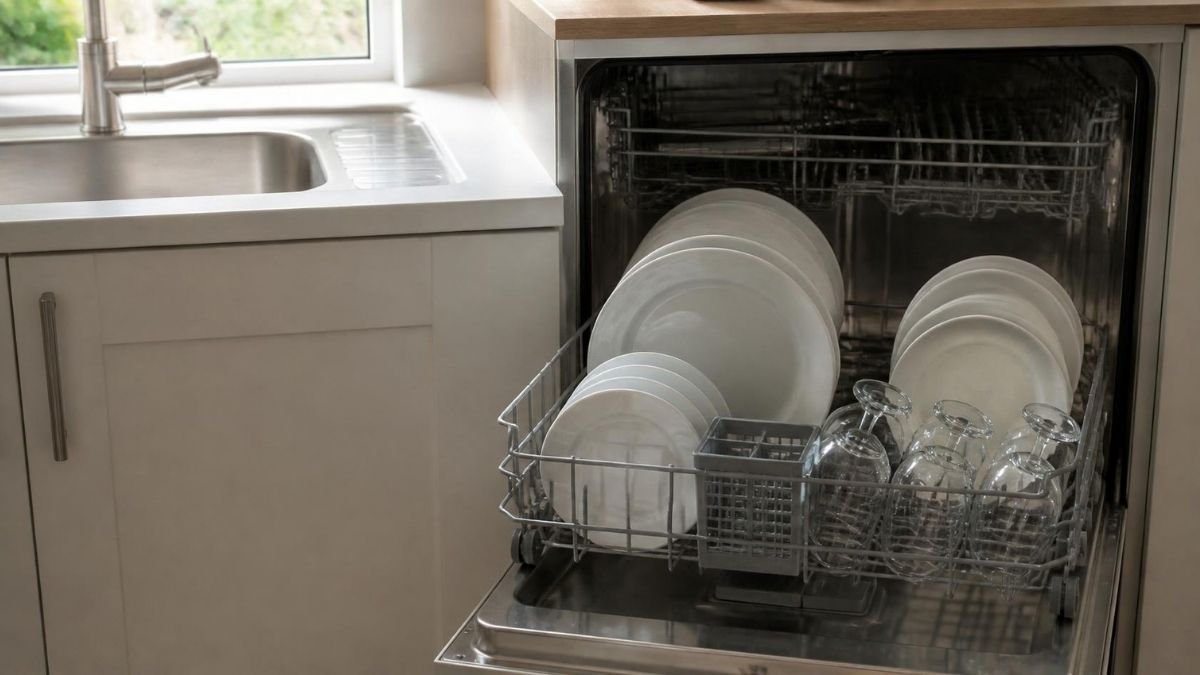
Short answer: a standard-size dishwasher made for the US market since 30 May 2013 may use no more than 5.0 gallons per cycle under the federal standard, and an ENERGY STAR model no more than 3.2 gallons. Compact machines are capped at 3.5 gallons (2.0 for ENERGY STAR). Metered data from homes, which include older machines, found an average of 6.1 gallons per load, down from 10 in the 1990s. That makes the dishwasher about 1% of indoor household water. Where hand washing has been measured, people typically used several times more water than the machine, although a careful two-basin hand wash can beat it on emissions. At ordinary US rates a cycle costs roughly 20 to 30 cents, most of it electricity rather than water.
The rest of this article sets out where each of those numbers comes from and which habits change the total.
The figures, and where they come from
There are three kinds of number in circulation: legal maximums, label criteria, and what was actually measured in homes. They answer slightly different questions.
| Measure | Value | Source |
|---|---|---|
| Federal maximum, standard-size dishwasher | 5.0 gallons per cycle, 307 kWh/year | 10 CFR 430.32(f), machines made on or after 30 May 2013 |
| Federal maximum, compact dishwasher | 3.5 gallons per cycle, 222 kWh/year | 10 CFR 430.32(f) |
| Federal maximum from 23 April 2027, standard | 3.3 gallons per cycle, 223 kWh/year | 10 CFR 430.32(f) |
| Federal maximum from 23 April 2027, compact | 3.1 gallons per cycle, 174 kWh/year | 10 CFR 430.32(f) |
| ENERGY STAR, standard | 3.2 gallons per cycle, 240 kWh/year | ENERGY STAR criteria, effective 19 July 2023 |
| ENERGY STAR, compact | 2.0 gallons per cycle, 155 kWh/year | ENERGY STAR criteria |
| Measured average in US and Canadian homes | 6.1 gallons per load | Residential End Uses of Water, 2016 |
| Measured average in the 1990s | 10.0 gallons per load | 1999 edition, as reported in the 2016 study |
"Standard" means a machine that holds at least eight place settings plus six serving pieces. "Compact" is anything smaller. The yearly energy figures assume 215 cycles a year, the number the federal test procedure uses, which is about four loads a week. The measured 6.1 gallons exceeds the 5.0-gallon limit because the homes studied contained machines of every age.
How many gallons does a dishwasher use over a year?
Multiplying out at the test procedure's 215 cycles a year (our arithmetic):
| Dishwasher | Gallons per cycle | Gallons per year (215 cycles) |
|---|---|---|
| 1990s machine, as measured | 10.0 | 2,150 |
| Average installed machine, 2016 | 6.1 | about 1,310 |
| Current federal maximum, standard | 5.0 | 1,075 |
| 2027 federal maximum, standard | 3.3 | about 710 |
| ENERGY STAR standard | 3.2 | 688 |
| ENERGY STAR compact | 2.0 | 430 |
What households actually do is less than 215 cycles. The Water Research Foundation's Residential End Uses of Water study, which obtained flow data at the meter from 762 homes and separated each use, found dishwashers accounted for 1.6 gallons per household per day, or 1% of indoor use, out of a total of 138 gallons. At 6.1 gallons a load, 1.6 gallons a day works out to about one load every four days. A dishwasher was present in 84% of the homes studied, so the low figure is not explained by homes without one.
That 1% is the most useful number in this article for keeping the subject in proportion. Faucets were 26.3 gallons per household per day in the same study, sixteen times the dishwasher. Showers are a far larger use as well, as set out in the article on how much water a shower uses.
Older dishwashers
The measured evidence on older machines is the same study: its 1999 edition found an average of 10.0 gallons per load and the 2016 edition 6.1, a fall of 39%. Higher figures for older machines appear widely, but none could be traced to a measurement for this article, so none is quoted.
The practical reading: a machine from the 1990s probably uses about twice the water of one at today's limit, and about three times that of an ENERGY STAR model. That is a difference of 5 to 7 gallons a load, or roughly 1,000 to 1,400 gallons a year at four loads a week.
Does a dishwasher use less water than hand washing?
Usually yes, but the size of the gap depends entirely on how the hand washing is done.
The official claims
ENERGY STAR says a certified dishwasher, compared with washing by hand, "saves 8,400 gallons of water each year". Divided across 215 cycles (our division, not ENERGY STAR's), that implies a saving of about 39 gallons a load, which would mean hand washing uses over 40 gallons each time. No measured study opened for this article supports a typical figure that high.
A running tap can get there, though. The EPA's WaterSense programme says that letting a faucet run for five minutes while washing dishes can waste 10 gallons, which is 2 gallons a minute. Twenty minutes of continuously running tap would reach 40 gallons. That describes the most wasteful method, not the average one.
What was measured
| Study | What was done | Hand washing | Dishwasher |
|---|---|---|---|
| Berkholz, Stamminger et al. 2010, as reported in Alt et al. 2024 | Study of UK consumers’ manual dishwashing habits, compared with a dishwasher of the time | 49 litres (about 13 gallons) and 1.7 kWh | 13 litres (about 3.4 gallons) and 1.3 kWh |
| Porras et al. 2020, University of Michigan, typical practice | Life-cycle model, 4 loads a week of 8 place settings for 10 years | 34,200 gallons and 5,620 kg CO2e over 10 years | 16,300 gallons and 2,090 kg CO2e over 10 years |
| Porras et al. 2020, recommended practice | Two-basin hand wash vs machine used as recommended | 1,610 kg CO2e | 1,960 kg CO2e |
| Alt et al. 2024 | Survey of 702 UK dishwasher users, 2021 | Not measured | Average 12.7 litres (about 3.4 gallons) and 1.16 kWh per cycle |
Three things stand out.
The machine wins against typical hand washing by a factor of roughly two to four on water. In the 2010 UK study, people used close to four times as much water as the machine. In the Michigan life-cycle model, typical hand washing used a little over twice as much.
The gap on energy is much smaller than the gap on water. In the UK comparison the dishwasher used 1.3 kWh against 1.7 kWh by hand, a saving of about a quarter. A dishwasher uses little water but heats it.
The best hand-washing method beats the machine on emissions. The Michigan study found that the two-basin method, in which dishes are soaked and scrubbed in hot water and then rinsed in cold water, produced lower greenhouse gas emissions than the machine: 1,610 kg over ten years against 1,960 kg for a dishwasher used as recommended, about 18% lower. The running-tap method had the highest emissions of all, and the university's summary says switching from the running tap to two basins would cut emissions by about two-thirds.
So "dishwasher versus hand washing" is not one comparison. A running tap loses to the machine badly. Two basins and a cold rinse are competitive with it.
Some limits on this evidence should be stated. The Michigan observations involved 38 participants, all employees of the appliance maker Whirlpool, and the ten-year totals come from a model rather than from household meters. The 2010 UK figures are quoted here second-hand, from the 2024 paper by the same research group. The metered household study adds one more awkward fact: homes without a dishwasher did not show higher faucet use. Faucet use averaged 26 gallons a day either way. That does not prove hand washing uses no extra water, since homes without dishwashers differ in other ways, but it suggests the real-world saving may be smaller than controlled comparisons imply.
How much electricity does a dishwasher use?
The rated yearly figures divide into per-cycle electricity. Under the federal test procedure the rated figure includes the energy needed to heat the water the machine draws, as well as the machine's own consumption, so it is a fair estimate of the total. Dividing by 215 cycles (our arithmetic):
- Federal maximum, standard: 307 kWh a year, 1.43 kWh per cycle
- ENERGY STAR, standard: 240 kWh a year, 1.12 kWh per cycle
- 2027 federal maximum, standard: 223 kWh a year, 1.04 kWh per cycle
- ENERGY STAR, compact: 155 kWh a year, 0.72 kWh per cycle
The UK survey average of 1.16 kWh per cycle sits in the same range. So a modern dishwasher uses a little over 1 kilowatt-hour per normal cycle, which is why it is a larger line on the electricity bill than on the water bill. Standby draw is a separate and much smaller matter, covered in the article on whether unplugging appliances saves electricity.
How much does it cost to run a dishwasher?
The arithmetic for one normal cycle, using the same ordinary US rates as the other cost articles on this site: about $11 per 1,000 gallons for water and sewer combined, and $0.17 per kWh. These are worked sums, not cited figures.
| Cost component | Working | Per cycle |
|---|---|---|
| Water and sewer, ENERGY STAR machine | 3.2 gal × $0.011 | ~$0.04 |
| Electricity, ENERGY STAR machine | 240 kWh ÷ 215 cycles = 1.12 kWh × $0.17 | ~$0.19 |
| Total, ENERGY STAR machine | ~$0.23 | |
| Water and sewer, machine at the federal maximum | 5.0 gal × $0.011 | ~$0.06 |
| Electricity, machine at the federal maximum | 307 kWh ÷ 215 cycles = 1.43 kWh × $0.17 | ~$0.24 |
| Total, machine at the federal maximum | ~$0.30 |
Over 215 cycles that is about $48 a year for the ENERGY STAR machine and about $64 for one at the legal limit. ENERGY STAR's own statement is that a certified standard-size dishwasher "costs about $50 per year to run", which agrees with the arithmetic. Detergent is extra and is not counted here.
Water is about 15 to 20% of the running cost and electricity the rest. Rates vary a good deal by region, and the general method for other appliances is set out in the guide to what appliances cost to run.
The same sum for the 2010 UK averages: hand washing at 49 litres (12.9 gallons) and 1.7 kWh comes to $0.14 of water plus $0.29 of energy, about $0.43 a load; the dishwasher in that study, at 13 litres and 1.3 kWh, comes to about $0.26. The hand-washing energy cost assumes an electric water heater.
Does a dishwasher save money?
On running costs, against typical hand washing, yes: on the figures above about 17 cents a load, or around $35 a year at four loads a week. That is a small sum, and it is nowhere near enough to pay for the machine.
This is what the Michigan life-cycle cost analysis found. Machine dishwashing cost more than manual dishwashing over ten years. The result reverses only when the user's time is given a value, in which case the machine paid for itself within a year.
ENERGY STAR's claim is larger. It says a certified dishwasher can cut utility bills by about $220 a year compared with hand washing. That sits alongside its 8,400-gallon saving, which implies a hand-washing baseline of roughly 40 gallons a load. Against the measured UK average of 13 gallons, the saving is a fraction of that.
A fair statement: a dishwasher is a time-saving appliance that also happens to use less water than most people do at the sink. It is not an investment that pays back through the water bill.
Pre-rinsing, half loads, eco cycles and heated dry
Should you pre-rinse dishes?
No. Rinsing plates under the tap before loading adds water that no label accounts for. The 2024 survey of British dishwasher users found that about half of all loads were pre-rinsed, and that the pre-rinse used an average of 4.4 litres (about 1.2 gallons) per cycle in the UK. The same paper gives 19.7 litres (about 5.2 gallons) for Italy, which is more than the 12.7 litres of the average machine cycle in the survey. A household pre-rinsing on the Italian pattern has more than doubled its water use per load before pressing start.
On greenhouse gases the effect is smaller: the Michigan study found that avoiding pre-rinsing lowered the machine's life-cycle emissions by 3%. The water saving is the stronger argument. Scrape solids into the bin instead.
Half loads
The EPA's estimate is that running the dishwasher only when it is full can eliminate one load a week and save the average family nearly 320 gallons a year. That is consistent with the measured 6.1 gallons a load multiplied by 52. It is a real saving and a modest one: about $3.50 of water, plus roughly $10 of electricity at 1.12 kWh a load.
Eco cycles
No US source opened for this article gives a measured saving for eco cycles, so no US figure is quoted. The British survey found an average programme length of 128 minutes and, by simulating a change in behaviour, estimated a potential energy saving of 21.3% from following basic rules for choosing the appropriate programme, without a loss of cleaning performance.
Heated dry
In the Michigan study, not selecting heated dry reduced the machine's life-cycle greenhouse gas emissions by 11%, nearly four times the effect of giving up pre-rinsing. It has no effect on water.
What is not worth doing
Replacing a working dishwasher to save water. Going from a 6.1-gallon machine to a 3.2-gallon one saves about 600 gallons a year at four loads a week, worth roughly $7 in water and sewer charges. Manufacturing a new machine has its own footprint, which the label does not count.
Hand washing to save water, with the tap running. This is the method the Michigan study ranked last.
Feeling guilty about the dishwasher. At about 1% of indoor water it is among the smallest uses in the house; faucets alone are sixteen times larger. The same sense of proportion applies to newer worries such as how much water AI uses.
Choosing a detergent format as a water measure. Detergent format does not change the water a cycle uses. It is a packaging question, covered in the guide to reducing plastic waste.
What to actually do
Run full loads. This is the EPA's suggestion and the one with a number attached: nearly 320 gallons a year for an average family.
Scrape, do not rinse. In the European survey data, pre-rinsing added between about 1 and 5 gallons a load.
Turn off heated dry. This was the larger of the two behavioural savings reported in the Michigan study, 11% of the machine's life-cycle emissions.
Choose the programme to suit the load. Check the manual for which cycle the energy label is based on.
If washing by hand, use two basins. Soak and scrub in hot water, rinse in cold, tap off. This is the method that beat the machine.
When the machine eventually fails, buy an ENERGY STAR model. The difference between 5.0 and 3.2 gallons a cycle, and between 307 and 240 kWh a year, comes with the replacement. Under the rule as it stands, the federal maximum for standard machines made from 23 April 2027 moves close to today's ENERGY STAR level in any case.
Questions people ask
How much water does a dishwasher use? A standard-size dishwasher made since 30 May 2013 uses no more than 5.0 gallons per cycle under the US federal standard, and an ENERGY STAR model no more than 3.2 gallons. Metered data from homes, which include older machines, found an average of 6.1 gallons per load.
How many gallons does a dishwasher use per load? Between about 3 and 6 gallons for most machines in use: 3.2 or less for ENERGY STAR standard models, up to 5.0 for any standard model made since mid-2013, and an average of 10 measured in the 1990s. Compact models are capped at 3.5 gallons, or 2.0 for ENERGY STAR.
Does a dishwasher use less water than hand washing? Compared with how most people wash by hand, yes. A 2010 study of UK consumers, as reported in a 2024 paper, found hand washers used an average of 49 litres (13 gallons) against 13 litres (3.4 gallons) for the dishwasher of the time. A two-basin hand wash narrows the gap.
Dishwasher vs hand washing water usage: what do the studies show? A University of Michigan life-cycle study estimated 34,200 gallons over ten years for typical hand washing and 16,300 gallons for typical machine use, at four loads a week. Washing under a running tap had the highest greenhouse gas emissions, and the two-basin method the lowest.
How much water does an ENERGY STAR dishwasher use? No more than 3.2 gallons per cycle for a standard-size model and 2.0 gallons for a compact model, under the criteria in effect since 19 July 2023. At 215 cycles a year that is at most 688 gallons for a standard machine.
How much electricity does a dishwasher use? A little over 1 kilowatt-hour per normal cycle. The federal maximum for a standard machine is 307 kWh a year and the ENERGY STAR limit is 240 kWh, both based on 215 cycles, which is 1.43 and 1.12 kWh per cycle. The rated figure includes the energy to heat the water.
Should you pre-rinse dishes? No. Scrape food into the bin instead. A survey of UK households found about half of loads were pre-rinsed, using an average of 4.4 litres per cycle, and the same paper gives 19.7 litres for Italy, which is more water than the average dishwasher cycle in the survey.
How much does it cost to run a dishwasher? About 20 to 30 cents per cycle at assumed US rates of $0.17 per kWh and $11 per 1,000 gallons, or roughly $50 to $65 a year at 215 cycles. Electricity is around 80% of that and water the rest. Detergent is extra.
Does a dishwasher save money? On running costs it saves a little against typical hand washing, roughly 17 cents a load on the UK study figures. A University of Michigan analysis found the machine still cost more than hand washing over ten years, unless the time saved was given a value.
Do half loads waste water? Running half loads means running more loads. The EPA estimates that running the dishwasher only when full can eliminate one load a week and save the average family nearly 320 gallons a year.
This article covers household water and energy use for general information. Appliance standards, utility rates and rebates vary by state and change over time; check the label on your own machine, your own bills and your local programme before buying equipment.
References
- U.S. Department of Energy. Energy and water conservation standards: Dishwashers, 10 CFR 430.32(f). ecfr.gov
- U.S. Department of Energy. Test procedures for the measurement of energy and water consumption: Dishwashers, 10 CFR 430.23(c). ecfr.gov
- ENERGY STAR. Dishwashers Key Product Criteria and Dishwashers product guidance. energystar.gov (criteria), energystar.gov (guidance)
- DeOreo, W.B., Mayer, P.W., Dziegielewski, B., & Kiefer, J. (2016). Residential End Uses of Water, Version 2. Water Research Foundation. waterrf.org
- Porras, G.Y., Keoleian, G.A., Lewis, G.M., & Seeba, N. (2020). A guide to household manual and machine dishwashing through a life cycle perspective. Environmental Research Communications, 2(2), 021004. doi:10.1088/2515-7620/ab716b
- Alt, T., Gebert, A., Kessler, A., Berto, C., & Stamminger, R. (2024). Saving resources without sacrificing results: an empirical investigation of the dishwashing reality of British consumers in an international comparison. Tenside Surfactants Detergents. doi:10.1515/tsd-2024-2582
- U.S. Environmental Protection Agency, WaterSense. Statistics and Facts. epa.gov
- University of Michigan News (2020). Fighting climate change at the sink: A guide to greener dishwashing. news.umich.edu
The weekly readout
One email each Thursday: what we tested, which claim collapsed under a closer look, and the one number worth paying attention to.