

Short answer: labelled water shows up in the bloodstream about five minutes after you drink it, half of a glass is absorbed in roughly 11 to 13 minutes, and the whole thing is in your body water within 75 to 120 minutes. So absorption is fast. Rehydration is slower, because it is not about getting water in; it is about keeping it. After genuine fluid loss, from exercise, heat or illness, restoring balance takes two to four hours and requires drinking about one and a half times what you lost, with sodium, or the kidneys simply pass most of it back out.
The gap between those two timescales explains almost every confusing experience people have with hydration: the headache that does not lift after a big glass of water, the sports drink that seems to work when water did not, the pint of water before bed that produces two trips to the bathroom and a dry mouth in the morning anyway.
How fast water is absorbed
Péronnet and colleagues (2012) gave volunteers water labelled with deuterium and tracked it through the blood. The tracer appeared within five minutes. The absorption half-life was 11 to 13 minutes: half the glass was in the body water by then. Full distribution took 75 to 120 minutes, with most of the action in the first three quarters of an hour.
| After drinking 300–500 ml of water | Where it is |
|---|---|
| 5 minutes | First traces in the bloodstream |
| 11–13 minutes | Half absorbed |
| 30 minutes | Peak dilution of the blood; kidneys already responding |
| 45–75 minutes | Essentially all absorbed |
| 75–120 minutes | Fully distributed through body water |
Nothing about that is slow. Which is why "how long does it take water to hydrate you" is the wrong question. The water gets in fast. What happens next is decided elsewhere.
Why absorbed is not the same as rehydrated
Your kidneys are watching blood concentration, not your intentions. Drink plain water when you are short of fluid and salt, which is what sweating produces, and the blood dilutes before it refills. Diluted blood switches off the hormone that tells the kidneys to retain water, and within about twenty to thirty minutes you are making urine from the water you just drank. You feel briefly better, you go to the bathroom, and you are back near where you started.
Shirreffs, Taylor, Leiper and Maughan (1996) demonstrated this directly. They dehydrated men by about 2% of body mass through exercise in the heat, then had them drink either 50, 100, 150 or 200% of the volume lost, with either low or high sodium. The results, six hours later:
| Drank, as % of fluid lost | Sodium | Net fluid balance at 6 h |
|---|---|---|
| 100% | Low (like water) | Still in deficit. Most of it had been urinated |
| 100% | High (like an oral rehydration solution) | Better, but not restored |
| 150% | Low | Not restored; the extra volume was largely lost |
| 150% | High | Restored to positive balance |
| 200% | High | Restored; excess urinated |
The conclusion is now the standard in the field: to recover from real dehydration you need to drink around 150% of what you lost, and it needs to contain sodium. Drinking 100% of the loss as plain water, which is what most people do and what "drink to replace what you sweat" implies, leaves you in deficit hours later.
Euhydration was achieved only when the volume consumed was 150% or more of sweat loss and the drink contained a high sodium concentration.
Shirreffs, Taylor, Leiper & Maughan, Medicine & Science in Sports & Exercise, 1996 — paraphrased from the findings
How long it takes, by how dehydrated you are
Dehydration is usually expressed as percent of body mass lost as fluid. Cheuvront and Kenefick's review places the threshold where physical and cognitive performance measurably fall at about 2%, roughly 1.5 kg for a 75 kg person. Ordinary daily thirst operates well below that. Here is what recovery looks like across the range.
| Loss | Typical cause | To restore | Time to feel normal | Time to full balance |
|---|---|---|---|---|
| Under 1% (up to ~0.7 L) | A dry office day, mild thirst | A glass or two of anything; food does the rest | 15–30 minutes | 1–2 hours |
| 1–2% (0.7–1.5 L) | An hour of hard exercise, a hot afternoon | 1–2 litres over 2–3 hours, with salt from food or a drink | 30–60 minutes | 2–4 hours |
| 2–4% (1.5–3 L) | Endurance sport in heat, a day of manual work in the sun | 150% of loss, sodium essential, spread over 4 hours or more | 1–2 hours | 4–8 hours |
| Over 4%, or any loss with vomiting/diarrhoea | Illness, heat illness | Oral rehydration solution, sipped continuously; medical help if it cannot be kept down | Hours | Up to 24 hours |
The "feel normal" and "full balance" columns differ for a reason. Thirst switches off and the headache lifts once blood concentration comes back into range, which happens early, on the first few hundred millilitres. Restoring the fluid inside cells and muscle takes the remaining hours, and it is that slower phase that determines whether you wake up the next day recovered or dry.
What you drink matters more than how much
Maughan and colleagues (2016) formalised this with a beverage hydration index: give people a litre of thirteen different drinks, measure how much of it they still have four hours later, and express it relative to still water.
| Drink | Fluid retained at 4 h, relative to water | Why |
|---|---|---|
| Oral rehydration solution | Highest | Sodium and a little glucose, which pulls water across the gut and tells the kidneys to keep it |
| Full-fat milk, skimmed milk | High, similar to ORS | Sodium, protein and fat slow gastric emptying and the electrolytes retain water |
| Orange juice | Slightly above water | Sugar and potassium |
| Sports drink | About the same as water | Sodium content is low in most commercial products |
| Cola, diet cola | Same as water | Nothing in them to retain fluid, nothing to lose it |
| Tea, coffee | Same as water | The caffeine dose in a cup is not enough to offset the water |
| Lager | Same as water | At ordinary beer strength the alcohol's diuretic effect roughly cancels out |
| Still water, sparkling water | Baseline | — |
Two of those rows overturn things people are sure about.
Coffee and tea hydrate you. Killer, Blannin and Jeukendrup (2014) had regular coffee drinkers consume four cups a day, or the same volume of water, for three days each, and measured total body water. There was no difference. Caffeine is a mild diuretic in people who never take it; in habitual users the effect is small and the water in the cup more than covers it. Coffee counts toward your fluid intake, which is fortunate because for a lot of people it is most of it. The separate question of what the caffeine does to your sleep is unchanged by this.
Most sports drinks are not better than water for rehydration. They are better than water for delivering carbohydrate during long exercise, which is what they were designed for. Their sodium content is typically well under half of an oral rehydration solution's, which is why they sit at water's level on the index. If the goal is to keep the fluid, milk does it better and costs less.
The general rule the index makes clear: a drink is retained in proportion to what is dissolved in it. Sodium especially, then other electrolytes, protein and, to a lesser degree, sugar. Plain water is absorbed fastest and kept least. That is not a criticism of water; for ordinary daily hydration, where salt comes from food and losses are small, it is exactly right. It is the wrong tool for replacing a large loss quickly.
Faster is not better, and it can be dangerous
Two limits to keep in mind when the instinct is to drink as much as possible as fast as possible.
The gut has a ceiling. Gastric emptying runs at something like a litre an hour for water, less during hard exercise. Drinking faster than that fills the stomach and slows you down; it does not speed rehydration. Sipping steadily over a few hours beats a litre in ten minutes, and the Shirreffs protocol spread the drinks over the first hour for that reason.
Too much plain water dilutes the blood. Exercise-associated hyponatraemia, low blood sodium, is caused by drinking more than you lose, usually of plain water, over hours of exercise. The international consensus statement on it (Hew-Butler and colleagues, 2015) is blunt that the condition is a product of over-drinking, that it has killed marathon runners and hikers, and that the prevention is to drink to thirst rather than to a schedule. The same mechanism, in milder form, is why a large volume of water after a sweaty session can leave you feeling washed out and nauseous: you have diluted yourself. Salt fixes it.
How to tell whether you are rehydrated
Urine colour, first thing in the morning. Pale straw is hydrated; dark yellow is not. Mid-day readings are confounded by whatever you drank an hour ago. Vitamins turn it bright yellow regardless.
Body weight, before and after. For exercise, the scale is the honest measure. Weigh yourself nude before and after; the difference is fluid, and 150% of it is the target over the next few hours.
Thirst, mostly. For daily life, thirst is a well-calibrated signal in healthy adults and the consensus statement above recommends it. It is less reliable in older adults, in whom the thirst response blunts, and in illness.
Not: how much you have drunk. Two litres of water on a hot day may be far too little or, if you were sitting in air conditioning, mildly too much. The volume tells you nothing without the loss.
What to actually do with this
Daily: drink to thirst, count coffee and tea, eat normally. Your food supplies the salt and roughly a fifth of your water.
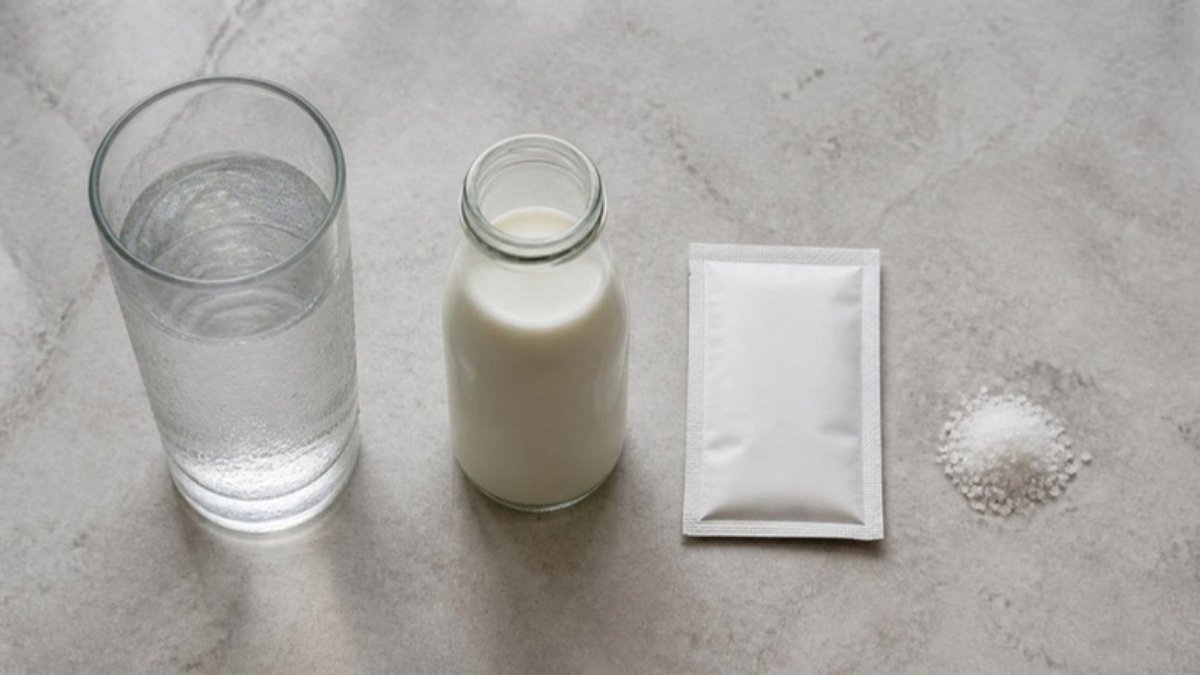
After exercise or a hot day, with a real loss: weigh in if you can. Drink about one and a half times the loss over the next two to four hours, and make sure sodium comes with it: a salty meal, milk, an oral rehydration sachet, or a pinch of salt in the water. Plain water alone will take longer and may not get there.
When ill: oral rehydration solution, small sips, continuously. It exists because it works better than water, and the difference is the sodium and glucose.
Before bed: a small amount, not a pint. The extra will be urine by 2am and will not hydrate you for the morning.
Questions people ask
How long does it take to rehydrate? Water reaches the bloodstream in about five minutes and is mostly absorbed within 45 to 75 minutes. Recovering from real dehydration, such as after exercise or illness, takes two to four hours and requires drinking around 150% of the fluid lost, with sodium.
How long does it take for water to hydrate you? Absorption begins within five minutes, half a glass is absorbed in about 11 to 13 minutes, and the whole glass is in your body water within about two hours. Whether you stay hydrated depends on what else is in the drink and what you lost.
How long does it take to rehydrate after drinking alcohol? The alcohol's diuretic effect ends as it is metabolised, and the resulting deficit recovers like any other over a few hours once you drink. Fluid with some salt, and food, helps; a hangover is only partly dehydration, so rehydrating fixes only part of it.
How much water do I need to rehydrate? About one and a half times what you lost. For exercise, weigh before and after; each kilogram lost is a litre. Drinking only what you lost, as plain water, leaves most people in deficit six hours later.
Is it better to drink water fast or slow to rehydrate? Slowly, over a couple of hours. The stomach empties at roughly a litre an hour, and drinking faster than that does not speed absorption. Large volumes of plain water drunk quickly also dilute blood sodium.
What hydrates better than water? Oral rehydration solution and milk retain more fluid over four hours than still water. Most commercial sports drinks, tea, coffee and lager retain about the same as water. Retention tracks sodium and other solute content.
Does coffee dehydrate you? Not in habitual drinkers at normal intakes. A controlled study of four cups a day found no difference in total body water compared with the same volume of water. Coffee counts toward daily fluid.
How long does it take to rehydrate from severe dehydration? With vomiting or diarrhoea, up to 24 hours of steady oral rehydration solution, and medical help if fluids cannot be kept down or the person is confused or not urinating. Severe dehydration is not a drink-a-lot-of-water problem.
How do I know if I'm hydrated? Pale, straw-coloured morning urine and normal thirst. For exercise, body weight back to the pre-session figure. Dark urine, a dry mouth and a headache that lifts on drinking are the ordinary signs of a deficit.
Can you rehydrate too fast? Yes. Drinking well beyond losses, especially plain water during long exercise, lowers blood sodium and can cause exercise-associated hyponatraemia, which is dangerous. Drink to thirst and include salt when losses are large.
This article summarises hydration physiology for general information and is not medical advice. Dehydration with confusion, fainting, no urine for many hours, or an inability to keep fluids down needs medical care, and in infants and older adults it becomes serious faster.
References
- Péronnet, F., Mignault, D., du Souich, P., et al. (2012). Pharmacokinetic analysis of absorption, distribution and disappearance of ingested water labeled with D2O in humans. European Journal of Applied Physiology, 112(6), 2213–2222. doi:10.1007/s00421-011-2194-7
- Shirreffs, S.M., Taylor, A.J., Leiper, J.B., & Maughan, R.J. (1996). Post-exercise rehydration in man: effects of volume consumed and drink sodium content. Medicine & Science in Sports & Exercise, 28(10), 1260–1271. doi:10.1097/00005768-199610000-00009
- Maughan, R.J., Watson, P., Cordery, P.A., et al. (2016). A randomized trial to assess the potential of different beverages to affect hydration status: development of a beverage hydration index. The American Journal of Clinical Nutrition, 103(3), 717–723. doi:10.3945/ajcn.115.114769
- Killer, S.C., Blannin, A.K., & Jeukendrup, A.E. (2014). No Evidence of Dehydration with Moderate Daily Coffee Intake: A Counterbalanced Cross-Over Study in a Free-Living Population. PLoS ONE, 9(1), e84154. doi:10.1371/journal.pone.0084154
- Cheuvront, S.N., & Kenefick, R.W. (2014). Dehydration: Physiology, Assessment, and Performance Effects. Comprehensive Physiology, 4(1), 257–285. doi:10.1002/cphy.c130017
- Hew-Butler, T., Rosner, M.H., Fowkes-Godek, S., et al. (2015). Statement of the Third International Exercise-Associated Hyponatremia Consensus Development Conference. Clinical Journal of Sport Medicine, 25(4), 303–320. doi:10.1097/JSM.0000000000000221
The weekly readout
One email each Thursday: what we tested, which claim collapsed under a closer look, and the one number worth paying attention to.