

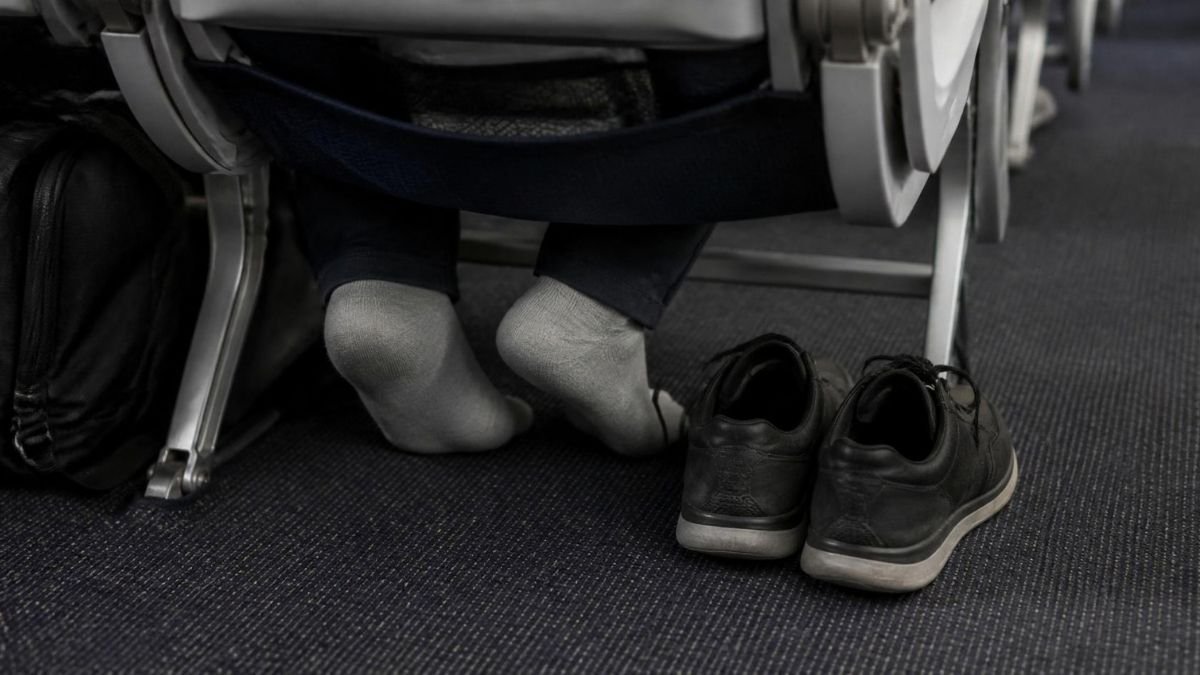
Short answer: ankles swell on a plane because you sit for hours with your legs hanging down and your calf muscles idle, so fluid settles into the tissue of the lower leg. Cabin pressure adds little: in a simulated-flight study of 18 volunteers seated for 8 hours, shin tissue thickened by roughly 8% at sea level and 13% at cabin altitude, with no significant difference between the two (percentages calculated here from the reported averages). Swelling in both ankles that fades after landing is ordinary. Swelling in one leg, with pain, warmth or redness, is different and needs prompt medical attention. Blood clots are uncommon, about 1 in 4,600 to 1 in 6,000 flights longer than 4 hours, and for flights under 4 hours the CDC calls the risk negligible.
What causes it, ranked by evidence
| Suggested cause | What the evidence says | Verdict |
|---|---|---|
| Sitting upright with legs down for hours | Leg tissue thickened over 8 seated hours whether the simulation was at 0 m or 2,500 m (Iblher 2013) | Main cause |
| Idle calf muscles | The calf pushes blood and fluid back up the leg each time it contracts; sitting still switches it off. The sources do not measure this directly, but movement is the common thread in CDC, NHS and aerospace-medicine guidance | Main cause, same mechanism |
| Low cabin pressure | No significant difference in leg swelling between sea level and cabin altitude in the same study; only the forehead swelled more at altitude | Small or none for legs |
| Dehydration and dry cabin air | Plasma viscosity was unchanged with adequate fluid intake (Iblher); the CDC finds no evidence linking dehydration to travel clots | Not supported |
| Salty airline food | Salt is a recognised general cause of oedema (NHS); no in-flight measurement in the sources read for this article | Plausible, unmeasured |
The first two rows are one explanation seen from two sides. The usual physiological account is that sitting upright leaves a column of blood between heart and ankle, the pressure at the bottom pushes fluid into the surrounding tissue, and the calf muscles, which squeeze blood back up the leg when you walk, are idle. None of the sources read for this article sets that mechanism out in full, so it is given here as the standard explanation, not a cited finding. What the sources do say fits it: the NHS lists "standing or sitting in the same position for too long" first among the usual causes of swollen ankles, feet and legs and recommends gentle exercise "to improve your blood flow", and the CDC Yellow Book calls calf-muscle exercises a reasonable recommendation for long-distance travellers.
The study that separated the seat from the cabin
On a real flight every passenger gets the seat and the cabin at once. Iblher and colleagues separated them in 2013 by putting 18 healthy men, average age 28, through two simulated 8-hour sessions in a crossover design. One ran at the equivalent of 2,500 metres of altitude with 15% humidity, close to real cabin conditions. The other ran at 0 metres with 50% humidity. Tissue thickness over the shin bone and the forehead was measured with a miniature ultrasound device.
Average shin tissue thickness rose from 4.8 to 5.2 in the ground-level session and from 4.7 to 5.3 in the altitude session (the abstract gives no unit). That is about +8% and +13%. Those percentages are calculated here from the reported averages (0.4 ÷ 4.8 and 0.6 ÷ 4.7); the authors report the raw values and state that the shin thickened in both sessions with no difference between them. The authors' conclusion was that the sitting position appeared to have the strongest influence on leg oedema during long-haul flights. Cabin conditions did do something, but to the face rather than the legs: forehead tissue thickened significantly in the altitude session (4.6 to 4.9) and ended higher than in the ground-level session (4.5).
Eighteen young men is a small and narrow sample, a simulation is not an aircraft, and only the abstract was read for this article. What the study shows is that removing the altitude and the dry air did not remove the swelling.
Is it normal for feet to swell after flying?
Yes, in the sense that it happened to healthy young volunteers in a controlled study. Ordinary travel swelling has a recognisable pattern: both feet or ankles, roughly equally; a tight-shoe feeling more than pain; skin that looks normal; improvement once you walk about and put your feet up.
None of the sources read for this article reports a measured recovery time, so the "24 to 48 hours" figures that circulate should be read as rules of thumb. The NHS's general guidance on swollen ankles is the nearest thing to a threshold: see a doctor if swelling in both legs has not improved after a few days of home treatment, or if it gets worse.
Ordinary swelling versus signs that need care
Swelling is also one of the symptoms of a deep vein thrombosis (DVT), a clot in a deep leg vein, so the distinction matters. The features below are taken from the CDC's traveller guidance and the NHS page on oedema.
| Ordinary travel swelling | Needs prompt medical attention | Emergency | |
|---|---|---|---|
| Where | Both ankles or feet, about equally | One ankle, foot or leg, with no obvious cause (NHS) | |
| Pain | Tightness, little or no pain | Pain or tenderness you cannot explain (CDC); swelling that is severe, painful or starts very suddenly (NHS) | Chest pain, often worse on a deep breath or cough (CDC) |
| Skin | Normal colour and temperature | Warm to the touch; red or discoloured (CDC) | |
| Breathing | Normal | Difficulty breathing, coughing up blood, fainting or lightheadedness, fast or irregular heartbeat (CDC) | |
| Timing | Appears during the trip, eases with walking and elevation | Can appear days later; most travel-related clots occur within 1 to 2 weeks of the trip (CDC) | Any time |
| What the source says to do | Move, elevate, wait | "Contact your doctor as soon as possible" (CDC); urgent GP appointment or NHS 111 (NHS) | "Seek medical help immediately" (CDC); call 999 (NHS). Editorial note for US readers: 911 |
Three points make this table less tidy than it looks. The CDC's consumer page says that about half of people with a DVT have no symptoms at all. It also says a pulmonary embolism, a clot in the lungs, can occur without any DVT symptoms. And the risk window is long: the Yellow Book says the raised risk after a long flight returns to baseline by 8 weeks.
Does flying cause blood clots?
It raises the risk, from a low base. The CDC's consumer page says most people who develop travel-associated clots have one or more other risk factors.
The CDC Yellow Book puts the annual incidence of venous thromboembolism (VTE, which covers DVT and pulmonary embolism) in the general population at 0.1%. Long-distance air travel may raise that 2- to 4-fold, although the Yellow Book describes the data as inconsistent. In absolute terms, it cites one study that found 1 clot per 4,656 person-flights of more than 4 hours and another that found 1 in 6,000. The Aerospace Medical Association's review gives the same 1 in 6,000 for flights over 4 hours and attributes it to the phase-one report of the World Health Organization's WRIGHT project, in a cohort of healthy individuals; the WHO report itself was not read for this article. For flights under 4 hours, the Yellow Book calls the risk of symptomatic VTE negligible.
The Aerospace Medical Association's review is useful on the cause. One early experiment reported that low cabin oxygen activated clotting but had no control group; a later controlled decompression-chamber study found no activation. The review states that no unique factor in the cabin environment has been shown to affect coagulation, that any form of travel involving more than 4 hours of immobility can predispose to thrombosis, and that encouraging mobility matters most. That points the same way as the leg-swelling study.
The risk is not spread evenly. The Yellow Book's list of factors that raise it:
- Previous VTE, or a family history of it
- Active cancer
- Recent hospitalisation, surgery or trauma
- Oestrogen use, including hormonal contraceptives and hormone replacement therapy
- Pregnancy and the period after childbirth
- Obesity, defined as a body mass index of 30 or above
- Older age, with risk rising after 40
- Limited mobility, such as a leg cast
- An inherited or acquired clotting disorder
Seat position also matters. In one study cited by the Yellow Book, window-seat passengers had roughly twice the VTE risk of aisle-seat passengers, and about six times if their BMI was 30 or above, presumably because they get up less.
Ordinary ankle swelling and clots share a setting, which is stillness, but none of the sources read here describes puffy ankles as an early stage of a DVT.
Do compression socks help when flying?
The Cochrane review by Clarke and colleagues, last updated in 2021, included 12 randomised trials with 2,918 participants. It looked for trials on flights of at least four hours; every flight in the included trials lasted more than five. The DVT result comes from nine of those trials, with 2,637 participants.
| Outcome | Result | Certainty of evidence (Cochrane) |
|---|---|---|
| Symptomless DVT, found by scanning | 50 cases among 2,637 passengers: 3 with stockings, 47 without. Odds ratio 0.10 (95% CI 0.04 to 0.25) | High |
| Superficial vein thrombosis | 16 cases among 1,804: 4 with stockings, 12 without. Not statistically significant | Moderate |
| Leg oedema | Lower with stockings in six pooled trials (mean difference −4.72 on the trials’ oedema score); three further trials pointed the same way | Low |
| Symptomatic DVT, pulmonary embolism, death | None occurred in any trial, so no conclusion is possible | Not assessable |
| Side effects | No significant adverse effects reported; stockings were well tolerated |
Stockings very probably reduce symptomless clots. They probably reduce swelling, though the oedema measurements were weak enough that Cochrane rates that evidence as low certainty, and neither the abstract nor the plain-language summary states the scale behind the −4.72 figure. And nobody knows whether they prevent the clots that actually harm people, because those events are too rare to show up in trials of this size. Cochrane notes that trials able to answer that would need a very large number of people.
The guideline bodies are more cautious than the headline odds ratio. As summarised in the CDC Yellow Book:
- The American College of Chest Physicians suggests properly fitted below-knee stockings giving 15 to 30 mmHg at the ankle only for travellers at increased risk on flights over 6 hours, as a weak recommendation, and does not recommend them for travellers who are not at increased risk.
- The American Society of Hematology suggests stockings or a preventive anticoagulant for travellers at substantially increased risk on flights over 4 hours, and advises against stockings, anticoagulants or aspirin for travellers without risk factors.
For someone whose only complaint is swollen ankles: the trials reported no significant adverse effects and suggest stockings reduce swelling, but that evidence is rated low, and neither guideline recommends them for clot prevention in people without risk factors. The CDC's consumer page says some people may benefit and suggests talking to a doctor first.
Prevention measures and the evidence behind each
| Measure | Evidence for less swelling | Evidence for fewer clots | Who recommends it |
|---|---|---|---|
| Walking the aisle every 1 to 2 hours | Mechanistic; no trial in the sources read | Indirect: immobility is the common factor | CDC, ACCP, Aerospace Medical Association |
| Calf and ankle exercises in the seat | Mechanistic; no trial in the sources read | Indirect; the CDC calls it a reasonable recommendation | CDC, ACCP |
| Aisle seat | None measured | Observational: window seats carried about twice the risk in one study | ACCP (for increased-risk travellers) |
| Graduated compression stockings | Six pooled trials, low certainty | High certainty for symptomless DVT; unknown for symptomatic clots | ACCP and ASH, for increased-risk travellers only |
| Drinking extra water | None; blood viscosity was unchanged with adequate intake | No evidence, per the CDC | Nobody, for this purpose |
| Aspirin | None | Not shown to help; ACCP advises against | ASH, only as a fallback for substantially increased risk |
Should I take aspirin before a long flight?
For most travellers the guidance says no, and this is a decision for a clinician.
The three bodies whose positions were read for this piece line up closely. The American College of Chest Physicians advises against using aspirin or anticoagulants to prevent travel-related clots. The American Society of Hematology advises against aspirin for travellers without risk factors, and for those at substantially increased risk suggests it only where stockings or a preventive anticoagulant are not feasible. The Aerospace Medical Association's review states that aspirin has not been shown in any scientific study to have a significant beneficial effect on the venous side of the circulation.
The Yellow Book notes that where a high-risk traveller does need medication, the choice is made individually and anticoagulants are preferred over aspirin.
What is not worth doing
Blaming cabin pressure. The one study that removed it found the legs swelled anyway.
Drinking water to stop the swelling. Staying hydrated on a flight is reasonable for comfort, and there is a separate question of how much a flight actually dehydrates you. As a remedy for swollen ankles or a clot preventive it has no support: the CDC says no evidence links dehydration to travel-associated VTE and that hydration cannot be specifically recommended for that purpose.
Paying for a better seat for this reason alone. The Aerospace Medical Association states that upgrading to business class to reduce clot risk is not supported by evidence.
What to actually do
Move. The CDC's traveller guidance is to move the legs frequently and to walk around every 1 to 2 hours on a long trip.
Exercise in the seat between walks. The CDC describes two: extend the legs straight out and flex the ankles, pulling the toes up and pointing them; and, as some airlines suggest, pull each knee towards the chest and hold it for 15 seconds, up to 10 times.
Pick the aisle on long flights. The observational data on clot risk favours it. The trade-off is that the window is the easier place to rest, which is part of deciding how to sleep on a plane.
Consider compression stockings if swelling bothers you or you have risk factors. They were well tolerated in the trials; the CDC suggests asking a doctor first.
After landing, walk and then elevate. The NHS suggests raising the legs on a chair or pillows when possible and getting gentle exercise such as walking. The other after-effect of a long flight is covered in why jet lag is worse coming home and the jet lag recovery calculator.
If you have a risk factor from the list above, talk to a doctor before a long flight.
Know the warning signs for the following weeks, not just for the flight. One-sided swelling, unexplained leg pain, warmth or redness: contact a doctor promptly. Breathlessness, chest pain, coughing blood or fainting: emergency services.
Swollen ankles are one of several ordinary physical effects of a long flight, alongside ear pain on descent.
Questions people ask
Why do my ankles swell when I fly? Because you sit upright for hours with your legs down and your calf muscles still, so fluid settles in the tissue of the lower legs. A simulated-flight study found the same swelling over 8 seated hours at ground level as at cabin altitude, so the seat is the main cause.
Why do my feet swell when I fly? For the same reason as the ankles: hours of sitting still with the legs down. The NHS lists sitting in the same position for too long among the usual causes of swollen feet, and advises against tight shoes. Ordinary swelling affects both sides about equally.
How to prevent swollen ankles on a plane? Walk the aisle every 1 to 2 hours, flex and point the ankles while seated, choose an aisle seat, and avoid tight shoes and clothing. Graduated compression stockings reduced swelling in pooled trials, though Cochrane rates that evidence as low certainty. Extra water has no evidence behind it for this purpose.
How long does swelling last after a flight? No source read for this article reports a measured recovery time, so commonly quoted figures are rules of thumb. Ordinary swelling eases with walking and raising the legs. NHS guidance is to see a doctor if swelling in both legs has not improved after a few days, or gets worse.
Do compression socks help when flying? In nine pooled randomised trials, symptomless clots occurred in 3 passengers wearing stockings and 47 not wearing them, among 2,637 people. Swelling was also lower, with low-certainty evidence. Whether they prevent symptomatic clots is unknown. Guidelines suggest them only for travellers at increased risk.
Is it normal for feet to swell after flying? Yes. It happened to healthy young volunteers after 8 hours seated in a controlled study, and the NHS lists sitting in one position too long as a common cause of swollen feet. Normal swelling affects both feet about equally, is not painful, and improves with movement and elevation.
Swollen ankles after a flight: when to worry? When the swelling is in one leg only, or comes with unexplained pain, warmth, redness or discolouration, the CDC advises contacting a doctor as soon as possible. Difficulty breathing, chest pain, coughing up blood or fainting need emergency help immediately. The Yellow Book says most travel clots occur within 1 to 2 weeks of the flight.
What does swelling in one leg after a flight mean? It may have a harmless cause, but one-sided swelling is the pattern associated with deep vein thrombosis, and the NHS lists unexplained swelling in one ankle, foot or leg as a reason to seek urgent medical advice. It should be assessed promptly, not watched for several days.
Does flying cause blood clots? Long flights raise the risk modestly from a low base. The CDC cites studies finding roughly 1 clot per 4,656 to 6,000 flights longer than 4 hours, and calls the risk negligible below 4 hours. The CDC says most people affected have another risk factor.
Should I take aspirin before a long flight? Guidelines advise against it for travellers without risk factors. The American College of Chest Physicians advises against aspirin for this purpose, and the Aerospace Medical Association notes it has not been shown to protect against clots in veins. Higher-risk travellers should ask their doctor before travelling.
This article covers leg swelling and blood-clot risk during travel for general information and is not medical advice. It does not replace assessment by a clinician; anyone with one-sided leg swelling, leg pain, breathlessness or chest pain, or with risk factors for blood clots before a long journey, should seek medical care.
References
- Iblher, P., Paarmann, H., Stuckert, K., Werner, A., Klotz, F.K., & Eichler, W. (2013). Interstitial fluid shifts in simulated long-haul flights monitored by a miniature ultrasound device. Aviation, Space, and Environmental Medicine, 84(5), 486–490. doi:10.3357/ASEM.3374.2013
- Clarke, M.J., Broderick, C., Hopewell, S., Juszczak, E., & Eisinga, A. (2021). Compression stockings for preventing deep vein thrombosis in airline passengers. Cochrane Database of Systematic Reviews, Issue 4, CD004002. doi:10.1002/14651858.CD004002.pub4
- Reyes, N.L., & Abe, K. Deep Vein Thrombosis and Pulmonary Embolism. CDC Yellow Book 2026: Health Information for International Travel. Centers for Disease Control and Prevention. cdc.gov
- Centers for Disease Control and Prevention (15 May 2024). Understanding Your Risk for Blood Clots with Travel. cdc.gov
- Johnston, R.V., & Hudson, M.F., for the Aerospace Medical Association Air Transport Medicine Committee (2014). Travelers’ Thrombosis. Aviation, Space, and Environmental Medicine, 85(2), 191–194. doi:10.3357/ASEM.3822.2014
- NHS (reviewed 26 February 2026). Swollen ankles, feet and legs (oedema). nhs.uk
The weekly readout
One email each Thursday: what we tested, which claim collapsed under a closer look, and the one number worth paying attention to.