

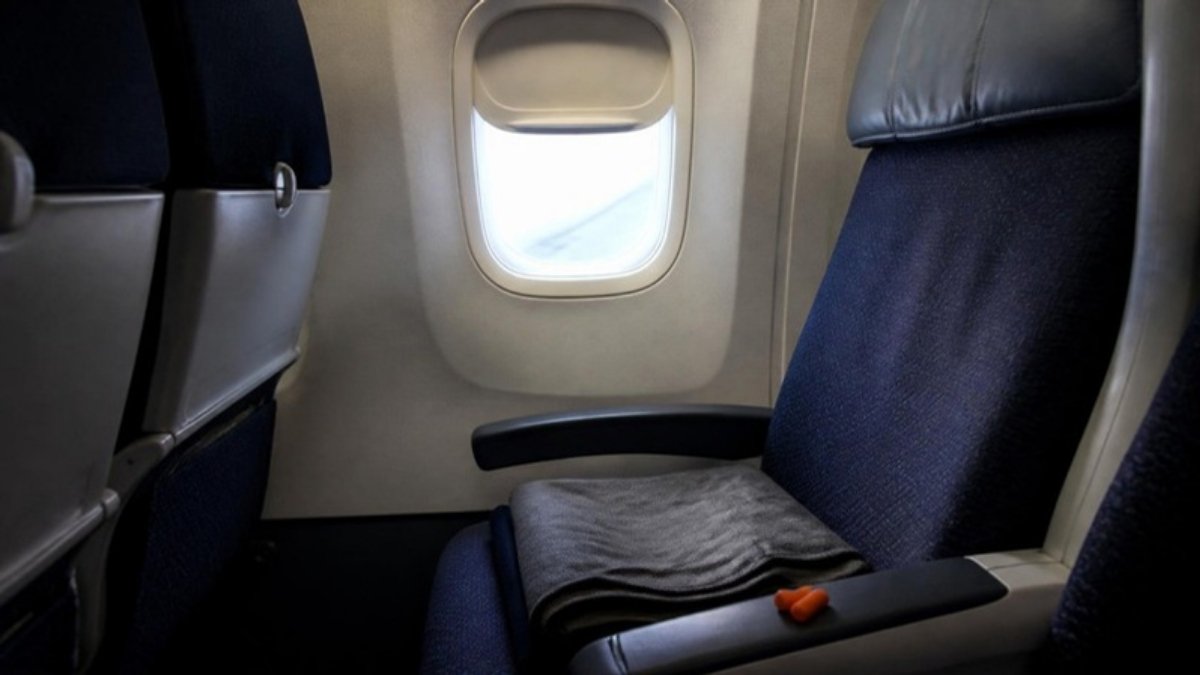
Short answer: the cabin is pressurised to the equivalent of up to 8,000 feet (2,400 m), the air is at 10 to 20% humidity, the noise runs around 85 decibels, and you are sitting at an angle that laboratory studies show is close to the worst possible for sleep. You cannot change the first three. You can change the angle a little, block the noise a lot, choose the timing, and avoid the two things that measurably make cabin sleep worse: alcohol, which at cabin altitude drops blood oxygen to levels that would concern a doctor on the ground, and screens in the hour before you try. Everything else on the usual lists is comfort, which is worth having, but is not what determines whether you sleep.
Here is each factor with its evidence, and then the plan.
The four conditions, and which ones you can touch
| Factor | Typical value in cruise | Effect on sleep | Can you change it? |
|---|---|---|---|
| Cabin altitude | Up to 8,000 ft / 2,400 m by regulation; 6,000–8,000 ft on most aircraft | Mild hypoxia: SpO₂ drops from ~97% to ~90%, breathing and heart rate rise, sleep is lighter | No |
| Humidity | 10–20%, drier than most deserts | Dry eyes, nose and throat; discomfort rather than a direct sleep effect | Only locally: water, eye drops, a scarf over the mouth |
| Noise | Median ~85 dB(A) across flight phases; lower in cruise, louder near engines and at the back | Continuous broadband noise is masking, sudden noises are the problem | Yes, substantially |
| Seat angle | Upright to ~20° recline in economy; 40° to flat in premium cabins | The single largest determinant of sleep quantity and quality in seated conditions | A little, and by seat choice |
| Light | Cabin lights, screens, window shades | Suppresses melatonin and shifts the clock | Yes |
| Timing | Departure time vs your body clock | Decides whether sleep pressure is available at all | Yes, by flight choice and preparation |
Altitude: why you are lighter-sleeping than you think
Commercial aircraft are pressurised, but not to sea level. Federal regulations require the cabin altitude not to exceed 8,000 feet under normal conditions, and most aircraft cruise with the cabin somewhere between 6,000 and 8,000 feet. At that altitude the air has about three-quarters of the oxygen of sea level, and blood oxygen saturation in healthy passengers falls from the high nineties to around 90%. Muhm and colleagues (2007) tested volunteers at simulated cabin altitudes in a hypobaric chamber for a New England Journal of Medicine study and found that discomfort, including fatigue and malaise, rose with altitude and that 8,000 feet produced measurably more of it than 6,000.
This is why sleep on a plane feels shallow even when you are exhausted. Mild hypoxia lightens sleep and increases arousals. Some newer aircraft pressurise to around 6,000 feet, which is a real if modest improvement, and it is a legitimate reason to prefer them for overnight flights if the choice exists.
Alcohol at altitude is a different drug
This is the most important finding in the article and the one most passengers get backwards.
Trammer and colleagues (2024) at the German Aerospace Center put 48 healthy adults aged 18 to 40 through two nights of sleep, one at sea level and one in a hypobaric chamber at 2,438 metres, the cabin equivalent, with and without a moderate dose of alcohol: about two cans of beer or two glasses of wine. The results, published in Thorax:
| Condition | Blood oxygen during sleep | Heart rate during sleep | Sleep |
|---|---|---|---|
| Sea level, no alcohol | ~96% | ~64 bpm | Normal |
| Altitude, no alcohol | ~88% | ~73 bpm | Lighter |
| Altitude, with alcohol | just over 85% | ~88 bpm | Deep sleep and REM both reduced |
Alcohol and altitude each lowered oxygen and raised heart rate; together they compounded. An oxygen saturation of 85% in a healthy young adult is a level that would prompt attention in a hospital. The authors' conclusion was that the combination places significant strain on the heart even in young, healthy people, and that larger amounts, older passengers and anyone with heart or lung conditions would fare worse.
The subjective experience is the trap. Alcohol shortens the time to fall asleep, so the drink seems to work. It then reduces deep and REM sleep and fragments the second half, which is the same pattern alcohol produces on the ground, now at reduced oxygen. The passenger wakes after four hours feeling worse than if they had not slept, and blames the seat.
The combination of alcohol and hypobaric hypoxia lowered oxygen saturation to a median just above 85% and raised sleeping heart rate to about 88 beats per minute, with reductions in deep and REM sleep.
Trammer et al, Thorax, 2024 — summarised from the findings
The seat angle is the variable that matters most
Roach and colleagues (2018) had participants attempt daytime sleep in a seat set to different angles of recline, from upright through partial recline to flat, and measured sleep with polysomnography. The title of the paper is its result: the quantity and quality of sleep increased as the angle of recline increased. Upright produced the least sleep and the most fragmented; each step toward flat added sleep and reduced arousals.
This is the physiological reason the airlines can charge what they do for flat beds, and it is also the reason the economy passenger's realistic goal is a series of naps rather than a night's sleep. What can be done with it:
Use every degree of recline you have. The difference between upright and the full economy recline is small in degrees and real in sleep. Recline after the meal service when the person behind you is also reclining.
Support the head so the neck does not have to. The reason people wake every twenty minutes upright is the head falling. A pillow that stops lateral movement, whether a wrap-around travel pillow or a rolled jacket wedged against the window, is addressing the actual failure mode. The classic U-shaped pillow worn at the back of the neck does not.
Window seat. Something to lean on, and control of the shade.
Feet up if at all possible. A footrest or a bag under the feet changes the angle at the hips, which is part of what recline is doing.
Noise: the one you can nearly eliminate
Zevitas and colleagues (2018) measured noise on 200 commercial flights across six aircraft types. Across all phases the median was 85.5 dB(A), with cruise generally quieter than takeoff and climb, seats near the engines and at the rear louder, and a small fraction of flights exceeding the occupational eight-hour exposure limit. For context, 85 dB is a busy restaurant or a lawnmower at some distance.
The steady engine roar is not the sleep problem; broadband, continuous noise masks rather than disturbs, and some people use it deliberately. The problem is the events on top of it: announcements, galley carts, the child, the overhead bin. Two tools handle this:
Foam earplugs, correctly inserted, cut 25 to 30 dB across the spectrum. They are the most effective single item on this list per gram, and they are the one most people use badly. Roll, pull the ear up and back, insert, hold for thirty seconds.
Active noise-cancelling headphones are excellent against the low-frequency engine drone and less effective against voices and sudden sounds. Wearing them with nothing playing, or with steady noise, works. Wearing them over earplugs works better.
Seat choice: forward of the wing is quieter than behind it on most aircraft; the rear rows near the galley are the worst of both worlds.
Light and screens
The cabin dims on most overnight flights, but the screen in front of you does not, and neither does the phone. Bright light in the hour before sleep suppresses melatonin and pushes the body clock later, which is the opposite of what an eastbound traveller needs and is unhelpful for everyone.
Shade down, screen off, eye mask on. The mask is more important than it sounds, because a cabin never goes fully dark and the reading light two rows ahead is enough to matter.
Timing is decided before you board
Sleep needs sleep pressure. If you board a 10pm departure having slept until noon, or having had a late double espresso, the seat is not the reason you are awake at 1am. Two practical rules:
Book the departure to match your bedtime, not the arrival to match your plans. An overnight flight that leaves around your normal bedtime gives you the pressure to sleep through the middle section, which is the quietest.
Handle caffeine on the ground. With a five-hour half-life, a coffee at 4pm is still half present at 9pm. On a night flight, the cutoff is midday.
For which direction is harder and what to do about it on arrival, the jet lag calculator and the piece on why coming home is worse cover the body-clock side.
Sleep aids, honestly
Melatonin. The Cochrane review by Herxheimer and Petrie found melatonin effective for jet lag, taken at the destination's bedtime, across a range of doses, and found it safe for short-term use. That is a timing effect on the body clock, not a sedative effect. As a sleeping pill for the flight itself, it does little; a small dose at the destination's bedtime, on the plane, is the evidence-based use.
Antihistamine sleep aids. They produce drowsiness and reduce sleep quality, and next-day grogginess is common. Not recommended for a first try on a plane.
Prescription sedatives. A conversation with a doctor, and never with alcohol, for the reasons above. Immobility plus sedation on a long flight is also a real concern for clotting.
Alcohol. See above. Not a sleep aid.
The plan, in order
Before: book a departure near your bedtime; no caffeine after midday; no alcohol at the airport; pack foam earplugs, an eye mask, a pillow that supports the side of the head, a large water bottle filled after security.
Boarding to meal: water, not wine. Eye drops if your eyes are sensitive. Screens off after the meal.
Sleep attempt: shade down, earplugs in, headphones over them if you have them, mask on, recline fully, feet up on a bag, pillow wedged so the head cannot fall sideways. Melatonin if you use it, timed to the destination's bedtime.
Expect naps, not a night. Two or three sleep episodes of an hour or two is a good economy result. Judge it against that, not against a bed.
On waking: water, walk the aisle, daylight at the destination as soon as you land if it is morning there.
Questions people ask
How do you sleep on a plane in economy? Recline fully, support the side of the head so it cannot fall, put your feet on a bag, block noise with foam earplugs or noise-cancelling headphones, wear an eye mask, avoid alcohol and screens, and time the flight to your bedtime. Seat angle is the largest single factor in seated sleep, so use every degree you have.
Why is it so hard to sleep on a plane? The cabin is pressurised to up to 8,000 feet, which lowers blood oxygen and lightens sleep; the air is at 10–20% humidity; noise is around 85 dB; and upright seating is the posture in which laboratory studies find the least and worst sleep.
Does alcohol help you sleep on a plane? No. In a controlled study at cabin altitude, a moderate dose dropped blood oxygen during sleep to just over 85%, raised sleeping heart rate to about 88 bpm, and reduced deep and REM sleep. It shortens the time to fall asleep and worsens everything after.
Should I take melatonin on a plane? For jet lag, yes: a Cochrane review found it effective when taken at the destination's bedtime. It is a body-clock signal rather than a sedative, so it does little for sleeping through the flight itself.
What is the best seat for sleeping on a plane? A window seat forward of the wing: something to lean on, control of the shade, and less engine noise than seats behind the wing or near the rear galley.
Are earplugs or noise-cancelling headphones better on a plane? Foam earplugs block more sound across all frequencies when inserted properly; noise-cancelling headphones are best against low-frequency engine drone. Both together is the most effective combination.
How much sleep can you realistically get on a plane? In an economy seat, a few naps totalling two to four hours on a long flight is a good outcome. Flat seats approach normal sleep; upright seats approach none.
Does cabin pressure affect sleep? Yes. At cabin altitude blood oxygen falls to around 90%, breathing and heart rate rise, and sleep becomes lighter with more arousals. Aircraft that pressurise to a lower cabin altitude are measurably more comfortable.
Should I stay awake on a plane to beat jet lag? Only if the flight arrives at your destination's evening and you would otherwise be trying to sleep on landing. Otherwise, sleep on the plane is sleep, and being rested makes the light-timing strategy for jet lag easier to follow.
Is it bad to sleep on a plane with contact lenses in? Yes. Cabin humidity is 10–20%, the eyes dry out, and sleeping in lenses raises infection risk. Take them out before trying to sleep.
This article covers travel physiology for general information and is not medical advice. Anyone with heart or lung disease, sleep apnoea, or a history of blood clots should discuss long flights, alcohol and sedatives with a doctor.
References
- Trammer, R.A., Rooney, D., Benderoth, S., Wittkowski, M., Wenzel, J., & Elmenhorst, E.-M. (2024). Effects of moderate alcohol consumption and hypobaric hypoxia: implications for passengers’ sleep, oxygen saturation and heart rate on long-haul flights. Thorax, 79(10), 970–978. doi:10.1136/thorax-2023-220998
- Roach, G.D., Matthews, R., Naweed, A., Kontou, T.G., & Sargent, C. (2018). Flat-out napping: The quantity and quality of sleep obtained in a seat during the daytime increase as the angle of recline of the seat increases. Chronobiology International, 35(6), 872–883. doi:10.1080/07420528.2018.1466801
- Zevitas, C.D., Spengler, J.D., Jones, B., et al. (2018). Assessment of noise in the airplane cabin environment. Journal of Exposure Science & Environmental Epidemiology, 28(6), 568–578. doi:10.1038/s41370-018-0027-z
- Muhm, J.M., Rock, P.B., McMullin, D.L., et al. (2007). Effect of Aircraft-Cabin Altitude on Passenger Discomfort. New England Journal of Medicine, 357(1), 18–27. doi:10.1056/NEJMoa062770
- Federal Aviation Administration. 14 CFR § 25.841 Pressurized cabins. ecfr.gov
- Herxheimer, A., & Petrie, K.J. (2002). Melatonin for the prevention and treatment of jet lag. Cochrane Database of Systematic Reviews, 2002(2), CD001520. doi:10.1002/14651858.CD001520
The weekly readout
One email each Thursday: what we tested, which claim collapsed under a closer look, and the one number worth paying attention to.