
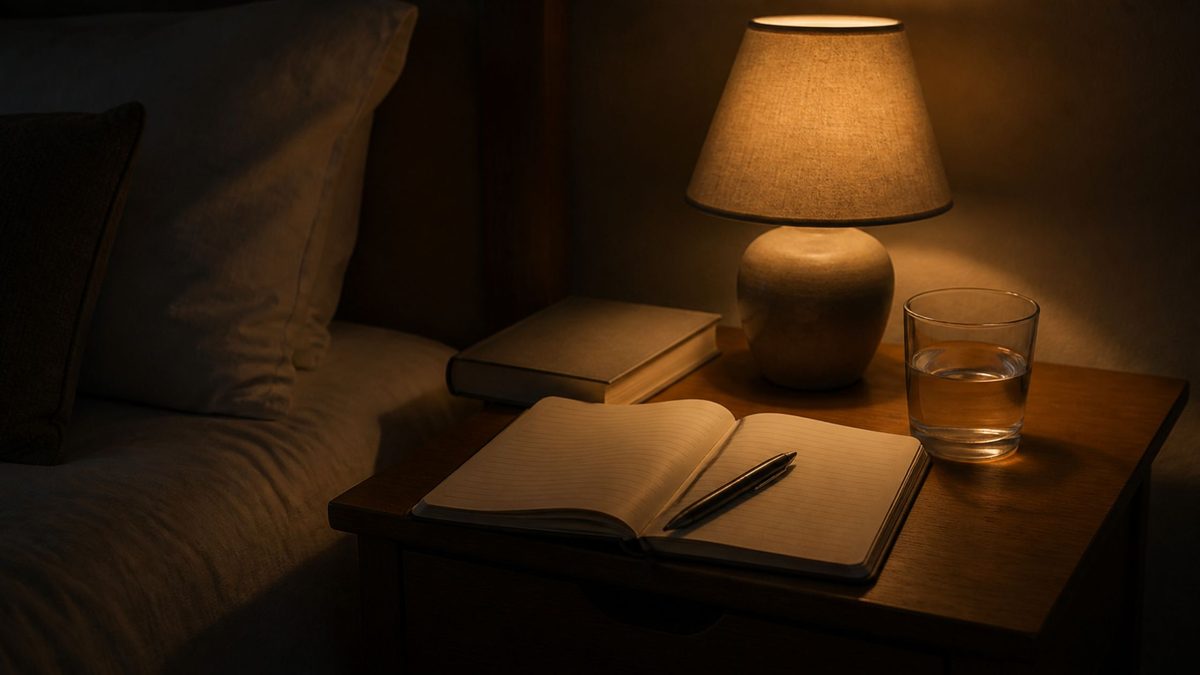
Short answer: the things to do before bed with the best evidence are: write tomorrow's to-do list (people fell asleep about 9 minutes faster in a lab study), take a warm shower or bath 1–2 hours before bed (about 10 minutes faster in a meta-analysis), dim the lights, stop caffeine about 6 hours before bed, finish alcohol early or skip it, keep the bedroom cool, and put the phone away. Moderate evening exercise is fine; only hard workouts in the last hour before bed seem to delay sleep.
Most bedtime-routine lists mix real effects with nice-sounding rituals. Each item below has at least one study behind it. Where the effect is small, we say so. A 10-minute faster sleep onset won't change your life if your schedule only leaves you six hours in bed.
1. Write tomorrow's to-do list
What to do: spend five minutes writing down everything you need to do tomorrow and over the next few days. Be specific.
The evidence: in a lab study at Baylor University, 57 young adults spent five minutes before lights-out writing either a to-do list or a list of tasks they'd already finished, then had their sleep measured with EEG. The to-do group fell asleep in about 16 minutes on average, against about 25 for the other group. The more specific the list, the faster people fell asleep. The authors' explanation is that writing tasks down "offloads" them so you don't keep running through them in bed.
Caveat: one study, healthy students, one night. But it's free and takes five minutes. If you journal, our journaling prompts work better earlier in the evening.
2. Take a warm shower or bath 1–2 hours before bed
What to do: shower or bathe in warm water (about 40–42.5 °C, 104–108.5 °F) for at least 10 minutes, finishing 1–2 hours before you plan to sleep.
The evidence: a meta-analysis from the University of Texas pooled 13 studies. Warm-water bathing at that temperature improved self-rated sleep quality and sleep efficiency, and when it was done 1–2 hours before bed, people fell asleep about 10 minutes faster. The mechanism is counterintuitive: warming the skin sends blood to the hands and feet, which helps the body lose heat. Your core temperature falls faster, and a falling core temperature is one of the body's signals that it's time to sleep.
Caveat: timing matters. A hot shower right before bed may leave you too warm to sleep.
3. Dim the lights for the last hour or two
What to do: switch to lamps instead of overhead lights, use warm bulbs, and keep the brightness low.
The evidence: in a study at Brigham and Women's Hospital, ordinary room light (under 200 lux) before bed suppressed melatonin and shortened the time the body produces it, compared with dim light (Gooley et al., 2011). Melatonin doesn't knock you out, but it's the body clock's signal for "night," and bright light pushes it later.
4. Stop caffeine about 6 hours before bed
What to do: set a caffeine cut-off around early afternoon if you go to bed around 10–11 p.m.
The evidence: in a randomized trial, 400 mg of caffeine (about 3–4 cups of coffee) taken 0, 3 or 6 hours before bed all disrupted sleep. Even at 6 hours, it cut total sleep by about an hour, and people often didn't notice (Drake et al., 2013). Caffeine's half-life is around 5 hours, so a 3 p.m. coffee is still partly active at bedtime. Our article on how long caffeine lasts has a table of how much is left after each hour.
5. Finish alcohol early, or skip it
What to do: if you drink, stop at least 3–4 hours before bed, and keep it to one drink.
The evidence: a review of the sleep-lab research found alcohol helps people fall asleep faster and deepens the first half of the night, then breaks up the second half: more waking and less REM sleep (Ebrahim et al., 2013). The "nightcap" trades a faster start for a worse night. More in our article on alcohol and sleep.
6. Make the bedroom cool
What to do: aim for a bedroom around 16–19 °C (60–67 °F), with bedding you can kick off.
The evidence: heat is one of the most reliable ways to disrupt sleep. In lab studies, a hot, humid room increases waking and reduces deep sleep and REM (reviewed by Okamoto-Mizuno & Mizuno, 2012). A cool room helps the core-temperature drop that tip 2 relies on. The exact best temperature differs from person to person and depends on bedding.
7. Put your phone and tablet away
What to do: stop scrolling 30–60 minutes before bed, and charge the phone outside the bedroom if you can.
The evidence: in a Harvard study, reading on a light-emitting e-reader for four hours before bed for five nights delayed melatonin, made people take longer to fall asleep and left them less alert the next morning, compared with reading a printed book (Chang et al., 2015). Most of the effect in everyday life probably comes from what's on the screen as much as the light. An engaging feed keeps you awake longer than you planned. Our guide to how to stop doomscrolling covers that side.
8. Do moderate exercise in the evening if that's when you have time
What to do: a walk, yoga, an easy run or a normal gym session in the evening is fine. Save very hard intervals for earlier in the day.
The evidence: a meta-analysis of 23 studies from ETH Zurich found evening exercise did not harm sleep. People who exercised in the evening actually spent slightly more of the night in deep sleep (21.2% vs 19.9%). The one exception was vigorous exercise ending within an hour of bedtime, which delayed sleep. Those people went to bed with their heart still beating 20+ beats a minute above resting (Stutz et al., 2019).
9. Keep the same bedtime and wake time
What to do: go to bed and, more importantly, get up at about the same time every day, including weekends.
The evidence: a regular schedule keeps your body clock stable, so sleepiness arrives at the same time each night. Consistent wake time is a standard part of behavioral treatment for insomnia. If you have a big gap between weekday and weekend sleep, our article on how to reset your circadian rhythm explains how to close it.
10. If you can't sleep, get up
What to do: if you've been lying awake for what feels like 20 minutes, get up, go to another room, do something calm in dim light, and go back to bed only when you feel sleepy.
The evidence: this is "stimulus control," one of the parts of cognitive behavioral therapy for insomnia (CBT-I). The American Academy of Sleep Medicine's 2021 guideline recommends it for chronic insomnia. The idea is to stop the bed from becoming a place where you lie awake and worry.
Things that sound helpful but have weak evidence
- A nightcap. See item 5: it helps you fall asleep, then hurts the rest of the night.
- Blue light glasses at night. A 2023 Cochrane review found too little evidence to say they improve sleep. Dimming the room does more. See do blue light glasses work.
- "Night mode" alone. Warmer screen colors reduce blue light, but bright, engaging content still keeps you up.
- Warm milk. Comforting, but the amount of tryptophan in a glass of milk is too small to have a measurable sleep effect on its own.
Quick reference
| Habit | When | Effect | Evidence |
|---|---|---|---|
| Write a to-do list | Last 5 min before bed | ~9 min faster sleep onset | One lab study (EEG) |
| Warm shower or bath | 1–2 h before bed | ~10 min faster; better quality | Meta-analysis of 13 studies |
| Dim lights | Last 1–2 h | Earlier, longer melatonin release | Lab study |
| Caffeine cut-off | 6+ h before bed | Protects ~1 h of sleep | Randomized trial |
| Alcohol early or none | 3–4+ h before bed | Less broken second half | Review of lab studies |
| Cool bedroom | All night | Less waking | Lab studies |
| Phone away | 30–60 min before | Less delay in sleep | Lab study |
| Avoid hard exercise late | Last hour | Avoids delayed sleep | Meta-analysis of 23 studies |
Questions people ask
What should I do 1 hour before bed? Dim the lights, put the phone away, and do something calm: read a paper book, stretch, or write tomorrow's to-do list. If you shower, do it 1–2 hours before bed rather than right before.
What is the best thing to do before bed to fall asleep faster? The two habits with the clearest numbers are a warm shower or bath 1–2 hours before bed (about 10 minutes faster in a meta-analysis) and writing a specific to-do list right before bed (about 9 minutes faster in a lab study).
Is it good to shower before bed? Yes, if it's warm and about 1–2 hours before bed. That timing helps your core temperature drop at the right moment. A shower right before bed can leave you too warm.
Is it bad to exercise before bed? Not usually. A meta-analysis of 23 studies found evening exercise didn't hurt sleep, and slightly increased deep sleep. Only vigorous exercise ending within an hour of bedtime delayed sleep.
How long before bed should I stop drinking coffee? At least 6 hours. In a trial, a large dose of caffeine taken 6 hours before bed still cut sleep by about an hour.
Should I read before bed? Reading a paper book in dim light is a good wind-down. In one study, reading on a light-emitting screen instead delayed melatonin and sleep.
What should I not do before bed? Avoid caffeine in the afternoon, alcohol close to bedtime, bright overhead lights, hard workouts in the last hour, and scrolling in bed.
Does a bedtime routine help adults? Yes, mainly by making the same cues happen at the same time each night. The specific steps matter less than doing them consistently.
What temperature should my bedroom be for sleep? Around 16–19 °C (60–67 °F) works for most people, with bedding you can adjust. A hot, humid room causes more waking.
What if I still can't sleep? If you lie awake for what feels like 20 minutes, get up and do something calm until you feel sleepy. If sleep problems last for months, ask about CBT-I, which works better long term than sleeping pills.
This article is general information, not medical advice. Long-lasting insomnia, loud snoring with pauses in breathing, or severe daytime sleepiness should be checked by a doctor.
References
- Scullin MK, Krueger ML, Ballard HK, Pruett N, Bliwise DL. The effects of bedtime writing on difficulty falling asleep: a polysomnographic study comparing to-do lists and completed activity lists. Journal of Experimental Psychology: General 2018;147(1):139–146. doi:10.1037/xge0000374
- Haghayegh S, Khoshnevis S, Smolensky MH, Diller KR, Castriotta RJ. Before-bedtime passive body heating by warm shower or bath to improve sleep: a systematic review and meta-analysis. Sleep Medicine Reviews 2019;46:124–135. doi:10.1016/j.smrv.2019.04.008
- Gooley JJ, Chamberlain K, Smith KA, et al. Exposure to room light before bedtime suppresses melatonin onset and shortens melatonin duration in humans. Journal of Clinical Endocrinology & Metabolism 2011;96(3):E463–E472. doi:10.1210/jc.2010-2098
- Drake C, Roehrs T, Shambroom J, Roth T. Caffeine effects on sleep taken 0, 3, or 6 hours before going to bed. Journal of Clinical Sleep Medicine 2013;9(11):1195–1200. doi:10.5664/jcsm.3170
- Ebrahim IO, Shapiro CM, Williams AJ, Fenwick PB. Alcohol and sleep I: effects on normal sleep. Alcoholism: Clinical and Experimental Research 2013;37(4):539–549. doi:10.1111/acer.12006
- Chang AM, Aeschbach D, Duffy JF, Czeisler CA. Evening use of light-emitting eReaders negatively affects sleep, circadian timing, and next-morning alertness. PNAS 2015;112(4):1232–1237. doi:10.1073/pnas.1418490112
- Stutz J, Eiholzer R, Spengler CM. Effects of evening exercise on sleep in healthy participants: a systematic review and meta-analysis. Sports Medicine 2019;49(2):269–287. doi:10.1007/s40279-018-1015-0
- Edinger JD, Arnedt JT, Bertisch SM, et al. Behavioral and psychological treatments for chronic insomnia disorder in adults: an American Academy of Sleep Medicine clinical practice guideline. Journal of Clinical Sleep Medicine 2021;17(2):255–262. doi:10.5664/jcsm.8986
The weekly readout
One email each Thursday: what we tested, which claim collapsed under a closer look, and the one number worth paying attention to.