
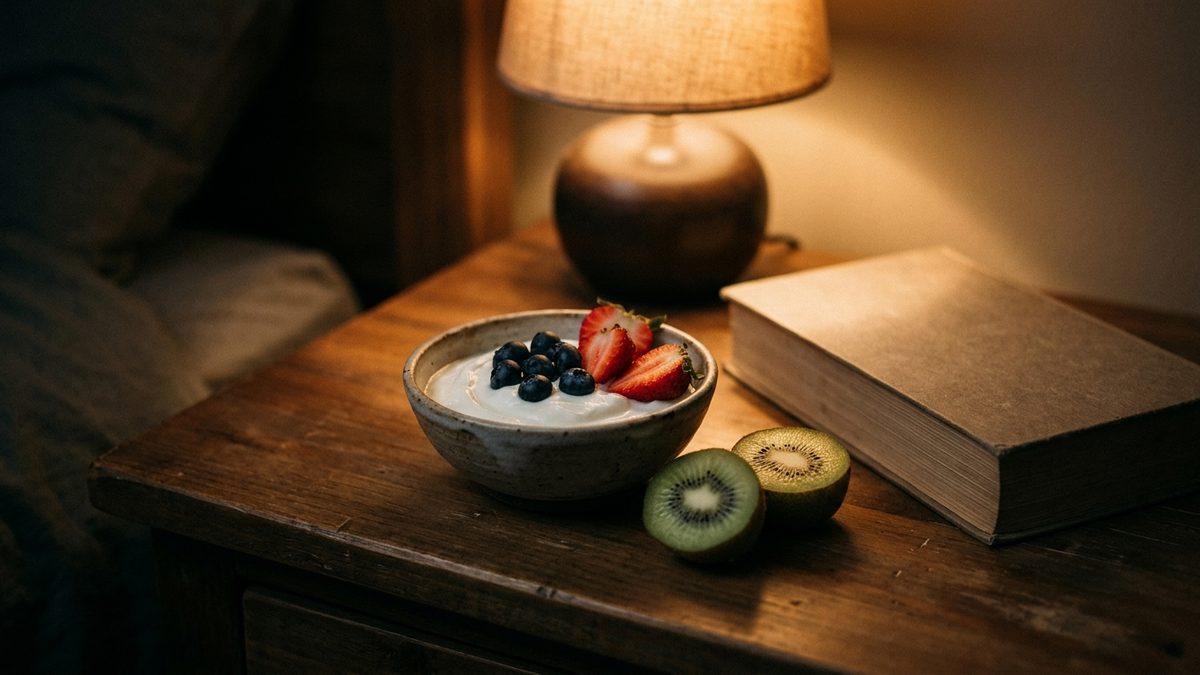
Short answer: healthy late night snacks are small (about 150 to 200 calories), low in saturated fat and added sugar, and include some protein or fiber. Good options: two kiwis, tart cherries or tart cherry juice, Greek yogurt with berries, a banana with nut butter, oatmeal, cottage cheese, a small handful of nuts, whole-grain toast with egg or hummus, cheese with whole-grain crackers, warm milk and plain popcorn. A review of night-time eating concluded that small, nutrient-dense snacks don't appear to be harmful. Large mixed meals late at night are what the review links to negative outcomes. In a lab study, more saturated fat during the day went with less deep sleep, and more sugar with more night-time arousals.
Is it bad to eat late at night?
It depends what and how much. A 2015 review contrasted large mixed meals at night, which it links to negative outcomes, with small, nutrient-dense snacks. It concluded that a small intake of about 150 calories doesn't appear to be harmful and may even benefit muscle protein synthesis and cardiometabolic health, a hypothesis the authors say needs more research. One caution from the same review: in obese women, eating before sleep without exercise training increased insulin resistance.
Three things are well supported:
- Composition matters. In a sleep-lab study of 26 adults, more fiber during the day was linked to more deep (slow-wave) sleep, more saturated fat to less, and more sugar to more night-time arousals. After a day of choosing their own food, people also took longer to fall asleep than after three days on a controlled diet: nine of the 26 went from under 30 minutes to over 30. These are associations from a single day, and the authors call for more testing.
- Lying down on a full stomach invites reflux. In a Japanese case-control study, people who went to bed within three hours of dinner had 7.45 times the odds of reflux disease compared with those who waited four hours or more. That's about meals, but it's a reason to keep a late snack small.
- You don't have to go to bed hungry. If you're hungry at 10 p.m., the review above gives no reason to avoid a small snack.
The 11 snacks
1. Two kiwis
The best-known "sleep food" study gave 24 adults with sleep problems two kiwifruit an hour before bed for four weeks. Time to fall asleep dropped by 35.4% and total sleep time rose by 13.4%. There was no control group: each person was compared with their own baseline, so the result can't separate the kiwis from a placebo effect.
Evidence: promising but weak (one small uncontrolled trial).
2. Tart cherries or tart cherry juice
One trial is behind the reputation; its title describes the "effect of tart cherry juice on melatonin levels and enhanced sleep quality." Choose unsweetened juice or a handful of dried tart cherries, and note that juice has sugar.
Evidence: one small trial.
3. Greek yogurt with berries
A 170 g pot of plain nonfat Greek yogurt has about 100 calories and 17 g of protein (USDA). A review of pre-sleep protein found that protein eaten before sleep is effectively digested and absorbed overnight, and that with resistance training it can add to gains in muscle mass and strength. The dose matters: the review says at least 40 g is needed for a robust effect, far more than a pot of yogurt.
Evidence: a light protein snack; the muscle research used at least 40 g of protein.
4. Banana with a spoonful of nut butter
A medium banana with a tablespoon of peanut butter comes to roughly 200 calories. Filling without being heavy.
Evidence: practical; no trial cited.
5. A small bowl of oatmeal
Warm, high in fiber, and easy on the stomach. Make it with milk for extra protein and skip the sugar.
Evidence: fits the pattern (more fiber, less sugar) linked to better sleep.
6. Cottage cheese
Half a cup of 2% cottage cheese has about 12 g of protein and 95 calories (USDA). Add fruit or a few whole-grain crackers.
Evidence: same as yogurt: protein, not sleep.
7. A small handful of nuts
Almonds, walnuts or pistachios. An ounce of almonds (about 23) has 164 calories, 6 g of protein and 3.5 g of fiber (USDA), so a handful, not the bag.
Evidence: practical; no trial cited.
8. Whole-grain toast with egg or hummus
A slice of whole-grain toast with a boiled egg, hummus or avocado gives fiber plus protein for about 150 to 200 calories.
Evidence: practical.
9. Cheese with whole-grain crackers
A small portion: one stick of string cheese (about 70 calories) and three or four crackers.
Evidence: practical.
10. Warm milk
A cup of warm milk is a traditional choice. No trial is cited here for it.
Evidence: tradition more than trials.
11. Plain air-popped popcorn
A whole grain with a lot of volume, and it takes a while to eat, which helps if the urge is more about habit than hunger. Go easy on butter and salt.
Evidence: practical; high fiber, low sugar.
Quick reference
| Snack | Approx. calories | Why it works | Evidence for sleep |
|---|---|---|---|
| Two kiwis | Not checked | Whole fruit | Small uncontrolled trial |
| Tart cherry juice | Check the label | Subject of one trial | One small trial |
| Greek yogurt, 170 g, plus berries | 100 + berries | 17 g protein | None cited |
| Banana with 1 tbsp peanut butter | About 200 | Filling | None cited |
| Oatmeal, 1 cup cooked | 166 | 4 g fiber | Fits the fiber pattern |
| Cottage cheese 2%, half cup | 95 | 12 g protein | None cited |
| Almonds, 1 oz | 164 | Protein and fiber | None cited |
| Whole-wheat toast with a boiled egg | About 150 | Fiber and protein | None cited |
| String cheese and crackers | Check the label | Protein | None cited |
| Warm milk | Check the label | Tradition | None cited |
| Air-popped popcorn | Check the label | Whole grain, volume | None cited |
Calorie figures are USDA FoodData Central values where a number is given. Where the table says to check the label, this article didn't verify a figure.
What to avoid before bed
- Large meals. The review links large mixed meals at night to negative outcomes, and going to bed soon after dinner was associated with reflux disease.
- Spicy and acidic food if you get heartburn.
- Sugary snacks. Ice cream, biscuits, sweets and sweetened cereal. More sugar was linked to more night-time arousals in the lab study above.
- Coffee and other sources of caffeine. See how long caffeine lasts.
- Alcohol. See how long alcohol affects sleep.
- Lots of fluid right before bed.
How much and when
Keep it to about 150 to 200 calories, and finish 30 to 60 minutes before lights out so you're not lying down straight after eating. If you get reflux, leave longer and keep your main evening meal at least three hours before bed.
One detail on timing: a 2007 study titled "High-glycemic-index carbohydrate meals shorten sleep onset" compared a high-glycemic meal eaten four hours before bed with a low-glycemic one, and with the same meal one hour before bed. That's about dinner, not about sugar at bedtime.
Food is a small part of sleeping well. The habits with the most evidence are in our list of things to do before bed.
Is it hunger or habit?
If you snack every night at the same time in front of the TV, it may be routine, boredom or tiredness more than hunger. A quick test: would you eat an apple right now? If yes, you're hungry and a snack from this list is reasonable. If only crisps will do, it's probably habit.
People with diabetes, reflux disease or a history of disordered eating should follow advice from their own doctor or dietitian about evening eating.
Questions people ask
What is the healthiest late night snack? Something small with protein or fiber and little added sugar: Greek yogurt with berries, two kiwis, a banana with nut butter or a small bowl of oatmeal.
Is it bad to eat before bed? A small snack isn't. Large, fatty or sugary meals close to bedtime can disturb sleep and trigger reflux.
What foods help you sleep? Kiwis and tart cherries each have one small trial behind them. In a sleep-lab study, more fiber and less saturated fat during the day were linked to more deep sleep.
What should I eat when I'm hungry at night? About 150 to 200 calories of something filling: yogurt, cottage cheese, toast with egg, a banana with nut butter or popcorn.
How long before bed should I stop eating? Finish a snack 30 to 60 minutes before bed. Finish a full meal about three hours before, especially if you get heartburn.
Does eating late at night cause weight gain? The review cited here links large late meals to negative outcomes and found that a small snack of about 150 calories doesn't appear harmful.
Is a banana a good bedtime snack? It's a reasonable light choice. Add nut butter if you need it to be more filling.
Is peanut butter good before bed? A spoonful on toast or with a banana is fine. Two tablespoons have 191 calories (USDA), so keep the portion to about one.
Does cheese before bed give you nightmares? No study cited here supports that. A small portion of cheese is a reasonable snack.
What should I not eat before bed? Large meals, sugary snacks, caffeine and alcohol, plus spicy or acidic food if you get heartburn.
This article is general information, not medical or dietary advice. People with diabetes, reflux disease or other conditions should follow their own clinician's advice on evening eating.
References
- Kinsey AW, Ormsbee MJ. The health impact of nighttime eating: old and new perspectives. Nutrients 2015;7(4):2648–2662. doi:10.3390/nu7042648
- St-Onge MP, Roberts A, Shechter A, Choudhury AR. Fiber and saturated fat are associated with sleep arousals and slow wave sleep. Journal of Clinical Sleep Medicine 2016;12(1):19–24. doi:10.5664/jcsm.5384
- Lin HH, Tsai PS, Fang SC, Liu JF. Effect of kiwifruit consumption on sleep quality in adults with sleep problems. Asia Pacific Journal of Clinical Nutrition 2011;20(2):169–174. PMID 21669584
- Howatson G, Bell PG, Tallent J, Middleton B, McHugh MP, Ellis J. Effect of tart cherry juice (Prunus cerasus) on melatonin levels and enhanced sleep quality. European Journal of Nutrition 2012;51(8):909–916. doi:10.1007/s00394-011-0263-7
- Afaghi A, O'Connor H, Chow CM. High-glycemic-index carbohydrate meals shorten sleep onset. American Journal of Clinical Nutrition 2007;85(2):426–430. doi:10.1093/ajcn/85.2.426
- Fujiwara Y, Machida A, Watanabe Y, et al. Association between dinner-to-bed time and gastro-esophageal reflux disease. American Journal of Gastroenterology 2005;100(12):2633–2636. doi:10.1111/j.1572-0241.2005.00354.x
- U.S. Department of Agriculture, Agricultural Research Service. FoodData Central. fdc.nal.usda.gov
- Trommelen J, van Loon LJC. Pre-sleep protein ingestion to improve the skeletal muscle adaptive response to exercise training. Nutrients 2016;8(12):763. doi:10.3390/nu8120763
The weekly readout
One email each Thursday: what we tested, which claim collapsed under a closer look, and the one number worth paying attention to.