

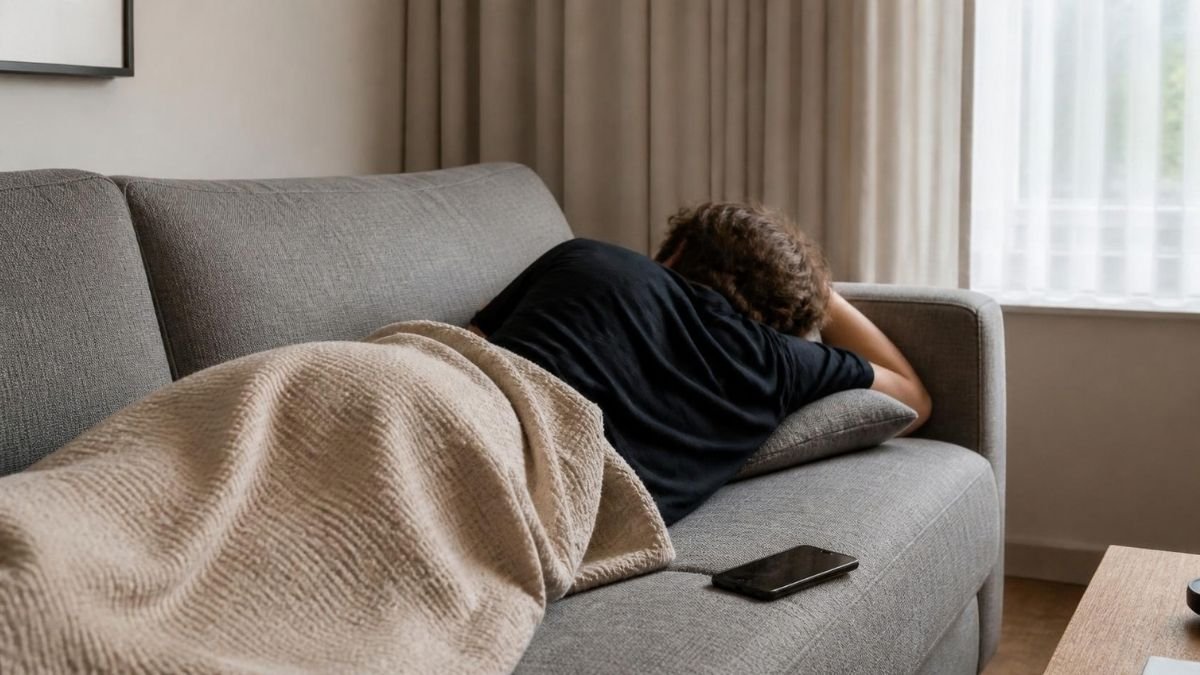
Short answer: for an ordinary afternoon slump, aim for 10 to 20 minutes of actual sleep, which means setting an alarm for roughly 25 to 30 minutes to allow time to drift off. In the one laboratory study that compared nap lengths directly, a 10-minute nap improved alertness and performance immediately and for up to 155 minutes; a 30-minute nap worked as well eventually but began with a spell of grogginess. NASA's cockpit study landed in the same region: pilots given 40 minutes slept 25.8 minutes and were more alert through landing. Longer naps have their uses, mainly paying back lost sleep, but habitual naps of 60 minutes or more are associated with higher cardiovascular risk in cohort studies, with real doubt about which way the causation runs.
The fuller answer is that "how long" depends on what the nap is for. A nap to stay sharp for a meeting, a nap before a night drive and a nap to recover from a four-hour night are different tools, backed by evidence of different quality.
Nap length at a glance
| Minutes asleep | What you get | Grogginess on waking | Evidence |
|---|---|---|---|
| 5 | Few benefits compared with no nap | Not reported | One lab trial |
| 10 | Immediate gains in alertness, mood and cognitive performance, some lasting up to about 2.5 hours | None reported | One lab trial; consistent with reviews |
| 20 | Gains that emerged about 35 minutes after waking and lasted up to about 2 hours | Not reported | One lab trial; the length most caffeine-nap studies used |
| About 26 | Better alertness and reaction time than no rest, in working pilots | Not reported as a problem | NASA field study |
| 30 | Gains lasting up to about 2.5 hours, after a period of impairment | Noticeable | One lab trial; sleep inertia reviews |
| 60–90 | More total sleep; useful after a badly short night | Likely, especially if woken from deep sleep | Pooled trials, weaker on optimum length |
| 60+ every day, as a habit | Unclear benefit | — | Linked to higher cardiovascular risk in cohorts; cause disputed |
Every figure in that table is minutes asleep, not minutes lying down, a distinction dealt with below.
The study that actually compared nap lengths
Most nap studies test one nap against no nap, which shows that napping helps and says nothing about how long the nap should be. The exception is an experiment by Amber Brooks and Leon Lack, published in Sleep in 2006, which is the source of most of the specific numbers that circulate on this subject.
The design: 24 healthy young adults, each tested under five conditions. After a night held to about 5 hours of sleep, at 3:00 pm they got either no nap or a nap of 5, 10, 20 or 30 minutes of EEG-verified sleep, and were then tested for three hours on sleepiness, fatigue, vigour and cognitive tasks.
| Nap (minutes of sleep) | Immediately after waking | Later | How long benefits were detected |
|---|---|---|---|
| 5 | Few benefits over no nap | Few benefits | — |
| 10 | Improved on all outcome measures | Some benefits maintained | Up to 155 minutes |
| 20 | No immediate benefit reported | Improvements emerged about 35 minutes after waking | Up to 125 minutes |
| 30 | Impaired alertness and performance (sleep inertia) | Improvements after the impairment cleared | Up to 155 minutes |
The authors' conclusion was that the 10-minute nap was "overall the most effective afternoon nap duration" of those tested.
Three limits are worth stating, because this study carries a lot of weight for its size. It is 24 people, all young and healthy. They were mildly sleep-deprived, so the ranking may differ after a full night. And the longest nap tested was 30 minutes: the study shows that a 10-minute nap beat a 30-minute nap immediately after waking and that both had benefits detectable up to 155 minutes, and says nothing about 45, 60 or 90 minutes.
Why NASA's "26 minutes" is not quite what it sounds like
The other number in nearly every nap article is 26 minutes, attributed to NASA. It comes from a 1994 NASA and FAA technical report by Mark Rosekind and colleagues on planned cockpit rest in long-haul flights.
What the report's summary states: 12 crew members were given a planned 40-minute rest period during the low-workload cruise portion of the flight, and 9 controls carried on as usual. The rest group slept on 93% of the opportunities, took 5.6 minutes to fall asleep, and slept for 25.8 minutes on average. Compared with the no-rest group, they showed better physiological alertness and performance, and the benefit held through descent and landing. The rest did not disturb their later sleep.
So 26 minutes was not a dose NASA selected and found optimal. It is how long tired pilots happened to sleep when given 40 minutes in a cockpit seat. The study compared a nap with no nap, not 26 minutes with 15 or 40. It is good evidence that a nap of that general size works under operational conditions, and no evidence that 26 is better than 20.
The same report is often quoted as showing a 34% improvement in performance and a 54% improvement in alertness. Those percentages do not appear in the report's published summary, and a check of the report PDF for this article did not find them either. They are not relied on here.
Sleep inertia: the cost that scales with length
Nap length matters because of sleep inertia, the grogginess and slowed thinking immediately after waking. A 2019 review by Hilditch and McHill in Nature and Science of Sleep summarises what is known.
- Duration. In most studies cognitive performance recovers within 15 to 30 minutes, although full dissipation takes longer. The CDC's occupational health institute, NIOSH, gives a typical range of 30 to 60 minutes and notes that researchers have observed up to 2 hours.
- Depth of sleep. Waking from slow-wave (deep) sleep is the main aggravating factor. One study in the review recorded a 41% drop in performance on waking from deep sleep, relative to before the nap. Longer naps reach deep sleep; 10-minute naps generally do not, which is why they largely avoid the problem. There is more on that stage in the piece on how much deep sleep you need.
- Prior sleep loss. Inertia is worse after a short night. The people most in need of a long nap are the ones who will wake from it in the worst state.
- Time of day. Inertia is greatest during the biological night, near the daily low in core body temperature.
In practice a nap has a price, paid in the first minutes after waking, that rises with length. If the next half hour involves driving, operating machinery or making a decision that matters, a 10 to 20-minute nap is the safer choice, or the nap should end well before the task begins.
What the pooled evidence says about longer naps
A 2021 systematic review and meta-analysis led by Frédéric Dutheil pooled 11 controlled trials with 381 participants. The naps in these trials were not especially short: they ranged from 15 to 90 minutes, with a mean of about 55 minutes.
| Outcome after a nap vs no nap | Pooled effect size | 95% confidence interval |
|---|---|---|
| Overall cognitive performance | 0.18 | 0.09 to 0.27 |
| Alertness | 0.29 | 0.10 to 0.48 |
| Executive function | 0.23 | 0.00 to 0.47 |
| Memory | 0.11 | −0.01 to 0.24 |
These are small effects by the usual conventions. The alertness effect is the firmest; the memory interval crosses zero and the executive function interval touches it. Benefits were detectable for up to 120 minutes after the nap. Results in the first 30 minutes after waking, the inertia window, were conflicting. Almost all of the trials were run in laboratories, and the authors said it was hard to draw conclusions about real working conditions.
What this adds is that naps of 30 to 90 minutes are not useless: they improve performance on average once the grogginess has passed. What it does not supply is a trial showing that a 90-minute nap beats a 20-minute one for a well-rested person.
The popular argument for exactly 90 minutes is that it matches one full sleep cycle, so the sleeper surfaces from light sleep and avoids inertia. None of the trials reviewed here tested the claim, and none of the sources used for this article establishes that a given sleeper's cycle is exactly 90 minutes. It is a hypothesis with a tidy number attached.
Are long naps bad for you?
Here the laboratory literature stops and the epidemiology begins, and the standard of evidence drops.
A dose-response meta-analysis by Yamada and colleagues, published in Sleep in 2015, pooled 11 prospective cohort studies covering 151,588 participants followed for about 11 years, with 5,276 cardiovascular events and 18,966 deaths. Its findings:
- Naps of 60 minutes or more per day were associated with a higher risk of cardiovascular disease than not napping (relative risk 1.82, 95% CI 1.22 to 2.71) and with higher all-cause mortality (relative risk 1.27, 95% CI 1.11 to 1.45).
- Naps of under 60 minutes per day were not associated with either.
- The dose-response curve for cardiovascular disease was J-shaped, falling for naps up to about 30 minutes a day and rising sharply at longer nap times; for overall mortality it was roughly linear.
The caveat matters more than the finding. These are observational studies of people who chose their own napping habits. People who sleep for an hour or more every day differ from those who do not in ways that matter for the heart. Untreated sleep apnoea, depression, diabetes, chronic inflammation and early undiagnosed illness all make people sleepy in the daytime, and all raise cardiovascular risk independently. In that case the long nap is a symptom, and removing it would change nothing. This is reverse causation; statistical adjustment for known illnesses reduces the problem without eliminating it, and no randomised trial of long daily naps over a decade exists. The fair summary is:
- Short naps show no signal of harm in this literature.
- Long daily naps are a marker of something, and it is not established that they are a cause of anything.
- A new need for long daytime sleep is worth mentioning to a doctor, because the likelier explanation is poor night-time sleep or an underlying condition, not the nap.
Best time to nap
Early afternoon, for most people on a conventional schedule. Many people feel a dip in alertness after midday, and a nap placed there is easier to fall into and further from bedtime.
The trial evidence is thinner than the confident advice suggests. In the Dutheil meta-analysis, naps taken before 1:00 pm were associated with a somewhat larger benefit (effect size 0.28) than later ones. Brooks and Lack napped their participants at 3:00 pm and still found clear effects.
None of the trials reviewed here tested late-afternoon naps against early ones for their effect on the following night. The guidance is nonetheless standard: the US National Heart, Lung, and Blood Institute advises people with insomnia to avoid naps, especially in the afternoon, because this may help them sleep longer at night. For someone whose body clock is shifted by travel or shift work, "early afternoon" means roughly the middle of the waking day, and resetting the circadian rhythm takes priority over nap timing.
The alarm problem: time asleep is not time lying down
The trials specify minutes of sleep, measured by EEG from sleep onset. A phone timer measures time since lying down. NASA's pilots, tired and mid-flight, took 5.6 minutes on average to fall asleep. A rested person on an ordinary afternoon may take considerably longer; the normal range is covered in the article on how long it takes to fall asleep. A 20-minute timer may therefore buy 5 to 12 minutes of sleep, which on the Brooks and Lack figures is between "very little" and "about right".
A workable approximation is to add an estimate of sleep latency to the target. For a 10 to 20-minute nap that gives an alarm of about 25 to 30 minutes.
Coffee naps: what the small studies showed
A "coffee nap" or caffeine nap means drinking coffee and then immediately lying down for a short nap. Caffeine takes about 30 minutes to reach full effect, according to NIOSH, so it arrives as the nap ends.
The evidence is real and small. The Hilditch and McHill review states that caffeine taken before a short nap of around 20 minutes has been shown to alleviate sleep inertia, and that caffeine taken after waking arrives too late for the worst initial minutes. One of the laboratory studies behind this, published in Clinical Neurophysiology in 2003, by Hayashi, Masuda and Hori, compared a 20-minute afternoon nap alone with the same nap preceded by 200 mg of caffeine, followed by bright light, or followed by face washing. Caffeine plus nap was the most effective combination for subjective sleepiness and performance, and the effect lasted through the hour after the nap; nap plus bright light was comparable. It had 10 participants.
That is the scale of the evidence: a few small experiments testing for an hour or so afterwards. It does not establish an ideal dose, and it does not support using the trick late in the day. Caffeine taken in mid-afternoon can still be in circulation at bedtime; the article on how long caffeine lasts has the arithmetic.
Napping and night-time sleep
For people who sleep well at night, the evidence that a short early-afternoon nap damages the following night is weak. In the NASA study, the cockpit nap did not change subsequent sleep.
Long or late naps may be a different case. None of the sources reviewed here measured how much an hour of late-afternoon sleep costs at bedtime, so the caution about them is standard sleep-hygiene advice and not a measured effect.
Who should not nap
People with insomnia are the clearest exception. The NHLBI's guidance on insomnia treatment includes avoiding naps, especially in the afternoon, on the grounds that this may help with sleeping longer at night. For anyone who lies awake for a long time at bedtime, the nap is the first thing to drop as an experiment.
The other group is people who cannot afford the inertia. Anyone who must be fully functional within minutes of waking, such as on-call staff or a driver stopping at a rest area, should keep naps short or build in a buffer before resuming.
What is not worth doing
Treating 26 minutes as a prescription. It is an average from one group of pilots given a longer window. No study compared it with neighbouring lengths.
Timing a nap to exactly 90 minutes to "complete a cycle". A phone timer cannot see sleep onset, and no trial reviewed here shows the manoeuvre works.
Pushing through dangerous sleepiness to avoid inertia. A drowsy driver is better off napping and then waiting a quarter of an hour than continuing. The same applies in transit, where a short nap in a seat is worth having; the mechanics are in the piece on how to sleep on a plane.
What to actually do
Decide what the nap is for.
| Purpose | Target sleep | Alarm from lying down | Note |
|---|---|---|---|
| Afternoon alertness, back to work soon | 10–20 min | 25–30 min | Least grogginess, fastest payoff |
| Before a long drive or evening shift | 20–30 min | 35–40 min | Allow 15–30 min after waking before starting |
| Recovering from a very short night | 60–90 min | 75–100 min | Expect grogginess; keep it early in the afternoon |
| Trouble sleeping at night | None | — | Skip the nap and protect the night |
Nap early, and set the alarm for the window, not the nap. Target sleep plus the time it usually takes to fall asleep. The later the nap, the shorter it should be.
Get up when it goes off. Dozing on turns a 15-minute nap into a 40-minute one and brings the inertia the short nap was meant to avoid.
Give inertia a few minutes. NIOSH mentions bright light and washing the face; the Hilditch review found light did not reliably improve objective performance. Time is the dependable remedy.
Questions people ask
How long should a nap be? For most purposes, 10 to 20 minutes of actual sleep, which usually means an alarm set for 25 to 30 minutes. In the one trial comparing lengths directly, 10 minutes gave immediate benefits lasting up to 155 minutes, while 30 minutes caused grogginess first.
What is the ideal nap length? There is no single ideal. For quick alertness with little grogginess, 10 to 20 minutes has the best support. For recovering from a badly short night, 60 to 90 minutes provides more sleep at the cost of sleep inertia.
How long is a power nap? The term has no scientific definition. It normally refers to a short nap of roughly 10 to 20 minutes, brief enough to avoid deep sleep. That range performed best in laboratory testing.
How long should you nap? Long enough to get about 10 to 20 minutes of sleep if the aim is alertness. Allow extra time to fall asleep: NASA's pilots needed a 40-minute window to get about 26 minutes of sleep, having taken 5.6 minutes on average to drift off.
Is a 20 minute nap good? Yes. In the Brooks and Lack trial a 20-minute nap improved alertness and performance for up to 125 minutes, although the benefit took about 35 minutes to appear. A 10-minute nap worked faster.
Is a 30 minute nap too long? Not too long, but it has a cost. Thirty minutes of sleep produced a period of impaired alertness on waking in the head-to-head trial, followed by benefits lasting up to 155 minutes.
Is a 90 minute nap good? It can help after a very short night, and pooled trials that included naps up to 90 minutes found small improvements in cognitive performance. The claim that 90 minutes neatly avoids grogginess by completing one sleep cycle was not directly tested in those trials.
What is the best time to nap? Early afternoon for people on a conventional schedule. One meta-analysis found somewhat larger benefits for naps before 1:00 pm, and the main head-to-head trial used 3:00 pm successfully. Standard advice for people who sleep badly at night is to avoid afternoon naps.
Are long naps bad for you? Habitual naps of 60 minutes or more a day are associated with higher cardiovascular risk and mortality in cohort studies; shorter naps are not. Much of the link may be reverse causation, because illness and poor night-time sleep both cause long napping.
Does a coffee nap work? Small laboratory studies suggest so. Caffeine taken just before a nap of about 20 minutes reduced grogginess and improved performance more than a nap alone, in experiments with around ten participants. The evidence is limited, and the method is unsuitable late in the day.
This article summarises published research on napping for general information and is not medical advice. Persistent daytime sleepiness, a new need for long daily naps, or ongoing difficulty sleeping at night should be discussed with a doctor or a sleep specialist, and nobody should drive or operate machinery while drowsy or in the minutes after waking.
References
- Brooks, A., & Lack, L. (2006). A brief afternoon nap following nocturnal sleep restriction: which nap duration is most recuperative? Sleep, 29(6), 831–840. doi:10.1093/sleep/29.6.831
- Rosekind, M.R., Graeber, R.C., Dinges, D.F., Connell, L.J., Rountree, M.S., Spinweber, C.L., & Gillen, K.A. (1994). Crew Factors in Flight Operations 9: Effects of Planned Cockpit Rest on Crew Performance and Alertness in Long-Haul Operations. NASA Technical Memorandum, DOT/FAA/92/24. ntrs.nasa.gov
- Hilditch, C.J., & McHill, A.W. (2019). Sleep inertia: current insights. Nature and Science of Sleep, 11, 155–165. doi:10.2147/NSS.S188911
- Dutheil, F., Danini, B., Bagheri, R., Fantini, M.L., Pereira, B., Moustafa, F., Trousselard, M., & Navel, V. (2021). Effects of a Short Daytime Nap on the Cognitive Performance: A Systematic Review and Meta-Analysis. International Journal of Environmental Research and Public Health, 18(19), 10212. doi:10.3390/ijerph181910212
- Yamada, T., Hara, K., Shojima, N., Yamauchi, T., & Kadowaki, T. (2015). Daytime Napping and the Risk of Cardiovascular Disease and All-Cause Mortality: A Prospective Study and Dose-Response Meta-Analysis. Sleep, 38(12), 1945–1953. doi:10.5665/sleep.5246
- National Institute for Occupational Safety and Health (NIOSH), Centers for Disease Control and Prevention. NIOSH Training for Nurses on Shift Work and Long Work Hours, Module 7: Napping and sleep inertia. cdc.gov
- Hayashi, M., Masuda, A., & Hori, T. (2003). The alerting effects of caffeine, bright light and face washing after a short daytime nap. Clinical Neurophysiology, 114(12), 2268–2278. doi:10.1016/S1388-2457(03)00255-4
- National Heart, Lung, and Blood Institute (NHLBI), National Institutes of Health. Insomnia: treatment. nhlbi.nih.gov
The weekly readout
One email each Thursday: what we tested, which claim collapsed under a closer look, and the one number worth paying attention to.