

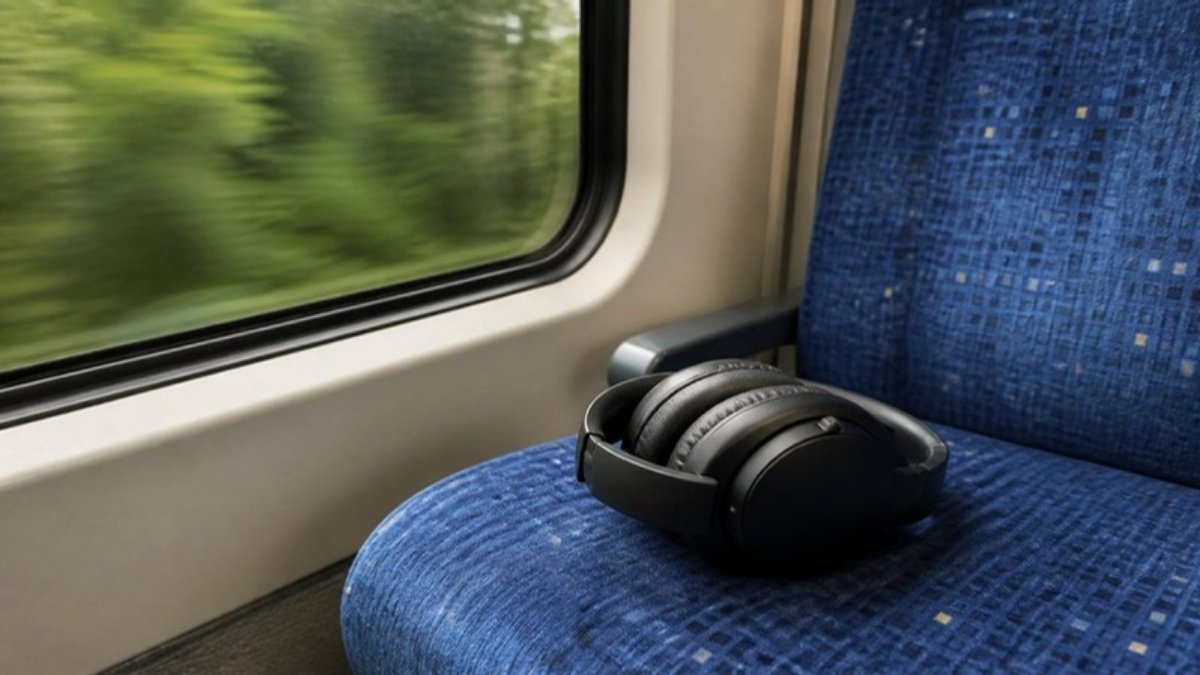
Short answer: no, and the worry has the physics backwards. Active noise cancellation produces a sound wave that is the inverse of the incoming noise, so the two cancel and less sound energy reaches the eardrum, not more. Hearing damage is a function of how loud and for how long: the WHO's safe-listening standard puts the weekly allowance at about 80 decibels for 40 hours, and every 3 dB louder halves the time. Headphones can hit 100 dB or more at full volume, and the reason people push them there is to hear music over a train or a plane. Cancelling removes the reason. The pressure feeling some people get is real and harmless, and the claim that cancelling causes "auditory processing disorder" has no study behind it.
The thing to be afraid of is the volume you choose. Cancelling is the feature most likely to lower it.
What noise cancelling does to the sound at your ear
There are two ways headphones reduce outside noise, and they get confused.
Passive isolation is a physical barrier: a sealed earcup or a well-fitting earbud tip. It blocks high frequencies well and low frequencies poorly, which is why voices drop away and the bus engine does not.
Active noise cancellation adds a microphone and a chip. The microphone picks up the incoming noise, the chip generates the same waveform inverted, and the speaker plays it. Where the two meet, at the eardrum, they sum to something close to silence. It works best on steady, low-frequency sound, engines, air conditioning, road hum, because those are predictable enough to invert in real time, and it does relatively little for sudden or high-pitched sounds, which is why a crying baby comes through and the drone does not.
The important point for hearing: the anti-noise is not "extra sound" that you also hear. Sound is pressure, and the two pressure waves cancel physically. A sound-level meter placed at the ear position under a good ANC headset in a loud environment reads lower with cancelling on. The eardrum is exposed to less, not more.
What actually damages hearing
Permanent hearing loss and tinnitus from noise come from the dose: intensity multiplied by time, delivered to the hair cells of the inner ear. The reference standards are consistent about the shape of the risk.
| Standard | Limit | Time at that level | Note |
|---|---|---|---|
| NIOSH occupational | 85 dB(A) | 8 hours a day | 3 dB exchange rate: 88 dB for 4 h, 91 dB for 2 h, 94 dB for 1 h, 100 dB for 15 minutes |
| WHO-ITU safe listening, adults | 80 dB(A) | 40 hours a week | Same exchange rate; a personal listening budget rather than a workplace one |
| WHO-ITU, sensitive users and children | 75 dB(A) | 40 hours a week | — |
Sliwinska-Kowalska and Zaborowski's systematic review for the WHO environmental noise guidelines found the evidence for permanent hearing loss from environmental and leisure noise consistent with those occupational dose–response relationships: the mechanism is the same whether the source is a factory or an earbud.
Where headphones sit on that scale is the point. Fligor and Cox (2004) measured portable players with a range of headphones and found maximum outputs from roughly 90 to over 120 dB(A), with earbud-style headphones reaching higher levels than over-ear ones at the same volume setting. Modern phones and earbuds are capped in some markets, but 100 dB at maximum is typical, and at 100 dB the safe budget is about 15 minutes a day.
Every 3 decibels doubles the sound energy and halves the safe exposure time. At 100 dB, the allowance is a quarter of an hour.
Derived from the NIOSH 3-dB exchange rate and the WHO-ITU safe listening standard
Why people listen too loud, and what cancelling changes
Nobody sets the volume to 100 dB in a quiet room. They set it there on the underground, in a plane, on a busy street, because music at 70 dB is inaudible over background noise at 80. Portnuff's review of why people overuse portable listening devices identifies exactly this: the volume people choose tracks the noise around them, and the highest levels are chosen in the loudest environments.
An aircraft cabin runs at a median of about 85 dB(A) across a flight, in the measurement study of 200 flights by Zevitas and colleagues, and the underground is often louder. To hear music at a normal signal-to-noise ratio over 85 dB of engine, people push the headphones to 95 or 100. That is the hearing-damage scenario, and it has nothing to do with the cancellation circuit.
Turn cancelling on and the background at the ear drops by 20 to 30 dB in the low frequencies. Music at 70 dB is now audible. The listener turns the volume down, or never turns it up. That is the mechanism by which ANC protects hearing, and it is the reason audiologists generally recommend cancelling or well-isolating headphones for commuters rather than warning against them.
| Situation | Without cancelling | With cancelling |
|---|---|---|
| Quiet room | Music at 60–70 dB; no risk either way | Same |
| Busy street, 75–80 dB background | Volume pushed to 85–90 dB to hear | Background at ear ~60 dB; music at 70–75 dB suffices |
| Underground or plane, 85+ dB | Volume pushed to 95–100 dB; damage territory within an hour | Background at ear ~60–65 dB; music at 75–80 dB suffices |
| Gym, open office | Middle | Middle; isolation matters more than ANC for voices |
The pressure feeling
Many people notice a sensation of pressure or "fullness" when cancelling switches on, similar to the feeling before ears pop on a plane. It is real, it is not pressure, and it is not harmful.
The ear detects pressure changes partly through low-frequency sound. Cancelling removes the low-frequency ambient noise your ears have been hearing continuously, and the brain interprets the sudden absence of that input the way it interprets a pressure change. Nothing has physically changed in the ear canal; a barometer next to the eardrum would read the same. The sensation fades for most people within days of regular use as the brain recalibrates, and for a minority it never stops being uncomfortable, which is a reason not to use ANC, not a sign of injury.
The auditory processing rumour
A claim circulated in 2024 and 2025 that heavy use of noise-cancelling headphones might cause auditory processing disorder, a condition in which hearing is normal on a hearing test but the brain struggles to make sense of sound, particularly speech in noise. The claim came from a small number of clinicians describing a handful of young patients and wondering aloud about a connection.
There is no study. No trial, no cohort, no case series with controls. The hypothesis, that a brain deprived of background noise loses practice at filtering it, is not absurd, and it is also not evidence. Auditory processing difficulties in young adults have many established associations, including attention disorders and prior ear infections, and the rise in diagnoses tracks the rise in awareness of the condition. Until somebody measures it, the honest statement is that no link has been shown, and that the well-established harm, loud music over background noise, runs in the opposite direction.
What is actually worth doing
Use the volume limit in the phone. Both major platforms have a headphone safety setting that caps output or warns at a chosen level. Set it at the WHO figure, around 80 dB, and leave it.
Turn cancelling on in loud places and then check the volume. If it was set for the noise, it is now too high. Many people find their commuting volume falls by a third once they stop fighting the engine.
Use the 60/60 heuristic if you have no meter: no more than 60% of maximum volume for no more than 60 minutes at a stretch. It is crude and it is in the right region.
Prefer over-ear or well-sealed in-ear for loud commutes. Isolation plus cancellation is the most effective combination; open earbuds with no seal let the noise in and invite the volume up.
Give the ears quiet time. Hair cells recover from moderate exposure with rest; continuous listening all day, even at moderate levels, uses the weekly budget.
Take ringing seriously. Tinnitus or muffled hearing after listening is a sign the dose was too high. Once, it usually recovers. Repeatedly, it does not.
If ANC is uncomfortable, use isolation only. The pressure sensation is harmless but there is no reason to endure it; passive isolation with the volume kept sensible achieves most of the same protection.
Questions people ask
Does noise cancelling damage hearing? No. Active noise cancellation reduces the sound energy reaching the eardrum by generating an inverted wave that cancels the incoming noise. Hearing damage comes from loud listening over time, which cancelling makes less likely by removing the reason to turn the volume up.
Is it bad to wear noise-cancelling headphones all day? Not because of the cancelling. Wearing headphones all day is a concern only if the volume is high; at moderate levels the weekly WHO allowance of 80 dB for 40 hours is not exceeded. Give the ears some quiet time regardless.
Why do noise-cancelling headphones feel like pressure in my ears? Because the brain reads the sudden absence of low-frequency background sound as a pressure change, as on a plane. No physical pressure changes in the ear; the sensation usually fades with use and is not harmful.
Can noise-cancelling headphones cause auditory processing disorder? No study has shown this. The claim comes from a few clinical anecdotes reported in 2024–2025 and has no cohort or trial behind it. The well-documented hearing risk from headphones is loud volume, which cancelling reduces.
What volume is safe for headphones? The WHO safe-listening standard is about 80 dB for up to 40 hours a week for adults, 75 dB for children. Each 3 dB above that halves the safe time; at 100 dB, roughly the maximum of many headphones, the daily allowance is about 15 minutes.
Are noise-cancelling headphones better for your ears than regular ones? In noisy environments, yes, because they let you listen at a lower volume. In a quiet room they make no difference to hearing either way.
Do noise-cancelling headphones emit anything harmful? No. They emit sound, the same as any headphone, at the level you set. The anti-noise signal cancels rather than adds, and there is no radiation or frequency involved beyond ordinary audio.
Can noise cancelling cause headaches or dizziness? Some people report discomfort, headache or mild disorientation from the pressure sensation, especially at first. It is a sensory effect, not damage, and it resolves on removing the headphones. If it persists, use passive isolation instead.
Is noise cancelling safe for children? The cancellation is safe; the volume is the concern, and the WHO's lower limit of 75 dB applies. Volume-limited children's headphones with a 85 dB cap are the usual recommendation, with cancelling as a bonus that reduces the temptation to turn it up.
How loud is too loud for headphones? If someone next to you can hear your music, or if you cannot hear someone speaking at normal volume an arm's length away, the level is above about 85 dB and the safe time is short. Ringing or muffled hearing afterwards means it was too loud.
This article covers hearing health for general information and is not medical advice. Persistent tinnitus, sudden hearing loss, or difficulty following speech in noise should be assessed by an audiologist or doctor.
References
- World Health Organization (2019). Safe listening devices and systems: a WHO-ITU standard. who.int
- National Institute for Occupational Safety and Health (1998). Criteria for a Recommended Standard: Occupational Noise Exposure. DHHS (NIOSH) Publication No. 98-126. cdc.gov/niosh
- Sliwinska-Kowalska, M., & Zaborowski, K. (2017). WHO Environmental Noise Guidelines for the European Region: A Systematic Review on Environmental Noise and Permanent Hearing Loss and Tinnitus. International Journal of Environmental Research and Public Health, 14(10), 1139. doi:10.3390/ijerph14101139
- Fligor, B.J., & Cox, L.C. (2004). Output Levels of Commercially Available Portable Compact Disc Players and the Potential Risk to Hearing. Ear and Hearing, 25(6), 513–527. doi:10.1097/01.aud.0000145992.31456.b2
- Portnuff, C.D.F. (2016). Reducing the risk of music-induced hearing loss from overuse of portable listening devices: understanding the reasons for listening. Medical Devices: Evidence and Research, 9, 27–35. doi:10.2147/MDER.S74000
- Zevitas, C.D., Spengler, J.D., Jones, B., et al. (2018). Assessment of noise in the airplane cabin environment. Journal of Exposure Science & Environmental Epidemiology, 28(6), 568–578. doi:10.1038/s41370-018-0027-z
The weekly readout
One email each Thursday: what we tested, which claim collapsed under a closer look, and the one number worth paying attention to.