

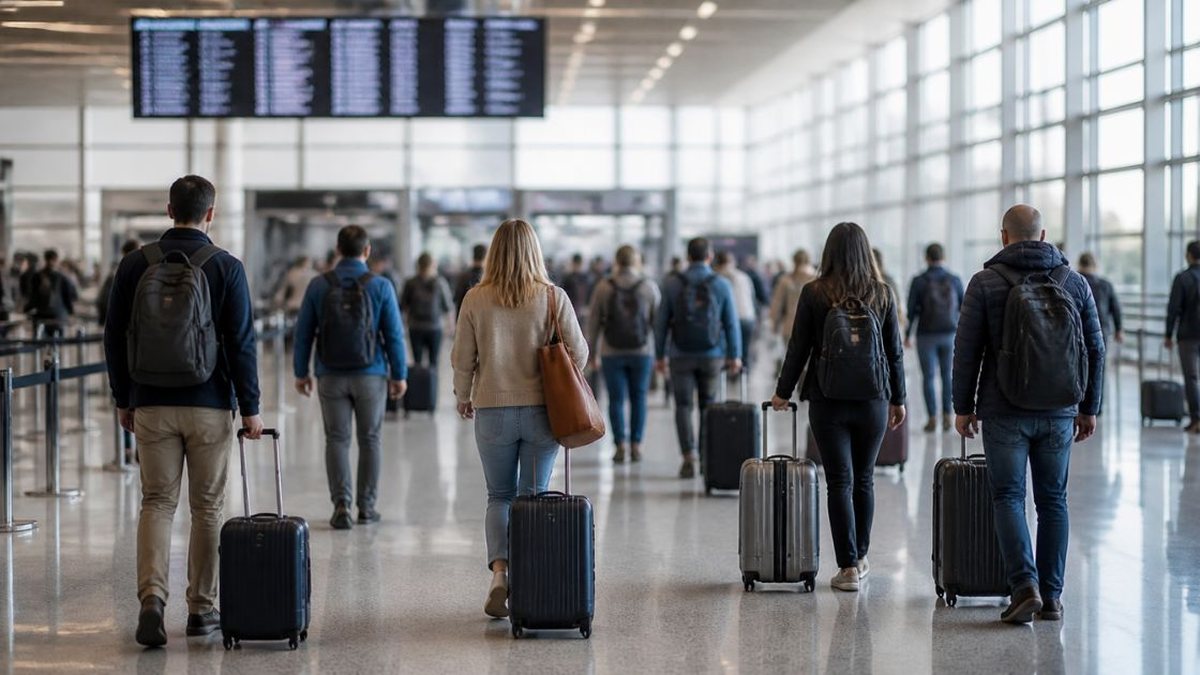
Short answer: how early should I get to the airport? The 2 hours domestic, 3 hours international advice comes from American and Delta, and it is a buffer, not a rule. The enforced deadlines are shorter: a checked bag must be dropped 45 minutes before a domestic departure at American, Delta and Southwest, and Delta wants you at the gate 15 minutes out. Security is the variable. TSA says about 99% of PreCheck passengers wait under 10 minutes. Plan backward from those numbers.
The two-hour figure sounds like a regulation. It is not. Nobody checks when you walked through the doors. The airline checks whether you were checked in, whether your bag reached the counter, and whether you were at the gate, each by a specific minute. Everything else is travel between those deadlines plus a margin for bad luck.
Where "two hours, three hours" comes from
The round numbers are the airlines' own. American Airlines' check-in page recommends arriving at least 2 hours ahead within the US and at least 3 hours ahead outside it. Delta says the same for domestic flights ("at least 2 hours prior to departure") and suggests at least 3 hours for international ones.
The TSA itself does not give a number. Its FAQ says only that travelers should allow time for parking or shuttle transportation, airline check-in, getting a boarding pass and going through security, and that "times may vary depending on the airport and date of travel," so travelers are encouraged to contact the airline.
The recommendation is one figure meant to cover nearly everyone, from first-time flyers to families with four bags at the busiest hub. For most others it is generous.
The deadlines that actually decide whether you fly
There are three hard constraints, and they are published:
- Check-in cutoff. The latest point at which the airline will check you in, online or at the airport.
- Bag-drop cutoff. The latest point at which a checked bag will be accepted. Usually the same as or earlier than check-in.
- Gate deadline. The time by which you must be at the gate, after which your seat can be given away and the door closed.
Here is what four large US airlines say for domestic and international flights.
| Airline | Domestic check-in cutoff | Domestic bag-drop cutoff | International check-in / bags | Gate or boarding deadline |
|---|---|---|---|---|
| American | 45 min at the airport; online check-in closes 45 min out | 45 min | 60 min; 75 min at most listed international airports; online check-in closes 90 min out | Boarding ends 15 min before departure; no boarding once doors close |
| Delta | 30 min without bags | 45 min | 1 hour; 75 min required at most listed international airports | At the gate 15 min before (domestic); 45 min recommended (international) |
| Southwest | 30 min | 45 min | 60 min (75 min from Aruba) | In the gate area at least 10 min before departure |
| United | 45 min without bags since June 2025 (as reported; not confirmed on United's own page) | 45 min (as reported) | 60 min (as reported) | Not confirmed |
All of these count from scheduled departure, not boarding. Southwest says a late check-in means you "will need to be rebooked on the next available flight," and that a passenger not in the gate area by the 10-minute mark may have the reservation canceled. American says that once the doors close, you will not be allowed to board.
Some exceptions catch people out. Delta lists longer domestic cutoffs at some airports, including 60 minutes with checked bags at New York JFK and 90 minutes at St. Thomas. Its international table requires 120 minutes at Athens and Accra, and recommends arriving 4 hours early at Dublin. American lists 90 minutes at several Caribbean and Venezuelan airports.
There is also a limit at the other end. Arriving very early with a bag does not always help. American will not accept checked bags more than 4 hours before departure at a list of airports that includes Denver, Las Vegas, Phoenix, Seattle and Salt Lake City; the limit is 6 hours at Honolulu and Orlando and 8 hours at Newark. Delta will not accept checked bags more than 6 hours before a domestic departure.
Security is the variable
Check-in can be done on a phone a day ahead. Security is the one stage whose length you do not control. TSA's own description of normal is useful as a planning figure. In a January 2019 statement, during a period of staffing strain, it described "normal TSA times of 30 minutes for standard lanes and 10 minutes for TSA Pre✓." On that day, it reported, 99.1% of passengers waited less than 30 minutes and 94.3% less than 15 minutes. Those figures are from 2019 and from one day; they show the scale TSA considers normal, not what you will find at your airport this year.
For PreCheck, TSA's current enrollment page makes a stronger claim: "About 99% of TSA PreCheck passengers wait less than 10 minutes." That is TSA's own figure about its own program, with no stated period or method on the page, so read it as a typical-day number rather than a guarantee for the Sunday after Thanksgiving. Enrollment costs $77.95 to $85 depending on the provider, per the same page.
For a specific airport and time, TSA points to its MyTSA app, which shows "how busy the airport is likely to be on your specific day and time of travel based on historical data." Southwest also notes that many airports post live security wait times on their own websites. Neither is a promise, but both are better than a national rule of thumb.
One newer source of delay is ID. REAL ID enforcement began on May 7, 2025, and TSA's page says passengers without acceptable identification will not be allowed through the checkpoint. Since February 1, 2026, travelers without a REAL ID or other accepted ID can pay a $45 fee for TSA's ConfirmID identity check; NBC News and Travel Agent Central reported that the process can take up to 30 minutes at the checkpoint, and that TSA advises paying before arriving at the airport. If that applies to you, add the half hour.
How early to get to the airport for a domestic flight
Working backward is simple arithmetic. Start at the departure time and subtract:
- The gate deadline. 15 minutes at Delta and American, 10 at Southwest.
- Security. Up to 30 minutes in a standard lane on a normal day by TSA's own description; about 10 with PreCheck.
- Walking. Curb to checkpoint and checkpoint to gate. This depends on the airport; a small regional terminal is minutes, a large hub with a train between concourses can be much longer. The table below assumes 15 minutes in total. That is this article's assumption, not a published figure.
- A checked bag, if any. The bag must be at the counter 45 minutes before departure, and there may be a line to get there.
- A margin. For a wrong turn, a slow shuttle, a long line. How large depends on what missing the flight would cost you.
For a carry-on-only domestic trip in a standard security lane, that gives roughly 15 + 30 + 15 = 60 minutes before departure, before any margin. Add 15 to 30 minutes of margin and you arrive 75 to 90 minutes out, which is comfortably inside every published cutoff. The two-hour recommendation leaves you 30 to 45 minutes more than that on a normal day.
With a checked bag, the bag cutoff becomes the controlling constraint. You need to be at the counter well before 45 minutes, then still clear security and reach the gate by the 15-minute mark. Arriving 90 minutes out leaves about 45 minutes for the bag line before the cutoff; arriving at 60 minutes leaves almost nothing if the line is long.
How early should I get to the airport? By situation
The figures in the "This article's arithmetic" column are calculations from the published cutoffs above, TSA's normal-wait figures and the 15-minute walking assumption. They are not airline policy.
| Situation | Hard constraint | Variable | Airlines recommend | This article's arithmetic |
|---|---|---|---|---|
| Domestic, carry-on only | Check-in 30 to 45 min; gate 10 to 15 min | Standard security, up to ~30 min on a normal day | 2 hours | 75 to 90 min; 90+ at a large hub |
| Domestic, checked bag | Bag drop 45 min | Bag line, then security | 2 hours | 90 min to 2 hours |
| Domestic, PreCheck, carry-on only | Same as above | ~10 min (TSA: 99% wait under 10) | 2 hours | About 60 min |
| International | Check-in 60 to 75 min (more at some airports); gate 45 min recommended at Delta | Document check at the counter, then security | 3 hours | 2.5 to 3 hours; follow airport-specific notes |
| Holiday peak (Thanksgiving Sunday, late December) | Unchanged | Longer lines, full parking, fuller flights with fewer rebooking options | 2 hours (domestic) | Add 30 to 60 min to the rows above |
The PreCheck row assumes no bag. A PreCheck traveler who checks a bag is back to the bag-drop constraint and should plan as for the checked-bag row, minus a little security time.
How early with only a carry-on
This is the case where the two-hour rule is most conservative. Without a bag, there is no counter to visit: check in online, put the boarding pass on a phone, and the only stages left are security and the walk. Delta's and Southwest's check-in cutoff for travelers without bags is 30 minutes, though that rarely matters once you have checked in online. Note that American's online check-in also closes 45 minutes before departure, and United was reported in 2025 to have moved its no-bag domestic cutoff from 30 to 45 minutes.
A carry-on-only traveler at a mid-size airport on a weekday can plan on about 75 to 90 minutes. The bigger risk is the trip to the airport.
Do I really need 3 hours for an international flight?
Often less, sometimes more. The hard numbers are longer than for domestic flights: American's international check-in and bag cutoff is 60 minutes, 75 at most of the international airports it lists, and Delta requires check-in at least 1 hour before departure and recommends being at the gate 45 minutes out.
From a US airport with a short check-in line, 2.5 hours is often enough. From some foreign airports, three is too little: Delta's own table recommends four hours at Dublin and 3.5 hours at Naples. The airline's airport-specific notes are the place to look. For long trips, also think about what happens after landing; the jet lag recovery calculator is more useful planned before departure than after.
Thanksgiving and December: what TSA's own records show
Holiday peaks are where the variable gets large, and TSA's screening counts show why. On Sunday, November 30, 2025, the Sunday after Thanksgiving, TSA said it screened about 3,133,924 people, the busiest day in its history, according to TravelPulse. The Hill reported the previous record as about 3.09 million, set on June 22, and noted that the third-busiest day on record was the Sunday after Thanksgiving of the year before. TravelPulse reported that all ten of TSA's busiest days now exceed 3 million travelers and that eight of them were in 2025.
The December holidays are spread over more days. TSA's forecast for the 2025 season, reprinted by Homeland Security Today, expected about 44.3 million travelers at checkpoints between December 19, 2025 and January 4, 2026, with the busiest day expected on Sunday, December 28, at about 2.86 million. It listed December 19, 20, 21, 27 and 29 as other heavy days. The 2024 peak had been Friday, December 27, at just under 2.85 million.
| Peak | TSA figure | Source |
|---|---|---|
| Sunday after Thanksgiving, Nov. 30, 2025 | About 3,133,924 screened, all-time record | TSA, via TravelPulse |
| Previous record, June 22 | About 3.09 million | The Hill |
| Dec. 19, 2025 to Jan. 4, 2026 | About 44.3 million forecast | TSA release, via HSToday |
| Busiest forecast December day, Sun. Dec. 28, 2025 | About 2.86 million | TSA release, via HSToday |
These counts do not say how long the lines were. What clearly changes on those days is the margin for error: parking fills, roads around the airport back up, and a missed flight is harder to fix because the next ones are full. That is the argument for adding 30 to 60 minutes on the Sunday after Thanksgiving and the days around Christmas, even with PreCheck. Sleeping on the plane is also easier if the airport part was not a sprint.
Can I arrive 1 hour before a flight?
Sometimes, and it is worth being honest about which times. With no checked bag, a boarding pass on your phone, PreCheck or a short standard line, and a small or familiar airport, one hour clears every published domestic cutoff. With a checked bag, one hour puts you 15 minutes from the bag cutoff on arrival at the terminal, which is too tight if there is any line.
The most-cited personal data on this is from the forecaster Nate Silver, who wrote in 2025 that he had tracked about 800 flights over 15 years and missed 3 or 4 of them because of lateness, roughly 0.5%, mostly from misjudging the trip to the airport rather than the time inside it. His baseline is 60 minutes from the terminal doors to departure for a domestic flight with expedited security and no checked bag, plus 20 minutes for a checked bag, 20 for regular security and 30 for holiday peaks in a regular lane.
That is one traveler's record, not a study. He flies mostly from New York with airline status and expedited screening, and says travelers with fewer backup flights should budget more. It shows one hour can work for a certain kind of traveler, not that it works for everyone.
A note for Canada
Canada's screening agency, CATSA, cited airline advice in a 2025 advisory: two hours for domestic flights and three for US and international ones. CATSA does not say why US flights get the longer figure, but preclearance is a likely reason. US Customs and Border Protection runs preclearance at 15 locations in 6 countries, including nine Canadian airports, among them Calgary, Edmonton, Toronto and Vancouver. Travelers to the US from those airports clear US customs and immigration before departure, an extra line between security and the gate.
What people forget to count
- The trip to the terminal. Silver's misses came mostly from here. Parking lots with shuttles, rental car returns and airport roads on holiday weekends all take longer than the map says.
- Slower travelers. Strollers, car seats and anyone who needs help add time; Silver's planning sheet has a setting for this.
- ID. No acceptable ID means no checkpoint, and ConfirmID can add up to 30 minutes.
- Arriving too early with a bag. Some airports will not take a bag more than four or six hours ahead.
- The flight itself. Arriving calm leaves time to fill a water bottle after security (see whether flying dehydrates you) and to walk before a long sit, which matters for ankle swelling on flights.
Questions people ask
How early should I get to the airport? American and Delta recommend 2 hours for domestic flights and 3 for international. Those are buffers. The enforced deadlines are shorter: 45 minutes to check a domestic bag at American, Delta and Southwest, and 10 to 15 minutes to be at the gate. Most domestic travelers without bags are comfortable arriving 75 to 90 minutes ahead on a normal day.
How early should I get to the airport for a domestic flight? Work backward. Be at the gate 15 minutes before departure at Delta and American, allow up to 30 minutes for a standard security lane, which TSA has described as normal, and add time to walk and a margin. That gives about 75 to 90 minutes without a bag and 90 minutes to 2 hours with one.
Do you really need to be at the airport 2 hours early? Not usually, if you have no checked bag, have checked in online and know the airport. The two-hour figure is the airlines' recommendation, meant to cover nearly every situation. It is sensible for first-time flyers, families with bags, large hubs and holiday peaks, and generous otherwise.
Do I really need 3 hours for an international flight? Often 2.5 hours is enough from a US airport. International cutoffs are longer: 60 minutes for check-in and bags at American and Southwest, 75 at many listed airports, and Delta recommends being at the gate 45 minutes out. Some airports need more; Delta recommends 4 hours at Dublin.
Can I arrive 1 hour before a flight? For a domestic flight with no checked bag, a mobile boarding pass and PreCheck or a short line, usually yes. One hour still clears every published cutoff. With a bag, it leaves about 15 minutes before the 45-minute bag-drop deadline, which is too tight if there is a line. It is a poor plan on holiday peaks.
How early should I get to the airport with only a carry-on? About 75 to 90 minutes before a domestic departure in a standard security lane, and about an hour with PreCheck. There is no bag-drop deadline to meet, so the constraints are security, the walk and the gate deadline of 10 to 15 minutes. Check in online first; some cutoffs are 45 minutes.
How early should I get to the airport with TSA PreCheck? About an hour for a domestic flight without a checked bag. TSA says about 99% of PreCheck passengers wait less than 10 minutes. PreCheck does nothing for the bag-drop deadline, so a PreCheck traveler checking a bag should still plan around the 45-minute cutoff and its line.
How early should I get to the airport for Thanksgiving? Add 30 to 60 minutes to your normal plan, and more on the Sunday after Thanksgiving. TSA screened about 3.13 million people on November 30, 2025, its busiest day on record. Parking and airport roads fill up on those days, and full flights make a missed connection hard to rebook.
What happens if I miss the check-in or bag cutoff? The airline can refuse to check you in or take the bag. Southwest says travelers who check in late will need to be rebooked on the next available flight, and may have the reservation canceled if they are not in the gate area 10 minutes before departure. American says no one boards once the doors close.
How early should I get to Calgary airport for a US flight? CATSA cites airline advice of three hours for US and international flights and two for domestic ones. Calgary is one of nine Canadian airports with US preclearance, so US-bound travelers clear US customs and immigration before boarding, which adds a line after security.
This article summarizes published airline policies and TSA and CATSA guidance for general information. Cutoffs differ by airline, airport, route and fare, and they change; check your airline's current check-in page and your departure airport's website before you travel.
References
- Transportation Security Administration. Frequently Asked Questions (General Screening: arrival time and the MyTSA app). tsa.gov
- Transportation Security Administration. TSA PreCheck. tsa.gov
- Transportation Security Administration. MyTSA Mobile App. tsa.gov
- Transportation Security Administration. (2019, January 15). TSA statement on checkpoint operations for January 15. tsa.gov
- Transportation Security Administration. REAL ID. tsa.gov
- American Airlines. Check-in and arrival. aa.com
- American Airlines. Boarding process. aa.com
- Delta Air Lines. Domestic Check-in Requirements. delta.com
- Delta Air Lines. International Check-in Requirements. delta.com
- Southwest Airlines. Airport arrival recommendation. southwest.com
- Canadian Air Transport Security Authority. (2025, February 28). CATSA March Break travel tips. catsa-acsta.gc.ca
- U.S. Customs and Border Protection. Preclearance. cbp.gov
- TravelPulse. Thanksgiving 2025 Breaks TSA's All-Time Daily Traveler Record. travelpulse.com
- The Hill. (2025, December 1). TSA sets new screening record. thehill.com
- Homeland Security Today. TSA Prepares for Holiday Travel Season to Cap Record Year. hstoday.us
- NBC News. No REAL ID yet? You can still fly, but it may cost $45 without another form of accepted ID. nbcnews.com
- Lopez, G. (2025, May 27). United is enforcing a new check-in time rule. Time Out. timeout.com
- Silver, N. (2025). I've tracked my last 800 flights. Here's when you really need to get to the airport. Silver Bulletin. natesilver.net
The weekly readout
One email each Thursday: what we tested, which claim collapsed under a closer look, and the one number worth paying attention to.