

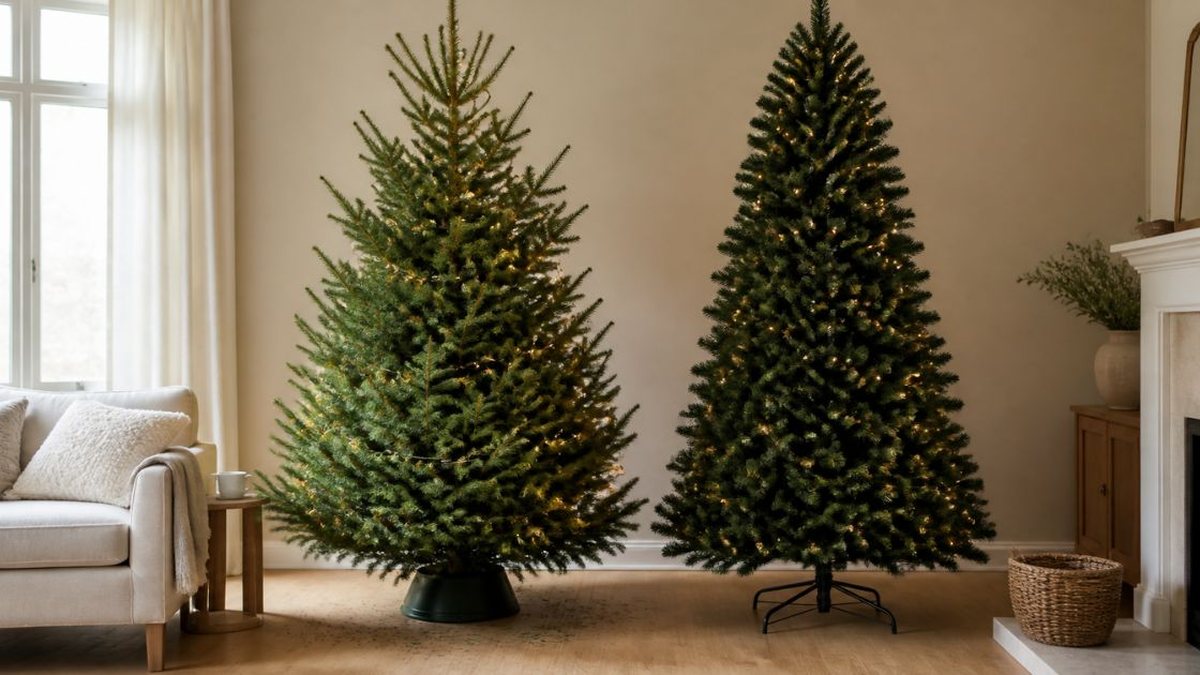
Short answer: in the real vs fake Christmas tree question, an artificial tree beats buying a real tree each year only if it is kept long enough. How long: 4.7 years in a 2018 study paid for by the artificial-tree industry, about 20 years in a 2009 Canadian study, 7 to 20 years per the Carbon Trust. Disposal matters almost as much: UK figures put a landfilled real tree at 16 kg of emissions and a chipped one at 3.5 kg.
Both options are small next to a household's annual footprint, but the question has an answer, and it is a number of years.
Real vs fake Christmas tree: why it is a break-even calculation
A real tree is grown, cut, trucked to a lot, driven home and disposed of, every year. An artificial tree is made once, mostly from PVC and steel, shipped once, and then reused. So the real tree's footprint is a yearly cost, and the artificial tree's is an upfront cost spread over however many seasons it lasts.
That turns the comparison into simple arithmetic:
Break-even years = footprint of one artificial tree ÷ yearly footprint of a real tree
Every study below is an estimate of the two terms in that fraction, and the assumptions move the answer more than the tree does.
The studies, and who paid for them
Four life-cycle figures dominate the coverage. We could open the summaries and secondary accounts below; we could not open the full Ellipsos or WAP reports themselves, and say so where it matters.
| Study | Who paid or commissioned | Setting | Real tree's end of life | Break-even for artificial tree (climate) |
|---|---|---|---|---|
| Ellipsos (2009), Montreal | Described in its press release as independent; no client named. Peer reviewed to ISO 14040/14044 | 7 ft trees; real tree grown 150 km away; artificial made in China, shipped to Vancouver, railed to Montreal | Burned for energy | About 20 years |
| PE Americas (2010) | Under contract with the American Christmas Tree Association (artificial-tree industry) | 6.5 ft Fraser fir vs tree made in Guangdong, China | Landfill, compost or incineration modeled | Real always better at a 2.5 mi one-way trip; 9 years at 10 mi (landfill); 4 years if composted or incinerated |
| WAP Sustainability (2018) | American Christmas Tree Association | US; extra shopping trip assumed for both trees | Modeled; largest source of the real tree's emissions | 4.7 years |
| Carbon Trust (UK) | Carbon Trust; current page cites no underlying study | 2 m tree | Landfill vs chipping | 7 to 20 years, "depending on the weight and materials used" |
Sources: Dovetail Partners review (Bowyer et al., 2018) for Ellipsos assumptions and PE Americas; Ellipsos press release; Cregg (2018) and Taylor (2020) for WAP; Carbon Trust (2023).
Ellipsos, 2009: about 20 years
The Montreal firm Ellipsos compared one 7-foot artificial tree, kept for 6 years (the average from a North American survey, according to the Dovetail review), with six real trees. Its press release gives 3.1 kg of greenhouse gases for the natural tree and 8.1 kg per year for the artificial one, and concludes the artificial tree "would need to be kept for at least 20 years to be equivalent". Most of the artificial tree's emissions came from manufacture in China and shipping, according to Purdue Extension's summary.
Two cautions. First, the per-year figures alone would put break-even nearer 16 years (8.1 × 6 ÷ 3.1); we could not open the full report to see what closes the gap to 20. Second, climate was one of 15 impact categories: artificial trees had the larger impact in seven, real trees in seven, and one was about equal. Per Purdue's summary, real trees did worse on ecosystem quality, mostly from land use, fertilizer and pesticides. And the study's own sensitivity test cut the other way: if the drive from the lot to home was 10 miles rather than 3, the artificial tree came out ahead after 6 years.
PE Americas, 2010, and WAP Sustainability, 2018: about 5 years
Both were done for the American Christmas Tree Association, which, as Michigan State University horticulturist Bert Cregg puts it, "represents artificial tree manufacturers". That does not make the numbers wrong, but readers should know it, and the industry's own headline figure is the low end of the range.
The 2018 WAP Sustainability report found a "breakeven point between the two trees" of 4.7 years, as quoted by economist Timothy Taylor. For the artificial tree, PVC "followed by steel sheets" was the largest source of impacts. For the real tree, the end-of-life phase contributed the most greenhouse gas emissions, which the report itself linked partly to modeling decisions about carbon taken up during growing. Cregg's main criticism is that the study ignored tree roots, which keep storing carbon in the soil after harvest, and that this "could significantly change the break-even analysis".
The earlier PE Americas study shows how much the disposal assumption moves things, and in a direction that surprises people. With real trees sent to landfill, it treated the buried wood as stored carbon, so the real tree looked good: at a one-way trip of 2.5 miles or less, the real tree always won on global warming potential. When real trees were composted or incinerated instead, break-even fell to 4 years.
The Carbon Trust: 7 to 20 years
The Carbon Trust's current page (November 2023) says an artificial tree is the lower-emission choice when "used over multiple years (7-20 years, depending on the weight and materials used)". It gives no study or kilogram figures. The often-quoted kilogram numbers are covered in the next section.
An independent review: 15 to 20 years
The Dovetail Partners review (2018), which summarized the published studies, concluded that artificial trees must stay in service 15 to 20 years to match real trees on global warming potential, or 4 to 6 years when a broader set of indicators is counted. The report does not say who funded it.
The disposal choice matters as much as the tree type
The kilogram figures quoted in most British coverage are these: a 2 m artificial tree, about 40 kg of greenhouse gas emissions; a 2 m real tree without roots that goes to landfill, 16 kg; the same tree chipped and spread, or planted, 3.5 kg. Euronews attributes the 40 kg and 3.5 kg figures to the Carbon Trust; a UK district council page gives all three, without naming a source, and attributes to the Carbon Trust the line that an artificial tree needs "ten Christmases or more". We could not find the kilogram figures on the Carbon Trust's current page, which says only that chipping can reduce a tree's footprint "by up to 80%". That is consistent with the step from 16 to 3.5 kg, a 78% drop.
The reason is methane. A tree rotting in landfill produces it, and the Carbon Trust calls methane "25 times more potent than carbon dioxide" (Cregg uses an older 21 times). Burning or chipping returns the tree's carbon as carbon dioxide, which the Carbon Trust treats as no net increase because the tree absorbed it while growing.
Put those figures into the break-even fraction and the disposal choice becomes visible. The driving row uses the EPA's figure of about 400 g of CO2 per mile for an average passenger vehicle, for a 10-mile round trip to buy the tree.
| Real tree scenario (2 m tree) | Real tree, per year | Years for a 40 kg artificial tree to break even |
|---|---|---|
| Landfilled | 16 kg | 2.5 |
| Chipped or planted | 3.5 kg | 11.4 |
| Landfilled, plus a 10-mile round trip (4 kg) | 20 kg | 2.0 |
| Chipped, plus a 10-mile round trip (4 kg) | 7.5 kg | 5.3 |
Our arithmetic from the figures above. Assumptions: the 40 kg covers the artificial tree's manufacture and delivery but not its own disposal, and the artificial tree needs no yearly trip. Treat the results as orders of magnitude.
The same artificial tree pays off in two or three years against a landfilled real tree and in more than a decade against a chipped one. That is why "it depends what you do with it in January" is not a dodge. It is the largest single lever after the tree's lifespan, and it is free: most US cities run curbside or drop-off tree collection that chips the trees into mulch.
The trip matters too. A 10-mile round trip emits about 4 kg of CO2, more than the chipped tree itself. Cregg notes that driving 10 miles each way may release about as much carbon dioxide as the tree absorbed.
The lights can outweigh the tree
The PE Americas study also modeled the lights. Running 400 incandescent bulbs for a season produced 1.5 to 3.5 times the carbon emissions of a real tree's whole life cycle, according to the Dovetail review; LED strings produced about one-fifth of the incandescent figure. For anyone still using old incandescent strings, switching to LEDs is likely a bigger cut than the choice of tree. The same logic of small standing loads is covered in whether unplugging appliances saves electricity.
What the farm numbers say
Most real trees in the US come from farms, not forests. The 2022 Census of Agriculture counted 292,050 acres in cultivated Christmas trees on 16,612 farms, with 14.5 million trees cut by 10,121 farms and sales of $552.9 million. That was slightly fewer trees cut than in 2017 (15.1 million).
Purchase figures run higher and vary by who is counting. The National Christmas Tree Association, the growers' trade group, projects from its own 2,000-person consumer survey that 21.58 million real trees were bought in 2023. Its page does not explain the gap with the Census count. The Nature Conservancy says about 30 million trees are harvested each year and about 10 million artificial trees are bought each season, without giving sources. We treat the USDA count as the firm number and the rest as estimates.
Growing time also varies. Cregg gives six to seven years; the industry-funded Real Christmas Tree Board, overseen by USDA and funded by assessments on growers and importers, says eight to 10 years. The Ellipsos tree spent 4 years in a nursery and 11 in the field, while Purdue Extension notes Indiana trees more typically take about 2 and 7, which would lower the real tree's footprint relative to the Montreal case. The Board also says growers plant at least one tree for every tree harvested; that is an industry claim we could not check independently.
A tree-sized conifer stores roughly 20 pounds of CO2 above ground, according to Cregg, and probably similar amounts in roots. The above-ground share returns to the air after disposal, as CO2 if chipped or burned, partly as methane if landfilled.
Artificial trees: PVC, China and the end of life
The life-cycle studies model artificial trees as PVC and steel, and the WAP report names PVC as the largest single source of their impacts. The Dovetail review says "the vast majority" are manufactured in China, and The Nature Conservancy puts the figure at "nearly 90%". The Real Christmas Tree Board, a growers' body, says most are made overseas and cites Census Bureau trade data without giving a share.
At the end of its life an artificial tree is mixed plastic and metal, which, as The Nature Conservancy notes, is usually not recyclable. The PVC problem is the same one discussed in how to reduce plastic waste, and the bulky box and foam inserts raise the questions covered in whether Styrofoam is recyclable. The Dovetail review suggests donating a usable tree, noting that Goodwill accepts them in the original box.
The logic is the same as for fast fashion's environmental impact or whether electric cars are really better for the environment: a higher upfront footprint pays back only through years of use. An artificial tree replaced after three seasons is the worst outcome in every study.
Are real Christmas trees a fire hazard?
Rarely, but the fires that happen are serious. According to the NFPA, as relayed by the Cook County Department of Public Health and trade press, US fire departments responded to an average of 155 home fires a year that began with Christmas trees in 2018 to 2022. Those fires caused an average of 4 civilian deaths, 7 injuries and $15 million in direct property damage a year. Electrical distribution or lighting equipment was involved in more than two in five, and 36% happened in January, when trees are at their driest.
The summaries we could open do not split those fires into real and artificial trees, so they cannot settle which type is safer. The practical points are the ones that apply to both: lights in good condition, off when no one is home, and the tree away from heat. For a real tree, that means water. Illinois Extension advises keeping it "as far as possible" from heaters, vents, radiators, fireplaces and direct sunlight, and checking the stand every day.
How long does a real Christmas tree last?
A properly cared-for fresh-cut tree lasts 3 to 4 weeks before drying out, according to University of Illinois Extension. Its advice is specific:
- A stand that holds at least 1 quart of water per inch of trunk diameter, which for most trees means at least a gallon.
- A fresh, straight ½-inch cut off the base when you buy it, and another when you bring it indoors.
- Water checked daily, and kept above the base of the trunk; a tree drinks most in its first week.
- Plain water only. The extension says research shows commercial preservatives, sugar, bleach, aspirin and soft drinks do not help, and water-holding gels can reduce the water available to the tree.
A tree bought in late November and left up well into January is outside that window.
Cost comparison
The only price figures we could verify are for real trees. The National Christmas Tree Association's consumer survey reports a median price of $75 in 2023 and $80 in 2022. That is industry survey data, and a median, not an average.
The cost comparison works like the carbon one: divide the artificial tree's price by the yearly cost of a real tree. At the 2023 median, every $75 of sticker price is one year of real trees. Real-tree prices vary by region and size, so a local price is the better input.
What to actually do
If you already own an artificial tree, keep it. The emissions were spent when it was made, and every extra year lowers its per-year footprint.
If you are buying an artificial tree, buy one you will keep for 10 years or more. That clears the industry's 4.7-year figure and the middle of the Carbon Trust's range. Short of 20 years it may not beat a chipped real tree under the Ellipsos assumptions.
If you buy real, sort out January first. Use the city's collection or drop-off chipping, chip it yourself, or compost it. Do not put it in the trash. The UK figures suggest this alone cuts the tree's footprint by about three-quarters.
Buy close, and combine the trip. A tree from a lot on your normal route has a smaller footprint than one you drive 20 miles to cut.
Switch to LED lights. In the one study that measured it, incandescent lights outweighed the tree.
Keep the perspective. Ellipsos put offsetting either tree at one to three weeks a year of carpooling or cycling to work.
Questions people ask
Is a real or fake Christmas tree better for the environment? It depends on how long the fake tree is kept and how the real one is disposed of. Break-even estimates range from 4.7 years in an industry-funded 2018 study to about 20 years in a 2009 Canadian study. A real tree that is chipped or composted, bought close to home, generally comes out ahead of an artificial tree kept only a few years.
Are real Christmas trees better for the environment? On climate, usually yes, unless an artificial tree is kept for many years. The Ellipsos study found real trees better on climate change and resource depletion, but worse on ecosystem quality because of land use, fertilizer and pesticides. Real trees are mostly farm-grown: the 2022 Census of Agriculture counted 292,050 acres of them.
How many years do you need to use an artificial Christmas tree? About 4.7 years according to a 2018 study commissioned by the American Christmas Tree Association; 7 to 20 years according to the Carbon Trust; about 20 years in the independent 2009 Ellipsos study. A tree kept 10 years or more clears the lower estimates, and the longer it is used the better it compares.
What is the carbon footprint of an artificial Christmas tree? The figure most often quoted is about 40 kg of greenhouse gas emissions for a 2 m tree, attributed to the Carbon Trust in UK coverage, mostly from making it from PVC and steel and shipping it, mainly from China. Spread over ten years, that is about 4 kg a year.
Are real Christmas trees a fire hazard? Christmas trees start an average of 155 US home fires a year (NFPA, 2018 to 2022), with about 4 deaths a year. Lighting or electrical equipment was involved in more than two in five. Risk rises as a real tree dries out: 36% of these fires happen in January. Keep it watered and away from heat sources.
How long does a real Christmas tree last? About 3 to 4 weeks indoors if properly cared for, according to University of Illinois Extension. Make a fresh half-inch cut before it goes in the stand, use a stand holding at least a quart of water per inch of trunk diameter, and check the water daily. Plain water works better than additives.
Is a real or fake Christmas tree cheaper? The National Christmas Tree Association's survey put the median real tree at $75 in 2023. Divide an artificial tree's price by that yearly cost to find its financial break-even: a tree costing three times the median pays for itself in about three years, if it lasts.
What is the best way to dispose of a real Christmas tree? Chip, mulch or compost it, or use a municipal collection that does. UK figures put a landfilled 2 m tree at 16 kg of emissions, mostly methane from rotting, against 3.5 kg when chipped. The Carbon Trust says chipping can cut a tree's footprint by up to 80%.
Can artificial Christmas trees be recycled? Generally not. They combine PVC, steel and other materials, and The Nature Conservancy notes they are usually not recyclable and often end up in landfill. The best end for a usable artificial tree is another household: donate it rather than throw it out.
Is a potted Christmas tree better? Potentially, if it is replanted. The Carbon Trust calls replanting a tree with roots "the preferred method". Indoors for a short period and planted at a suitable time, it avoids both the yearly cut and the disposal question. A potted tree that dies after the holidays offers no advantage.
This article compares the environmental footprint, cost and safety of real and artificial Christmas trees for general information. Life-cycle results depend on assumptions about distance, disposal and lifespan that may not match your situation, and several studies cited were funded by industry groups; check local tree collection programs and fire safety guidance for your area.
References
- Bowyer, J. L., Groot, H., Erickson, G., Henderson, C., Pepke, E., Howe, J., & Fernholz, K. (2018). Environmental Assessment of Natural vs. Artificial Christmas Trees. Consuming Responsibly Report No. 3. Dovetail Partners. dovetailinc.org
- Ellipsos. (2008). Press release on the comparative life cycle assessment of artificial and natural Christmas trees (Couillard, S., Bage, G., & Trudel, J.-S.), dated Montreal, December 16, 2008, as reprinted by Woodworking Network. woodworkingnetwork.com
- Cregg, B. (2018, December 13). Don't stress about what kind of Christmas tree to buy, but reuse artificial trees and compost natural ones. The Conversation, republished by the World Economic Forum. weforum.org
- Taylor, T. (2020, December 24). Real vs. artificial Christmas trees: comparing environmental effects. Conversable Economist (quotes WAP Sustainability Consulting, Comparative LCA of the Environmental Impacts of Real and Artificial Christmas Trees, March 2018, prepared for the American Christmas Tree Association). conversableeconomist.com
- Carbon Trust. (2023, November 29). The Carbon Trust's tips for a more sustainable Christmas. carbontrust.com
- Malvern Hills District Council. Should you buy a real Christmas tree or an artificial one? malvernhills.gov.uk
- Khatsenkova, S. (2023, December 23). Fact check: Are real or artificial Christmas trees better for the environment? Euronews. euronews.com
- U.S. Department of Agriculture, National Agricultural Statistics Service. (2024). 2022 Census of Agriculture, Volume 1, United States, Table 40: Woodland Crops Sales, 2022 and 2017. nass.usda.gov
- U.S. Environmental Protection Agency. Greenhouse Gas Emissions from a Typical Passenger Vehicle (last updated June 3, 2026). epa.gov
- Cook County Department of Public Health. (2024, December 11). Keep your home and loved ones safe this holiday season (citing NFPA). cookcountypublichealth.org
- National Fire Protection Association. Christmas Tree Fires (fire statistical report). nfpa.org
- Johnson, K. (2018, December 11). Caring for Christmas trees. Good Growing, University of Illinois Extension. extension.illinois.edu
- Purdue University Forestry and Natural Resources Extension. Which Christmas tree is better for the environment: real or artificial? Got Nature? blog. purdue.edu
- National Christmas Tree Association. (2024, November 2). What NCTA wants everyone to know about the farm-grown Christmas tree supply for 2024. realchristmastrees.org
- Real Christmas Tree Board. 2025 Seasonal Media Briefing Guide. realchristmastreeboard.com
- The Nature Conservancy. Real vs. Fake: Which Christmas Tree Is Better for the Environment? nature.org
The weekly readout
One email each Thursday: what we tested, which claim collapsed under a closer look, and the one number worth paying attention to.