

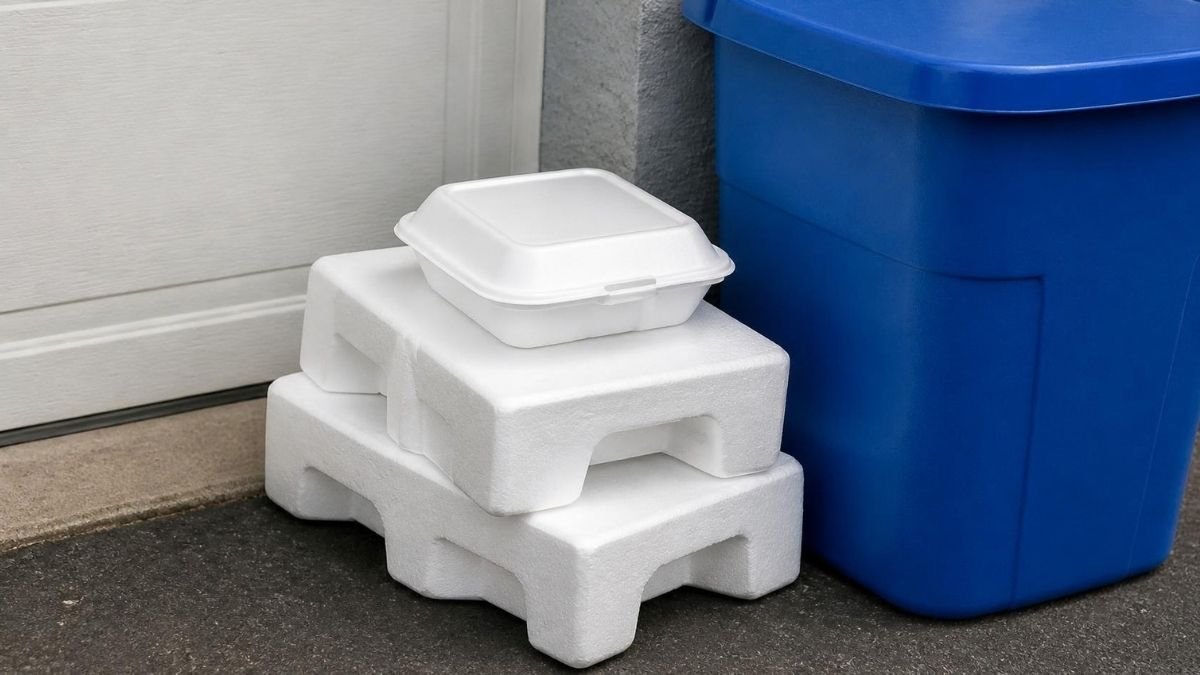
Short answer: technically yes, practically almost never through a household bin. Foam cups, clamshells and packing blocks are expanded polystyrene, resin code 6, and the polymer can be melted and remoulded. But the EPA’s most recent national tables which cover 2018, put US polystyrene waste of every kind, rigid as well as foam, at 2.26 million tons, of which about 20,000 tons was recycled: a rate of 0.9%, against 8.7% for plastics overall. The EPA’s consumer guidance says very few localities accept foam kerbside, and state agencies in New York and Washington say most programmes there do not take it. Clean white packaging blocks can sometimes go to a drop-off site. Food-soiled foam goes in the trash, and in a growing number of states it can no longer be sold at all.
The gap between "has a recycling symbol" and "gets recycled" is wider for foam than for any other common household plastic, and it is worth understanding why before deciding what to do with the box the microwave came in.
The quick table: what goes where
| Foam item | Kerbside recycling bin? | Drop-off? | What to do |
|---|---|---|---|
| Takeaway clamshell, foam cup, foam plate | No, almost everywhere | Rarely accepted, even clean | Trash. Refuse it at the source where possible |
| Meat or produce tray | No | No | Trash |
| Clean white moulded block from an appliance or TV box | No in most programmes | Sometimes; check the local agency | Drop-off if one exists, otherwise trash |
| Foam cooler | No | Sometimes, if clean | Reuse first; drop-off or trash |
| Polystyrene packing peanuts | No | Sometimes taken for reuse by shipping shops | Reuse, or hand on for reuse; otherwise trash |
| Starch-based packing peanuts | No (not plastic) | Not needed | Dissolve in water, compost, or trash |
| Rigid, non-foam #6 (clear lids, some yoghurt pots) | Depends on the programme | Depends | Check local rules; it is a different product from foam |
| Blue, pink or grey insulation board | No | No | Reuse on site, or construction waste |
Recycling is run by local programmes with their own contracts, so the only authoritative answer for a given address is on that programme’s own page. The table describes the usual result.
What "Styrofoam" actually is
The word is a trademark, and it does not belong to the cup. Styrofoam is a brand of extruded polystyrene (XPS) insulation board, invented in 1941 and now owned by DuPont, which says it holds more than 150 trademark registrations for the name worldwide. The company’s own page on the subject is titled to make the point: no cup, food container, cooler or packaging is made from Styrofoam Brand material. The board was traditionally blue; since a reformulation in late 2023 the newest version is grey.
What Americans call styrofoam is expanded polystyrene, EPS: small beads of polystyrene puffed up with a blowing agent and steam-fused in a mould. Both materials are polystyrene, a plastic made from the petrochemical styrene, and both are mostly air by volume. The difference matters for disposal only at the edges: insulation board is a building product and belongs with construction waste, not household recycling.
What the numbers say
The EPA’s Advancing Sustainable Materials Management series is the standard national account of what Americans throw away. Its most recent full tables cover 2018, which is old, and the agency has not published a later edition with the same resin-level detail. With that caveat, these are the measured figures.
| Measure, US municipal solid waste, 2018 | Value |
|---|---|
| All plastics generated | 35.68 million tons |
| All plastics recycled | 3.09 million tons, 8.7% |
| Plastics landfilled | 26.97 million tons |
| Polystyrene generated (all forms) | 2.26 million tons |
| Polystyrene recycled | About 20,000 tons, 0.9% |
| Polystyrene in plates and cups | 820,000 tons; no polystyrene recycling figure published (plates and cups of all resins: negligible, under 5,000 tons) |
| Polystyrene in durable goods | 760,000 tons; no polystyrene recycling figure published |
| Polystyrene in containers and packaging | 550,000 tons; 20,000 recycled, 3.6% |
| of which "other plastics packaging" (includes loose fill, shapes, trays, clamshells, lids) | 330,000 tons; 20,000 recycled, 6.1% |
Three things are worth noticing.
First, the polystyrene line covers every form of the resin, rigid as well as foam. The EPA does not publish a foam-only figure, so anyone quoting a precise national "styrofoam recycling rate" is either using this all-polystyrene number or using an industry estimate. The 0.9% is the best official figure and it is not specific to foam.
Second, the only polystyrene recycling the table puts a number on is in one row: packaging other than bottles, containers and bags. That is consistent with what local programmes say, which is that clean moulded blocks are the foam with a realistic route to a reprocessor. For polystyrene in other plastic containers the entry is "Neg.", which the table defines as under 5,000 tons.
Third, a blank is not a zero. The table carries the note "Some detail of recycling by resin omitted due to lack of data", and the polystyrene cells for plates and cups and for durable goods are empty. What the table does say is that recycling of plastic plates and cups of all resins together was negligible, under 5,000 tons out of 1.03 million, and polystyrene is 820,000 tons of that category.
Why a recyclable plastic is not recycled
The explanation is economic and physical rather than chemical. Polystyrene melts and remoulds without difficulty. The problems come before the melting.
It is mostly air. Recyclers buy plastic by weight and hauliers charge by the truckload. Foam fills a truck long before it weighs anything, so a load of loose foam is a load of very little polystyrene. Washington’s Department of Ecology describes EPS as "a lightweight cellular plastic material consisting of small hollow spherical balls". The engineering fix is a densifier, a machine that compresses or melts foam into dense ingots at the collection point. Programmes that own one can sell the output. Most do not, because the machine has to be paid for out of a material stream that brings in very little.
It breaks up in the sorting line. Kerbside recycling is collected mixed and compacted in the truck. Foam snaps into beads and fragments that scatter into the paper and cardboard bales and lower their value. This is why Washington’s Department of Ecology says foam is "treated instead as a contaminant" in most of the state’s residential programmes, and why putting it in the bin hopefully is worse than putting it in the trash.
Food service foam is dirty. The EPA’s general rule for all recyclables is that items with food debris cannot be recycled. A rigid tub can be scraped clean; a porous foam clamshell that has held curry cannot, at least not at a cost anyone will pay. New York’s environmental agency gives two reasons why most programmes in the state do not take foam containers and peanuts: the material is difficult to recycle and has a low value.
Virgin polystyrene is cheap. Recycled resin has to compete with new resin. When the collected material is bulky, dirty and scattered across thousands of small programmes, it loses.
The same forces explain why the overall plastics rate is 8.7% while PET bottles, which are dense, clean and valuable, reach 29.1% in the same EPA table. The resin code changes none of this: the EPA is explicit that the symbol "does not necessarily mean it can be collected for recycling in your community." A 6 inside chasing arrows means "this is polystyrene" and nothing more. The wider picture is covered in the guide to reducing plastic waste at home.
Where foam is banned
Because recycling has not worked for food service foam, the policy response in a growing number of states has been to stop it being sold. The three below were verified against the state agency’s own page for this article; other states and many cities have comparable laws, and the details differ, so the local agency is the source to check.
| State | What is restricted | Effective | Notable exemptions |
|---|---|---|---|
| New York | EPS foodware (cups, plates, bowls, trays, clamshells) and polystyrene packing peanuts | 1 January 2022 | Raw meat, seafood and poultry packaging; food sealed before it reaches the seller; rigid non-foam polystyrene |
| New York | Foam coolers and ice chests not encased in a durable shell | 1 January 2026 | Certain medical and laboratory shipping uses |
| Washington | EPS packing peanuts and other loose fill | June 2023 | Moulded block packaging is not covered |
| Washington | Foam coolers; foodware such as containers, plates, bowls, clamshells, trays and cups | June 2024 | Trays for raw meat, fish, produce and eggs; cold-chain medical shipping |
| California | EPS food service ware sold, distributed or imported by producers | 1 January 2025 | See below |
California’s route is the most telling. Its packaging law, SB 54, did not ban foam foodware outright. It said producers could keep selling it only if they demonstrated that all EPS met a recycling rate of 25% as of 1 January 2025, with the required rate rising in later years. CalRecycle’s page on the requirement says "To date, this recycling rate requirement has not been met", describes statewide sales and distribution restrictions as of that date, and records that the agency sent notification letters to potential producers on 6 August 2025. The restriction falls on producers as the law defines them; CalRecycle notes that retailers, distributors and restaurants may not be producers, so some foam foodware may still be seen on sale. In other words, the industry was given a threshold below the 29.1% the EPA recorded for PET bottles and jars in 2018 and did not show it had reached it.
One limit on what bans do: they mostly cover foodware and loose fill. Block packaging is not included in Washington’s ban and outside the New York law, and a ban on sale does nothing about the foam that still arrives in a parcel.
How long it lasts: the "500 years" problem
Nearly every article on foam says it takes 500 years, or a million years, or forever, to decompose. Those figures are repeated far more often than they are sourced.
What NOAA actually says is more careful. Its National Ocean Service page on debris gives no figure for foam or for any specific plastic. It says human-made products "will take a long time, possibly hundreds of years, to degrade", that the time depends on material type, size, thickness and environmental conditions such as exposure to sunlight, and that photodegradable plastics never completely degrade but divide into tiny pieces called microplastics. That is an order-of-magnitude statement with the uncertainty left in, which is the honest state of knowledge. Nobody has watched a foam cup for 500 years.
The laboratory evidence complicates the "forever" version from the other side. In a 2019 study in Environmental Science & Technology Letters, Ward and colleagues studied what sunlight does to polystyrene. Their abstract reports that sunlight partially oxidises polystyrene to dissolved organic carbon on a timescale of decades and completely oxidises it to carbon dioxide over centuries, much faster than biological breakdown, and it sets that against what it calls the prevailing assumption that polystyrene persists for millennia. Additives altered the rate.
That is not good news about litter. The estimate applies to polystyrene in sunlight; foam in a landfill is in the dark. And foam is brittle and sheds beads long before it oxidises, which is why state agencies single it out as a source of litter and microplastic pollution. The microplastics question for other everyday items is covered in the article on whether tea bags shed microplastics.
A defensible sentence is this: polystyrene does not biodegrade in any practical sense, breaks into small pieces quickly, and persists for somewhere between decades and centuries depending on light. A specific number of years is an estimate presented as a fact.
Packing peanuts and the water test
Loose-fill peanuts come in two materials that look similar and behave completely differently.
Polystyrene peanuts are foam plastic, often white, pink or green. They are not accepted kerbside, and their sale is banned in New York and Washington. Starch-based peanuts are puffed plant starch, usually off-white or beige and slightly rough.
The test takes a few seconds. Drop one in a glass of water, or hold it under a tap. A starch peanut softens, collapses and dissolves; a polystyrene one floats unchanged. Starch peanuts can be dissolved in the sink, composted or put in the trash without much consequence. They should not go in the recycling bin either, since they are not plastic and are not what the sorting line wants.
For polystyrene peanuts the best outcome is reuse, because a peanut does its job as well the fifth time as the first. Some parcel and shipping shops accept clean ones for their own packing; policies vary by shop and it is worth a phone call before carrying a bag across town.
Drop-off and mail-back
Where foam recycling exists for households, it takes one of two forms.
Drop-off sites. Some county and municipal recycling centres, and some foam manufacturers and packaging firms, accept clean EPS and run it through a densifier. The EPA’s recycling guidance points readers to location-search directories for this. The usual conditions are the same everywhere: white moulded foam only, clean and dry, with tape, labels and cardboard removed, and no food service items. Peanuts are often excluded.
Mail-back. Some foam industry members accept clean EPS by post, with the sender paying postage. Whether shipping a box that is nearly all air across several states is an environmental gain has not been measured in any source reviewed for this article.
Neither route is available to most people within a reasonable drive, which is the practical meaning of the 0.9% figure.
What is not worth doing
Putting foam in the kerbside bin in the hope that someone sorts it. Where the programme does not accept it, it is pulled out and landfilled at best, and at worst it fragments into the paper stream. The honest bin for unaccepted foam is the trash.
Washing takeaway containers for recycling. Drop-off sites generally refuse food service foam even when clean, and the EPA’s 2018 table puts recycling of plastic plates and cups of all resins at negligible, under 5,000 tons. The hot water spent on the wash is a real cost with no return.
Treating it as the largest problem in the bin. In the EPA’s 2018 figures polystyrene is about 6% of plastic waste by weight (2.26 of 35.68 million tons, a calculation from the table), and plastics are 12.2% of municipal waste. Foam matters disproportionately as litter, because it is light, brittle and blows away. As tonnage it is modest next to, for example, discarded clothing.
What to actually do
Look up the local rule once. Search the city or county solid-waste page for "foam" or "polystyrene". It takes two minutes and settles the question for that address. Expect the answer to be no for kerbside.
Sort foam into three piles. Food-soiled or food service foam: trash. Clean moulded blocks: drop-off if one is convenient, otherwise trash. Peanuts: water test, then reuse or dissolve.
Reuse what is reusable. Coolers, blocks and peanuts are durable. A foam cooler kept for years is a better outcome than one recycled after a weekend. Blocks can be cut for packing, plant-pot drainage or craft use; peanuts can be passed on.
Reduce it at the source, which is where the leverage is. Decline foam cups and clamshells where there is a choice; bring a container for leftovers; where a retailer offers reduced or paper-based packaging, choose it. Reusable cups and plates need washing, but a full machine load is an efficient way to do it, as the figures on dishwasher water use show.
Keep it in proportion. Sorting foam correctly is worth doing and takes little effort. It is also a small item in a household’s footprint compared with heating, driving and flying; the comparison of electric and petrol cars over their lifetime deals in tons of carbon, where a year’s foam deals in pounds.
Questions people ask
Is styrofoam recyclable? Technically yes: it is polystyrene, resin code 6, and can be melted and remoulded. In practice very little is. EPA tables show about 0.9% of all US polystyrene waste, foam and rigid together, was recycled in 2018, the latest year with this detail, and the agency says very few localities accept foam in kerbside bins.
Can you recycle styrofoam? Only where a programme specifically accepts it, which usually means a drop-off site taking clean white moulded packaging. Standard household recycling bins in most of the United States do not accept foam, and Washington’s environment agency says it is treated as a contaminant there.
Does styrofoam go in recycling or trash? Trash, in most places. Unless the local programme’s own page says it accepts foam, putting it in the recycling bin causes sorting problems and it is landfilled anyway. Clean packaging blocks can go to a foam drop-off site where one exists.
How to dispose of styrofoam? Food-soiled foam goes in the trash, bagged so fragments do not escape. Clean moulded blocks can be reused or taken to a drop-off site if one is nearby. Polystyrene packing peanuts are best reused; starch-based ones dissolve in water.
What number is styrofoam? Number 6, the resin code for polystyrene. The code identifies the type of plastic and is shared by foam and rigid polystyrene. The EPA notes that the symbol does not mean an item can be collected for recycling in a given community.
Are packing peanuts recyclable? Not in kerbside bins. Polystyrene peanuts can be reused, and some shipping shops take clean ones. Starch-based peanuts are not plastic: they dissolve when wetted and can be composted or binned. A glass of water tells the two apart in seconds.
How long does styrofoam take to decompose? Nobody has measured it directly. NOAA says only that human-made products may take "possibly hundreds of years" and that some plastics break into microplastics instead of fully degrading. A 2019 laboratory study estimated decades to centuries for polystyrene in sunlight. The popular 500-year figure is an estimate, not a measurement.
Is styrofoam banned? Not nationally. Several states restrict it: New York banned foam foodware and packing peanuts from 1 January 2022, Washington banned loose fill in June 2023 and foodware and coolers in June 2024, and California has restricted producers from selling foam foodware since 1 January 2025. Many cities have their own rules.
Can you recycle styrofoam food containers? Almost never. Food residue rules them out of most programmes, drop-off sites usually refuse them even when rinsed, and EPA’s 2018 data put recycling of plastic plates and cups at negligible. They belong in the trash.
What is styrofoam made of? The cups and packaging called styrofoam are expanded polystyrene: beads of a petroleum-derived plastic expanded with a blowing agent and fused in a mould, so the finished item is mostly air. The Styrofoam trademark itself belongs to an extruded polystyrene insulation board.
This article covers household waste and recycling for general information. Collection rules, drop-off sites and state and local restrictions on polystyrene differ by address and change over time; the local solid-waste agency’s own page is the authority on what a given bin accepts.
References
- U.S. Environmental Protection Agency (2020). Advancing Sustainable Materials Management: 2018 Tables and Figures, Table 8, Plastics in Products in MSW. epa.gov
- U.S. Environmental Protection Agency. How Do I Recycle Common Recyclables. epa.gov
- New York State Department of Environmental Conservation. Expanded Polystyrene Foam Containers and Polystyrene Loose Fill Packaging Ban. dec.ny.gov
- California Department of Resources Recycling and Recovery (CalRecycle). Expanded Polystyrene Food Service Ware Requirements. calrecycle.ca.gov
- Washington State Department of Ecology. Expanded polystyrene (EPS) ban. ecology.wa.gov
- National Oceanic and Atmospheric Administration, National Ocean Service. How long does it take for marine debris to degrade? oceanservice.noaa.gov
- Ward, C.P., Armstrong, C.J., Walsh, A.N., Jackson, J.H., & Reddy, C.M. (2019). Sunlight Converts Polystyrene to Carbon Dioxide and Dissolved Organic Carbon. Environmental Science & Technology Letters, 6(11), 669–674. doi:10.1021/acs.estlett.9b00532
- DuPont. What Is Styrofoam? (Styrofoam Brand XPS Insulation). dupont.com
The weekly readout
One email each Thursday: what we tested, which claim collapsed under a closer look, and the one number worth paying attention to.