
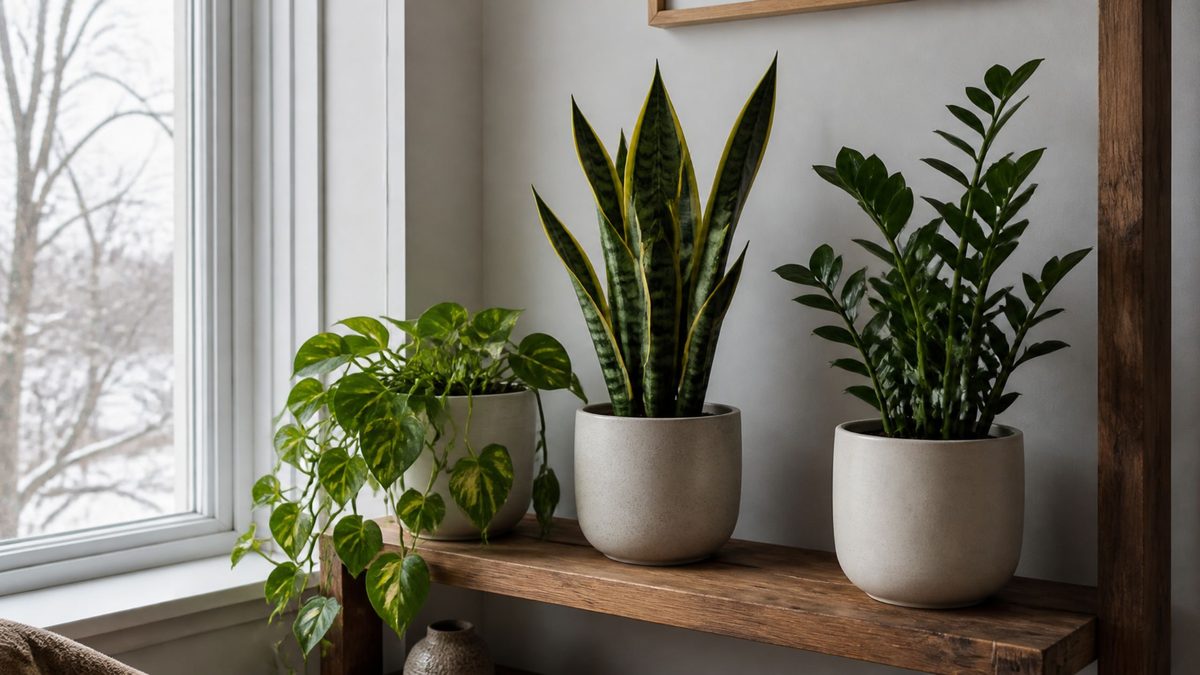
Short answer: the most reliable low light indoor plants are snake plant, ZZ plant, pothos, heartleaf philodendron, cast iron plant and Chinese evergreen. They're followed by parlor palm, peace lily, dracaena, spider plant, prayer plant, peperomia, rabbit's foot fern, Boston fern and lucky bamboo. "Low light" still means some daylight, such as a few feet from a north window. No houseplant grows in a windowless room without a grow light. In winter, the main way people kill these plants is overwatering. If you have cats or dogs, the cast iron plant, parlor palm, spider plant, prayer plant, peperomia, Boston fern and rabbit's foot fern are listed as non-toxic by the ASPCA.
Winter is the real test for houseplants. Days are short, the sun is low, and indoor heating dries the air. A plant that does fine in a bright summer window can sulk in a north-facing room in January. The plants below tolerate those conditions. "Tolerate" is the key word: in low light they'll stay healthy but grow slowly.
First: what "low light" actually means
Plants measure light in intensity and hours, not in how bright a room feels to you. Our eyes adjust to dim rooms; plants don't. A rough guide:
- Bright indirect: right next to an east or west window, or a few feet back from a south one.
- Medium: a few feet from an east or west window, or right next to a north one.
- Low: several feet from a north window, or in the back half of a bright room.
- Too dark: a windowless bathroom or hallway. Nothing on this list will last there long without a grow light.
A simple test: at midday, if you can read comfortably without a lamp and your hand casts a faint shadow, it's low light. If there's no shadow at all, it's probably too dark. A free light-meter app gives a rough number.
The 15 best low light indoor plants
1. Snake plant (Dracaena trifasciata)
The toughest plant on the list. Stiff, upright leaves store water, so it handles weeks of neglect. Water only when the soil is dry all the way down, which can mean once a month in winter. Pets: toxic (ASPCA).
2. ZZ plant (Zamioculcas zamiifolia)
Glossy leaves and thick underground rhizomes that store water. Very slow in low light but almost impossible to kill except by overwatering. Pets: considered toxic; contains calcium oxalate crystals that irritate the mouth.
3. Pothos (Epipremnum aureum)
Fast-growing trailing vine that copes with dim corners. Variegated varieties lose some of their pattern in low light; plain green ones do best. Let the top few centimeters of soil dry between waterings. Pets: toxic (ASPCA).
4. Heartleaf philodendron (Philodendron hederaceum)
Similar to pothos, with softer, heart-shaped leaves. Tells you when it's thirsty by drooping, and recovers quickly after watering. Pets: toxic (ASPCA).
5. Cast iron plant (Aspidistra elatior)
Named for surviving the dark, drafty Victorian parlors where it was popular. Broad dark-green leaves, very slow growth, tolerates cool rooms. Pets: non-toxic (ASPCA).
6. Chinese evergreen (Aglaonema)
Patterned leaves in green, silver or pink. Darker-leaved varieties handle low light best. Dislikes cold drafts and temperatures below about 15 °C (60 °F). Pets: toxic (ASPCA).
7. Parlor palm (Chamaedorea elegans)
A small, feathery palm that's been grown indoors for more than a century. Likes evenly moist (not soggy) soil. Pets: non-toxic (ASPCA).
8. Peace lily (Spathiphyllum)
One of the few flowering plants that copes with low light, though it flowers more with more light. Wilts dramatically when dry and perks up within hours of watering. Pets: toxic (ASPCA). It's not a true lily, but it irritates the mouth and stomach.
9. Dracaena (corn plant, Dracaena fragrans, and relatives)
Tall, cane-like stems with strappy leaves; good as a floor plant. Sensitive to fluoride in tap water, which causes brown tips. Rainwater or filtered water helps. Pets: toxic (ASPCA).
10. Spider plant (Chlorophytum comosum)
Arching striped leaves and baby plantlets you can root in water. Prefers medium light but tolerates low. Pets: non-toxic (ASPCA), though cats like to chew it.
11. Prayer plant (Maranta leuconeura)
Leaves fold up at night, like hands in prayer. Likes humidity and evenly moist soil, so keep it away from radiators. Pets: non-toxic (ASPCA).
12. Peperomia (Peperomia spp.)
Small, compact plants with thick, often textured leaves. Great for desks and shelves. Water sparingly. Pets: non-toxic (ASPCA).
13. Rabbit's foot fern (Davallia)
Furry rhizomes creep over the pot edge. Tougher than most ferns because the rhizomes store water. Pets: non-toxic (ASPCA).
14. Boston fern (Nephrolepis exaltata)
Lush and pet-safe, but the most demanding plant on this list: needs humidity and steady moisture. In winter, a bright bathroom or a room with a humidifier suits it. Pets: non-toxic (ASPCA).
15. Lucky bamboo (Dracaena sanderiana)
Not a bamboo at all. Grows in water or soil and handles low light. Change the water every week or two. Pets: toxic (ASPCA), like other dracaenas.
Quick comparison
| Plant | Lowest light it tolerates | Winter watering | Pet-safe (ASPCA) | Difficulty |
|---|---|---|---|---|
| Snake plant | Low | Every 3–6 weeks | No | Very easy |
| ZZ plant | Low | Every 3–5 weeks | No | Very easy |
| Pothos | Low | Every 1–2 weeks | No | Easy |
| Heartleaf philodendron | Low | Every 1–2 weeks | No | Easy |
| Cast iron plant | Very low | Every 2–3 weeks | Yes | Very easy |
| Chinese evergreen | Low | Every 1–2 weeks | No | Easy |
| Parlor palm | Low | Weekly | Yes | Easy |
| Peace lily | Low | Weekly | No | Easy |
| Dracaena | Low–medium | Every 2 weeks | No | Easy |
| Spider plant | Low–medium | Weekly | Yes | Easy |
| Prayer plant | Low–medium | Weekly | Yes | Moderate |
| Peperomia | Low–medium | Every 2–3 weeks | Yes | Easy |
| Rabbit's foot fern | Low–medium | Weekly | Yes | Moderate |
| Boston fern | Medium | Keep moist | Yes | Harder |
| Lucky bamboo | Low | Change water weekly | No | Easy |
Watering intervals are rough. Check the soil, not the calendar.
How to keep low light plants alive in winter
- Water less. In short, dim days, plants use much less water. Soggy soil plus cool roots is the classic recipe for root rot. Check with a finger: water when the top few centimeters (or, for snake and ZZ plants, the whole pot) are dry.
- Move them closer to the window. A plant that was fine a few meters back in summer may need to be right by the glass in winter. Keep leaves from touching cold panes.
- Keep them away from heaters and drafts. Radiators and heating vents dry leaves out; cold doorways chill them.
- Watch the humidity. Heating can drop indoor humidity below 30%. Ferns, prayer plants and calatheas suffer most. Our guide to the best humidity level for your home in winter covers how to raise it without encouraging mold.
- Skip the fertilizer. Most houseplants barely grow in winter. Start feeding again in spring.
- Dust the leaves. In low light, a layer of dust blocks a meaningful share of what little light the plant gets.
- Consider a grow light. A small LED grow light on a timer can turn a "too dark" spot into a usable one.
Do houseplants clean the air?
Not in any way you'd notice. The idea comes largely from a 1989 NASA study that tested plants in small sealed chambers. In 2020, researchers at Drexel University reviewed 12 chamber studies with 196 results and converted them into the standard measure used for air purifiers, the clean air delivery rate. A single plant's median rate was about 0.023 m³ per hour. Matching the air cleaning that normal ventilation already does in a typical building would take 10 to 1,000 plants per square meter of floor. Grow plants because you like them, not as air purifiers. Our articles on houseplants and air quality and whether air purifiers work go deeper.
Questions people ask
What is the best plant for low light? The snake plant and ZZ plant are the most forgiving. The cast iron plant tolerates the lowest light and is safe for pets.
Can plants live without any sunlight? Not for long. They need light to make food. In a windowless room, use a grow light for 10–12 hours a day.
What low light plants are safe for cats and dogs? The ASPCA lists cast iron plant, parlor palm, spider plant, prayer plant, peperomia, Boston fern and rabbit's foot fern as non-toxic.
How often should I water low light plants in winter? Less than in summer. Many need water every 1–3 weeks; snake and ZZ plants may go a month or more. Always check the soil first.
Why are my plant's leaves turning yellow in winter? The most common cause is overwatering in low light. Too little light and cold drafts are the next most likely.
Do low light plants grow? Slowly. In low light, most will stay healthy but put out only a few new leaves a year.
Is a north-facing window good for plants? Yes, for low light plants. It gives steady, gentle light all day. Put plants right by the window in winter.
Which plants are best for a dark bathroom? If there's a window, pothos, Boston fern, peace lily and lucky bamboo like the humidity. Without a window, you'll need a grow light.
Do snake plants clean the air? Not meaningfully in a real home. Chamber studies found tiny effects that are overwhelmed by normal ventilation.
Are peace lilies toxic to cats? They're listed as toxic by the ASPCA and can irritate the mouth and stomach. They're not true lilies, which cause kidney failure in cats, but keep them out of reach.
This article is general information, not veterinary advice. If a pet eats a plant and shows symptoms, call your vet or the ASPCA Animal Poison Control Center. Toxicity listings are a guide; individual reactions vary.
References
- Cummings BE, Waring MS. Potted plants do not improve indoor air quality: a review and analysis of reported VOC removal efficiencies. Journal of Exposure Science & Environmental Epidemiology 2020;30(2):253–261. doi:10.1038/s41370-019-0175-9
- ASPCA. Toxic and Non-Toxic Plant List. aspca.org
- Wolverton BC, Johnson A, Bounds K. Interior Landscape Plants for Indoor Air Pollution Abatement. NASA, 1989. ntrs.nasa.gov
The weekly readout
One email each Thursday: what we tested, which claim collapsed under a closer look, and the one number worth paying attention to.