

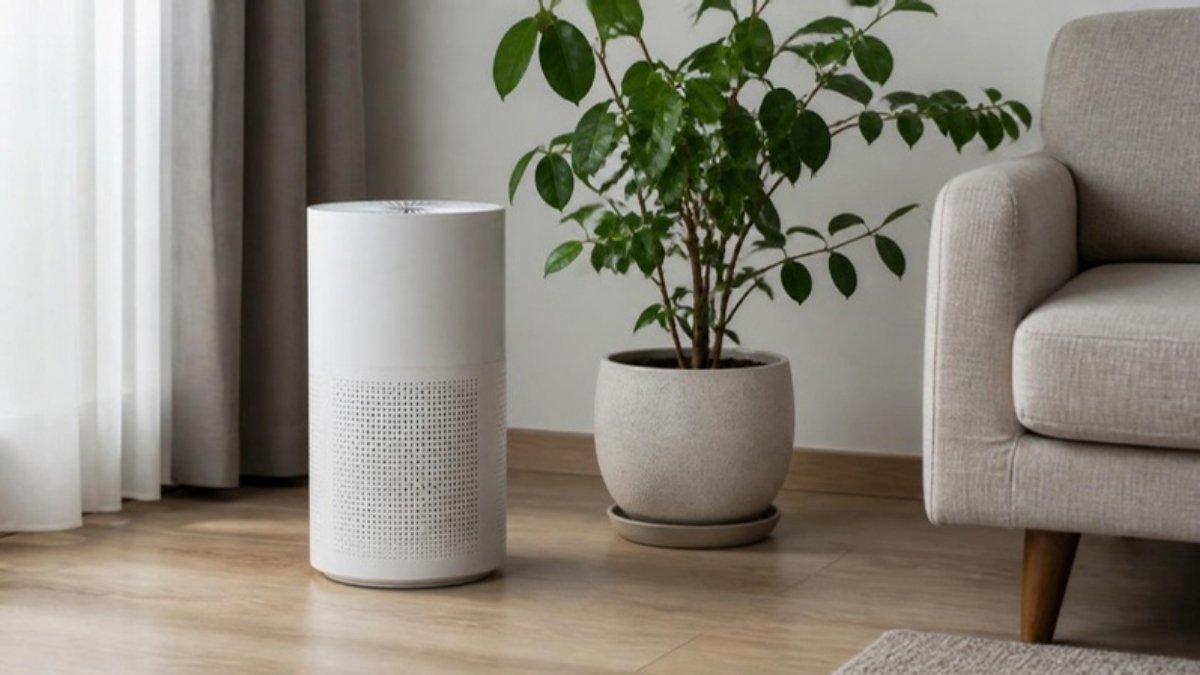
Short answer: yes, for the one thing they are good at. A portable HEPA purifier with enough airflow for the room reliably cuts fine particles, the PM2.5 from traffic, cooking, smoke and pollen, by half or more, and randomised trials have measured what that does to people: in a woodsmoke-affected community, two weeks of filtration improved blood-vessel function by about 9% and lowered an inflammation marker by a third. What a purifier does not do is most of the rest of the label. It does little for gases and odours unless it carries a large amount of activated carbon, it cannot protect you from someone coughing in the same room at close range, and the ioniser or "plasma" feature on the front is either useless or a source of ozone.
The variable that decides whether yours works is not the brand. It is whether the unit moves enough air for the room, which is a number printed on the box that almost nobody reads.
What the trials actually measured
The evidence for particle filtration is better than for most things sold for the home, because it has been tested with real outcomes rather than only with a particle counter.
| Study | Setting | Intervention | What changed |
|---|---|---|---|
| Allen et al. 2011, randomised crossover | 45 healthy adults in a woodsmoke-affected town, British Columbia | HEPA filtration for 7 days vs sham | Indoor PM2.5 down 60%; endothelial function (reactive hyperaemia index) up 9.4%; C-reactive protein down 32.6% |
| Fisk 2013, review of the field | Homes and offices | Particle filtration generally | Consistent reductions in allergy and asthma symptoms; estimated reductions in cardiovascular and mortality risk from lower PM2.5 |
| Cheek et al. 2021, systematic review | 54 studies of portable purifiers | HEPA units in homes | Indoor PM2.5 typically cut by 30–70%; improvements in some respiratory and cardiovascular markers; effect depends heavily on unit size, placement and run time |
| Sublett 2011, review for allergists | Homes with allergic occupants | HEPA in bedroom | Modest but real reductions in symptoms; best results when combined with source control such as mattress covers |
The Allen study is the one to hold onto because of how it was done. Participants had a purifier in their home for a week with a real filter and a week with the filter removed, in random order, without knowing which was which. Blood vessel reactivity and a standard inflammation marker both moved in the direction you would expect if breathing fewer particles is good for the circulatory system, which every large outdoor-pollution study says it is. The effect was in healthy adults, over one week, from a single unit.
HEPA filtration reduced indoor PM2.5 by 60% and was associated with a 9.4% increase in reactive hyperaemia index and a 32.6% decrease in C-reactive protein.
Allen et al, American Journal of Respiratory and Critical Care Medicine, 2011 — summarised from the results
The Cheek review adds the caveat that the size of the benefit in the literature ranges from large to nothing, and that the difference is almost always explained by the same three things: the unit was too small for the room, it was on a low fan setting, or it was not on.
The number that decides everything: CADR
A purifier is a fan and a filter. How much it cleans is how much air it moves through the filter per minute, called the clean air delivery rate, expressed in cubic feet per minute or cubic metres per hour, and reported separately for smoke, dust and pollen. The EPA's technical summary on residential air cleaners puts it plainly: the CADR, not the filter type or the marketing tier, determines the result in a given room.
The rule of thumb that the EPA guidance and the industry rating scheme both use is that the smoke CADR should be at least two-thirds of the room's floor area in square feet, which for a standard ceiling delivers roughly four to five air changes an hour. In practice:
| Room | Floor area | Minimum smoke CADR | What that looks like |
|---|---|---|---|
| Small bedroom | 120 sq ft / 11 m² | 80 cfm | A compact unit on medium |
| Large bedroom or office | 200 sq ft / 19 m² | 135 cfm | A mid-size unit |
| Living room | 350 sq ft / 33 m² | 235 cfm | A large unit, or two mid-size |
| Open-plan kitchen-living | 600 sq ft / 56 m² | 400 cfm | Two large units; one will not do it |
Two consequences follow. The small, quiet, attractive unit on the bedside table is rated for perhaps 100 square feet, and in the open-plan room where it usually ends up it is cleaning a corner. And the "quiet" or "night" setting on most units cuts airflow by two-thirds or more, which reduces the CADR to a fraction of the rated figure. A purifier on its lowest setting in a room twice its rated size is doing close to nothing, which is the state most purifiers in most homes are in.
What it removes, and what it does not
| Pollutant | Source | HEPA filter | Activated carbon | Notes |
|---|---|---|---|---|
| Fine particles, PM2.5 | Traffic, cooking, smoke, candles, wildfire | Yes, very well | No | The main health benefit |
| Pollen, dust, pet dander | Outdoors, bedding, animals | Yes | No | Most is settled on surfaces; the purifier catches what is airborne |
| Mould spores | Damp | Yes, airborne spores only | No | Does nothing about the colony on the wall |
| Dust mite allergen | Bedding | Partly | No | Mostly too heavy to stay airborne; covers and washing do more |
| Cooking odours, VOCs, formaldehyde | Cooking, furniture, paint, cleaning products | No | Partly, if there is a lot of it | Thin carbon mesh saturates in days; needs a thick bed, replaced often |
| Nitrogen dioxide from a gas hob | Gas cooking | No | Poorly | Ventilation is the answer, not filtration |
| Carbon dioxide | People breathing | No | No | Only fresh air lowers CO₂ |
| Viruses | People | Yes, on the particles they ride on | No | Reduces the room-wide concentration over time; does not stop a cough at arm's length |
| Radon | Ground | No | No | Requires sealing and ventilation |
The gases row is where most disappointment comes from. Almost every purifier lists an odour or VOC filter, and almost every such filter is a thin sheet of carbon-impregnated fabric that adsorbs a small amount and is saturated within days. Removing gases takes kilograms of activated carbon with real contact time, which exists in a few specialist units and in none of the popular ones. If the problem is the smell of cooking or a new sofa, the intervention is a window, not a filter.
The features that are theatre, or worse
Ionisers and "plasma" modes. These charge particles so they stick to surfaces, and some generate ozone as a by-product. Ozone is a lung irritant with no safe indoor role, and the EPA's guidance is direct that ozone-generating devices should not be used in occupied spaces. A purifier that has an ioniser button should have it off. One that cannot turn it off is a worse purchase than one without it.
UV lamps. A UV lamp inside a purifier exposes air to light for a fraction of a second as it passes, which is far too short to inactivate much. The HEPA filter behind it has already caught the particles. The lamp is a cost, a bulb to replace, and in some designs another ozone source.
"Medical grade" and "true HEPA". HEPA is a defined standard, 99.97% of 0.3-micron particles. Filters that meet it say so and are tested. "HEPA-type", "HEPA-like" and "99% HEPA" are not the standard, and "medical grade" is a marketing phrase with no definition.
Air quality sensors and auto mode. The onboard sensor is a cheap optical particle counter, which is fine for detecting a large change, such as cooking, and poor at low concentrations, which is where the purifier does most of its work. Auto mode tends to drop the fan to the lowest setting whenever the sensor reads "good", which is exactly when the unit should be running steadily. Manual medium, all day, outperforms auto mode in most homes.
Apps. Fine if you like them. They do not clean air.
Who gets the most out of one
The benefit scales with how bad the air was. That means:
People near traffic, or downwind of wildfire smoke, or in cities with high PM2.5. The health literature on particles is the largest in environmental medicine, and cutting indoor exposure by half in a polluted city is the most cost-effective thing on this list.
People who cook a lot on gas or with high heat and have no extractor. Frying and searing produce a great deal of PM2.5. A purifier in the kitchen-living space, on high during and after cooking, makes a measurable difference; an extractor hood vented outdoors makes a larger one.
Allergy and asthma sufferers, in the bedroom, with the door closed. The bedroom is where you spend eight hours in one place with the air you are given. Pair the purifier with the source-control measures that the allergy literature ranks above it: mattress and pillow covers, washing bedding hot, keeping pets out.
Anyone during a smoke event. Wildfire smoke turns a purifier from a marginal purchase into an essential one, and this is when the CADR sizing rule stops being pedantic and starts being the difference between working and not.
People with a musty flat, a smelly kitchen, a new-furniture smell or high CO₂: no. Those are ventilation problems, and the fix is air exchange, which a purifier does not provide.
How to actually use one
Size it to the room, then round up. Smoke CADR of at least two-thirds the floor area in square feet. If the room is open to another, add the areas.
Run it continuously on medium, not on auto. Steady airflow beats bursts. The electricity cost of a mid-size unit on medium is on the order of a few cents a day.
Place it where air can reach all sides, a foot or more from walls, not behind furniture, not in a corner.
Close the door of the room it is in. A purifier cleans the volume it can reach; a door open to the rest of the flat multiplies that volume.
Change the filter when the manual says, not when the light says. The filter-change light is a timer. Hold the used filter up to a lamp; if it is grey through, it is done.
Turn the ioniser off. Permanently.
Measure if you want to know. A low-cost PM2.5 monitor, placed across the room from the unit, shows within an hour whether the purifier is sized correctly. This is one of the few home gadgets where the measurement is cheap and the answer is clear.
Questions people ask
Do air purifiers actually work? For airborne particles, yes: a HEPA unit sized to the room cuts fine particles by 30 to 70% in controlled studies, and a randomised trial found improved blood-vessel function and lower inflammation after one week. For gases, odours, carbon dioxide and mould on surfaces, no.
Are air purifiers worth it? If you live with high outdoor particle pollution, wildfire smoke, gas cooking without extraction, or allergies, a correctly sized HEPA purifier is one of the better-evidenced home health purchases. If the problem is smell, stuffiness or damp, the money is better spent on ventilation.
Do air purifiers help with allergies? Modestly, mainly in the bedroom with the door closed. Reviews for allergists rank source control, such as mattress covers and hot washing, above filtration, and recommend the purifier as an addition rather than the main measure.
Do air purifiers remove smells or VOCs? Most do not. The thin carbon layer in ordinary units saturates within days. Removing gases needs a large bed of activated carbon, which only a few specialist units carry. Opening a window works better.
Do air purifiers work for COVID or viruses? They lower the concentration of virus-carrying particles in a room over time, which helps in shared spaces, and do nothing about a cough at close range. Ventilation and distance matter more; a purifier adds to them.
What size air purifier do I need? A smoke clean air delivery rate of at least two-thirds of the room's floor area in square feet: about 135 cfm for a 200-square-foot room, 235 cfm for 350 square feet. Rooms open to other rooms count as the combined area.
Should I leave my air purifier on all the time? Yes, on a medium setting. Continuous operation keeps particle levels low; the lowest setting and auto mode often reduce airflow so far that the unit is doing little.
Are ionisers or UV purifiers better than HEPA? No. Ionisers can generate ozone, which the EPA advises against in occupied rooms, and UV lamps inside purifiers expose air for too short a time to matter. HEPA filtration is the part with evidence.
Do air purifiers help with dust? They remove the fraction that is airborne, which is what you breathe. Most dust is settled and is dealt with by cleaning; a purifier reduces how much resettles.
How do I know if my air purifier is working? A low-cost PM2.5 monitor placed across the room shows the difference within an hour. Cook something, watch the number rise, and watch how fast it falls with the unit on high versus off. If it barely moves, the unit is too small for the room.
This article covers home air quality for general information and is not medical advice. People with asthma, heart or lung disease, or those exposed to wildfire smoke, should follow guidance from their clinician and local air-quality authority.
References
- U.S. Environmental Protection Agency (2018). Residential Air Cleaners: A Technical Summary, 3rd edition. epa.gov
- U.S. Environmental Protection Agency. Guide to Air Cleaners in the Home. epa.gov
- Allen, R.W., Carlsten, C., Karlen, B., et al. (2011). An Air Filter Intervention Study of Endothelial Function among Healthy Adults in a Woodsmoke-impacted Community. American Journal of Respiratory and Critical Care Medicine, 183(9), 1222–1230. doi:10.1164/rccm.201010-1572OC
- Cheek, E., Guercio, V., Shrubsole, C., & Dimitroulopoulou, S. (2021). Portable air purification: Review of impacts on indoor air quality and health. Science of The Total Environment, 766, 142585. doi:10.1016/j.scitotenv.2020.142585
- Fisk, W.J. (2013). Health benefits of particle filtration. Indoor Air, 23(5), 357–368. doi:10.1111/ina.12036
- Sublett, J.L. (2011). Effectiveness of Air Filters and Air Cleaners in Allergic Respiratory Diseases: A Review of the Recent Literature. Current Allergy and Asthma Reports, 11(5), 395–402. doi:10.1007/s11882-011-0208-5
The weekly readout
One email each Thursday: what we tested, which claim collapsed under a closer look, and the one number worth paying attention to.