

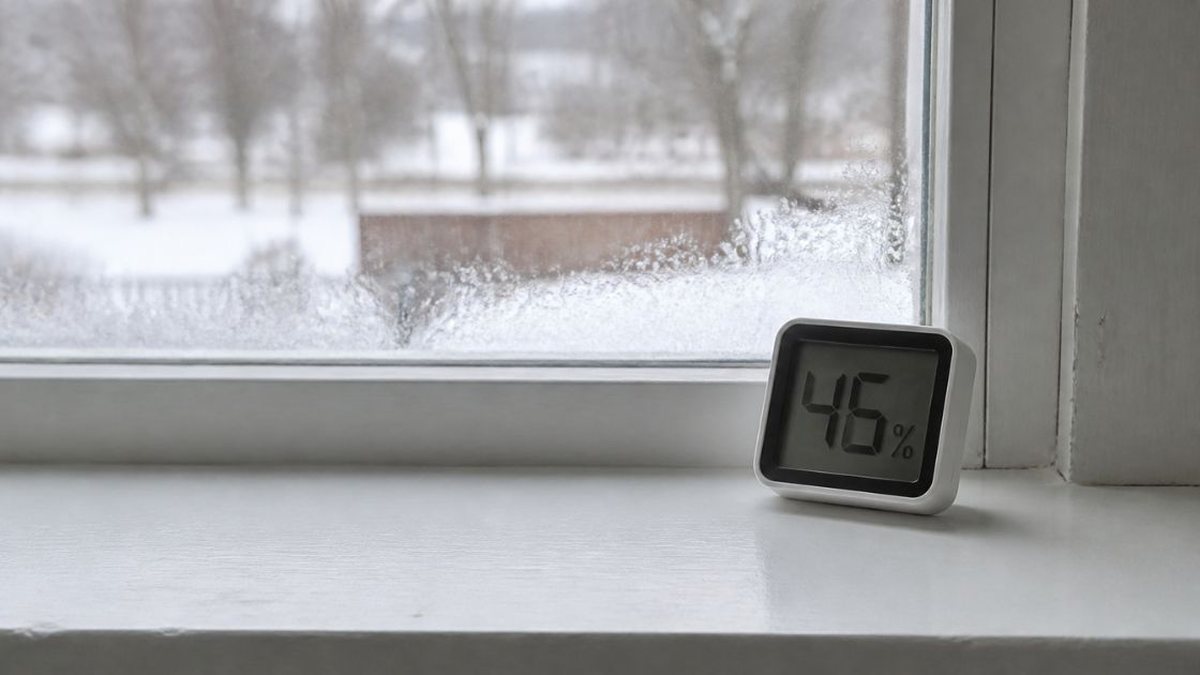
Short answer: the best humidity level for a home in winter is the highest level that does not fog or frost the windows. In most cold climates that means about 30 to 40% relative humidity, and less in deep cold: a Minnesota guide sets the ceiling at 25% when it is between -10 and 0°F (-23 to -18°C) outside, and 15% below -20°F (-29°C). Health research favors 40 to 60%, so in a cold snap the building, not the body, sets the limit.
The confusion in most answers to this question comes from mixing two different ranges. One is about people: the humidity at which airborne germs, dust mites and dry noses all do least harm. The other is about houses: the humidity a building can hold before water condenses on its coldest surfaces. In summer the two ranges overlap. In a northern winter they pull apart, and the outdoor thermometer decides how far.
The two ranges, and why they conflict
The health range. The reference point most guides trace back to is a 1986 review in Environmental Health Perspectives by Arundel, Sterling and colleagues. Pulling together studies on microbes, allergens and indoor chemistry, they concluded that most of the adverse health effects linked to humidity would be minimized by keeping indoor levels between 40 and 60%. They noted that this would require humidifying in winter in cold climates. Their chart of which problems rise at which humidity, often reproduced without credit, is the origin of the "40 to 60" figure. This article relies on the abstract.
The building range. Government guidance on mold and moisture sets a lower and more cautious band. The EPA advises keeping indoor humidity below 60%, ideally between 30 and 50%, and its humidifier guidance says not to humidify above 50%. Canada Mortgage and Housing Corporation (CMHC) says that in the heating season relative humidity should not exceed 45%, and that in very cold weather a level of 30% or lower may be needed to prevent window condensation. The University of Minnesota Extension puts the comfortable range at 25% in winter to 50% in summer, and warns that above 50% moisture problems may occur.
The conflict is plain in the numbers. The health range starts at 40%. In a hard frost, the building range can end well below that.
| Source | Range or limit | What it is protecting |
|---|---|---|
| Arundel et al., 1986 | 40 to 60% | People: infections, allergens, chemical reactions |
| EPA, mold guide | Below 60%, ideally 30 to 50% | The building: mold and moisture damage |
| EPA, humidifier guide | Do not humidify above 50% | Avoiding biological growth |
| CMHC, Canada | Not above 45% in the heating season; 30% or lower in very cold weather | Windows and building envelope |
| University of Minnesota Extension | 25% in winter to 50% in summer | Comfort and the house |
| Center for Energy and Environment, Minnesota | 30 to 40% humidifier setting in winter; lower as it gets colder | Windows and walls |
Why the outdoor temperature sets the ceiling
Relative humidity is a ratio: how much water vapor the air holds compared with the most it could hold at that temperature. Warm air can hold more than cold air. When room air touches a surface cold enough, it can no longer hold all its vapor and the excess turns to water, or to frost if the surface is below freezing. The temperature at which that happens is the dew point.
In winter the coldest surfaces inside a house are usually the window glass and frames, and the inside of exterior walls, especially in corners, behind furniture and around poorly insulated spots. Their temperature follows the weather. As it gets colder outside, the glass gets colder, and the indoor humidity at which it starts to sweat gets lower.
The window itself matters a great deal. North Dakota State University Extension's energy educator put it this way in 2011: with indoor humidity around 40%, condensation on double-pane windows begins when the outside temperature dips below zero (°F), while triple-pane windows should stay clear until it is closer to -40°F. An Iowa State University Extension note gives a similar picture at 70°F indoors and 35% humidity: single-pane windows sweat at about 30°F outside, double-pane windows only below zero, and triple-pane windows at about -40°F. CMHC makes the same point in general terms: upgraded, energy-efficient windows can support a higher humidity without condensation.
That is why a single number cannot be right for every house: a triple-glazed new build and an older house with tired double glazing need different settings on the same January morning.
Recommended maximum humidity by outdoor temperature
The table below is the one most often cited for this question, from the Center for Energy and Environment (CEE), a Minnesota non-profit. Older versions of the same scheme, from Minnesota state and extension publications, use the same steps. The Celsius column is a conversion added here.
| Outdoor temperature (°F) | Outdoor temperature (°C, approx.) | Keep indoor relative humidity below |
|---|---|---|
| 20 to 40°F | -7 to 4°C | 40% |
| 10 to 20°F | -12 to -7°C | 35% |
| 0 to 10°F | -18 to -12°C | 30% |
| -10 to 0°F | -23 to -18°C | 25% |
| -20 to -10°F | -29 to -23°C | 20% |
| -20°F or below | -29°C or below | 15% |
Three cautions apply. First, this is a guide for typical windows, not a law of physics: tighter, better-insulated glazing can hold more humidity, and old single glazing less. Second, it assumes a normal indoor temperature; CEE's guide does not specify one, and cooler rooms reach their dew point sooner. Third, the right column is a ceiling, not a target. CEE's own advice for humidifier users is to set a low level, 30 to 40%, and to let the windows show whether that is still too high.
A 1988 University of Minnesota extension bulletin on condensation in cold-climate housing gave the same advice in a sentence: humidity should be reduced to the lower end of the range during very cold weather.
What the health evidence actually shows
The case for keeping winter air from getting too dry rests on three lines of evidence. They are real, but each is narrower than it is often made to sound.
Influenza and absolute humidity. Shaman and Kohn, in PNAS in 2009, reanalyzed earlier laboratory data on influenza virus in guinea pigs and found that absolute humidity (the actual amount of water vapor in the air) explained the variation in virus survival and transmission much better than relative humidity did. They also noted that absolute humidity in temperate regions falls to its lowest in winter, when flu peaks. This matters indoors: heating cold outside air raises its temperature but adds no water, so a heated house in January can have very dry air even when the relative humidity reading looks moderate. This article relies on the abstract.
Influenza in simulated coughs. Noti and colleagues at the US National Institute for Occupational Safety and Health used a manikin that coughed aerosolized influenza virus into a room and measured how much stayed infectious. At 23% relative humidity or lower, 70 to 77% of the virus was still infectious after one hour. At about 43%, only 14% was, and most of the loss happened in the first 15 minutes. The authors concluded that keeping indoor humidity above 40% may substantially reduce the infectivity of airborne flu virus. This was a single laboratory simulation, not a study of illness in households, and this article relies on a published summary of it rather than the full paper.
Dry noses and eyes. CMHC notes that low humidity can cause discomfort such as dry eyes and nasal and throat irritation. That is a comfort statement, not a disease claim. Whether dry winter air itself makes people more likely to catch a cold is a separate question, covered in does cold weather make you sick.
What the evidence does not show is a specific number below which people in their own homes get sick more often. The Arundel review cites nine epidemiological studies that found fewer respiratory infections or less absenteeism at mid-range humidity than at low or high humidity. Those were mostly studies of workplaces, schools and barracks, and the review is from 1986.
The other end: what goes wrong when it is too humid
Over-humidifying has its own costs, and they fall mainly on the house and on people with allergies.
Mold. The Arundel review notes that most fungi cannot grow unless humidity exceeds about 60%. That is a figure for room air; a cold wall or window frame can be far wetter at its surface than the room average, which is how a house at 45% in January can still grow mold in the corners of a bedroom. The EPA calls condensation a sign of high humidity. Once mold is established, drying the air helps prevent its return but does not remove what is there; see does a dehumidifier help with mold and does vinegar kill mold.
Dust mites. Mites absorb water from the air and dry out when it is low. Arundel's review puts the minimum mite population below 50% relative humidity and the maximum at 80%. In a 2001 study by Arlian and colleagues in Ohio, homes kept below 51% humidity through two humid summers saw live mites fall from about 401 to 8 per gram of dust over 17 months, and allergen levels ended more than ten times lower than in homes that stayed humid. That study was about summer dehumidifying, but it gives a second reason not to push winter humidity much above 50%. More on the mites themselves is in do dust mites bite.
Hidden damage. University of Minnesota Extension points out that warm, moist air leaking into walls, ceilings and the attic can condense there, out of sight. Frost or water on the inside of windows is the visible part of the same process.
How to resolve the conflict in practice
The two ranges cannot both be met in a cold snap with ordinary windows. A reasonable way through, drawn from the sources above:
- Measure first. Many homes in cold climates are dry enough in winter that a humidifier makes sense; some are already too humid from cooking, showers, laundry, plants, people and an unvented basement. Without a reading, there is no way to know which.
- Aim for 40% when the weather allows it. On mild winter days, around freezing or above, most windows can tolerate 35 to 40%, which is close to the bottom of the health range.
- Lower the setting as it gets colder. Follow the table, or simply watch the windows. Condensation along the bottom of the glass in the morning means the humidity is above what that window can take at that temperature.
- Accept a drier house in deep cold. At -20°F (-29°C), CEE's ceiling is 15%. No source in this article suggests that the health cost of a few dry weeks outweighs the cost of wet walls and mold.
- Fix the cold surfaces. The EPA's advice for condensation is to reduce humidity, increase air movement, raise the air temperature and insulate cold surfaces. Better windows, opening curtains at night so warm air reaches the glass, and not blocking supply vents under windows all raise the glass temperature and let the house hold more moisture.
A room humidifier in a bedroom does not escape this logic. Water vapor spreads, and the bedroom window will be the first to show it if the setting is too high.
How to check the humidity in a room
The instrument is a hygrometer. CMHC describes it as an instrument for measuring the moisture content of the air and says it can be bought at a hardware or building supply store; the EPA puts the cost of a humidity meter at about $10 to $50. Many digital thermostats also show humidity.
Place the hygrometer away from the humidifier, kettle, bathroom door and exterior walls, and check it at different times of day, since showers and cooking add moisture. Treat the windows as a second instrument. A hygrometer reading of 35% means little if the glass is dripping, and the glass is the reading that matters to the house.
How to reduce humidity in a house in winter
If the windows sweat or the hygrometer reads above the table's ceiling, the University of Minnesota Extension suggests reducing the sources of water: humidifiers, drying laundry indoors, uncovered pots, aquariums, large numbers of plants. It also suggests, in winter, opening windows just a little for a while to let warm, moist air out and cold, dry air in. Cold outdoor air holds very little water, so once heated it is drier than the air it replaces.
Other measures from the same sources: run bathroom and kitchen exhaust fans during and after showers and cooking; check that the clothes dryer vents outside; seal openings that let warm, moist air into walls and the attic; and, per CMHC, run a dehumidifier in the basement in fall, spring and summer. CEE suggests a basement dehumidifier setting of 55%.
Using a humidifier without making things worse
If a house is too dry, the EPA's guidance on home humidifiers is specific:
| Issue | EPA advice |
|---|---|
| Target | Do not humidify above 50% relative humidity |
| Water | Use low-mineral water; distilled is the most effective; "spring", "artesian" or "mineral" bottled water is not demineralized |
| Daily care | Empty the tank, wipe surfaces dry and refill portable units daily |
| Cleaning | Clean portable units every third day; rinse thoroughly after any cleaner |
| Type | Ultrasonic and impeller ("cool mist") units disperse the most microbes and minerals; evaporative and steam units disperse fewer minerals |
The fine "white dust" some humidifiers leave on furniture is minerals from the water. The 1986 review made a similar point about type: it favored evaporative or steam humidifiers over cool-mist units, which can spread contaminated aerosols. For homes with small children, pediatric sources favor cool mist for burn safety, covered below.
Humidity for babies and for sleep
Babies. No source opened for this article gives a separate humidity target for infants. The Children's Hospital of Philadelphia says the American Academy of Pediatrics recommends cool-mist humidifiers over steam vaporizers, because steam and a tipped-over tank of hot water can burn a child. It advises keeping the unit about 3 feet from the crib, emptying and drying it whenever it is turned off, and cleaning it every two to three days. MedlinePlus, from the US National Library of Medicine, also recommends cool-mist units around children and distilled water to avoid releasing minerals into the air. Because cool-mist units disperse more microbes, the cleaning schedule matters more with them, not less.
Sleep. There is little direct evidence on an ideal humidity for sleeping. MedlinePlus suggests keeping a humidifier set at 40 to 50%, and warns that constantly damp surfaces can lead to mold. In a cold climate, the bedroom window remains the limit. Bedroom fans are another common suspect for a dry throat; that evidence is in is sleeping with a fan on bad for you.
Questions people ask
What is the best humidity level for a home in winter? In most cold climates, about 30 to 40% relative humidity, lowered as the weather gets colder. A Minnesota guide sets the maximum at 40% when it is 20 to 40°F outside and 25% between -10 and 0°F. The practical test is the windows: if they fog or frost, the humidity is too high for that day.
Is 50% humidity OK for a house in winter? Usually not in a cold climate. CMHC says winter humidity should not exceed 45%, and the EPA advises against humidifying above 50%. At 50% indoors, most windows will collect condensation once it is below freezing outside. In a mild-winter region with good windows, 50% may cause no problems, but there is little reason to aim that high.
How dry is too dry for a house? There is no agreed lower limit. Health research favors staying above 40%, and a lab study found flu virus survived much better at 23% or below than at 43%. Building guidance allows 15 to 25% in severe cold. The practical signs of air that is too dry are dry eyes and nasal and throat irritation, which CMHC lists as discomfort from low humidity.
Is 30% humidity too low in winter? For people, it is below the 40 to 60% range a 1986 review linked to the fewest health effects, so it is on the dry side. For the house, 30% is what CMHC says may be needed in very cold weather and what a Minnesota guide sets as the maximum between 0 and 10°F outside. At 30%, the building usually takes priority.
Is 35% humidity good in winter? For many homes in moderate cold, yes. It is the maximum a Minnesota guide gives for outdoor temperatures of 10 to 20°F (-12 to -7°C), and inside the 30 to 40% winter setting that guide recommends. Iowa State Extension notes that at 35% indoors, double-pane windows generally stay clear until it is below 0°F outside.
Is 25% humidity too low in a house? It is dry, and many people will notice it. It is also the maximum a Minnesota guide recommends when it is between -10 and 0°F (-23 to -18°C) outside, and the University of Minnesota Extension describes 25% as a healthy and comfortable winter level. In very cold weather, 25% is often the trade-off that keeps windows and walls dry.
What is the best humidity for a baby's room in winter? No pediatric source opened for this article gives a separate number for babies, so the general winter guidance applies. If a humidifier is used, pediatric guidance favors a cool-mist type over a steam vaporizer to avoid burns, placed about 3 feet from the crib, emptied daily and cleaned every two to three days with distilled or filtered water.
What is the best humidity for sleeping? There is little direct evidence. MedlinePlus suggests 40 to 50% when using a humidifier, which suits mild weather. In a cold climate the bedroom window sets the limit: if it collects condensation overnight, the setting is too high for that night. A closed bedroom with sleeping people in it adds moisture for hours, so check that window in the morning.
How can I check the humidity in my room? Use a hygrometer, a small gauge that measures relative humidity. The EPA puts the cost at about $10 to $50, and many thermostats include one. Place it away from humidifiers, bathrooms and exterior walls, read it at several times of day, and compare it with what the windows show.
How do I reduce humidity in my house in winter? Cut moisture sources such as indoor laundry drying and humidifiers, run kitchen and bathroom exhaust fans, and make sure the dryer vents outdoors. The University of Minnesota Extension also suggests briefly opening windows a little, since cold outdoor air is dry once heated. Persistent condensation can also point to cold surfaces that need better insulation or windows.
This article provides general information about indoor humidity for homes and is not medical or building-engineering advice. The right setting depends on the climate, the house and its windows; persistent condensation, mold or breathing symptoms are reasons to consult a qualified building professional or a clinician.
References
- Higgins, C. (2026). Managing indoor humidity levels, all year round. Center for Energy and Environment, Minneapolis (published July 9, 2026). mncee.org
- U.S. Environmental Protection Agency. A Brief Guide to Mold, Moisture and Your Home. epa.gov
- U.S. Environmental Protection Agency. Use and Care of Home Humidifiers. epa.gov
- Canada Mortgage and Housing Corporation. (2004, revised to 2015). Moisture and Air: A Guide for Understanding and Fixing Interior Moisture Problems in Housing. Ottawa: CMHC. PDF
- University of Minnesota Extension. Controlling moisture problems in your home. extension.umn.edu
- Peterson, R. A., & Hendricks, L. T. (1988). Condensation Control in Cold Climate Housing (CD-FO-3567). Minnesota Extension Service, University of Minnesota. conservancy.umn.edu
- North Dakota State University Extension. (2011). Window condensation common problem (news release, January 2011). ag.ndsu.edu
- Iowa State University Extension and Outreach, AnswerLine. (2015). Winter window condensation. extension.iastate.edu
- Arundel, A. V., Sterling, E. M., Biggin, J. H., & Sterling, T. D. (1986). Indirect health effects of relative humidity in indoor environments. Environmental Health Perspectives, 65, 351–361. PubMed 3709462
- Shaman, J., & Kohn, M. (2009). Absolute humidity modulates influenza survival, transmission, and seasonality. Proceedings of the National Academy of Sciences, 106(9), 3243–3248. doi:10.1073/pnas.0806852106
- Noti, J. D., Blachere, F. M., McMillen, C. M., Lindsley, W. G., Kashon, M. L., Slaughter, D. R., & Beezhold, D. H. (2013). High humidity leads to loss of infectious influenza virus from simulated coughs. PLoS ONE, 8(2), e57485. doi:10.1371/journal.pone.0057485
- Arlian, L. G., Neal, J. S., Morgan, M. S., Vyszenski-Moher, D. L., Rapp, C. M., & Alexander, A. K. (2001). Reducing relative humidity is a practical way to control dust mites and their allergens in homes in temperate climates. Journal of Allergy and Clinical Immunology, 107(1), 99–104. doi:10.1067/mai.2001.112119
- MedlinePlus, U.S. National Library of Medicine. Humidifiers and health. medlineplus.gov
- Children's Hospital of Philadelphia. Vaporizer or humidifier: which is best? chop.edu
The weekly readout
One email each Thursday: what we tested, which claim collapsed under a closer look, and the one number worth paying attention to.