
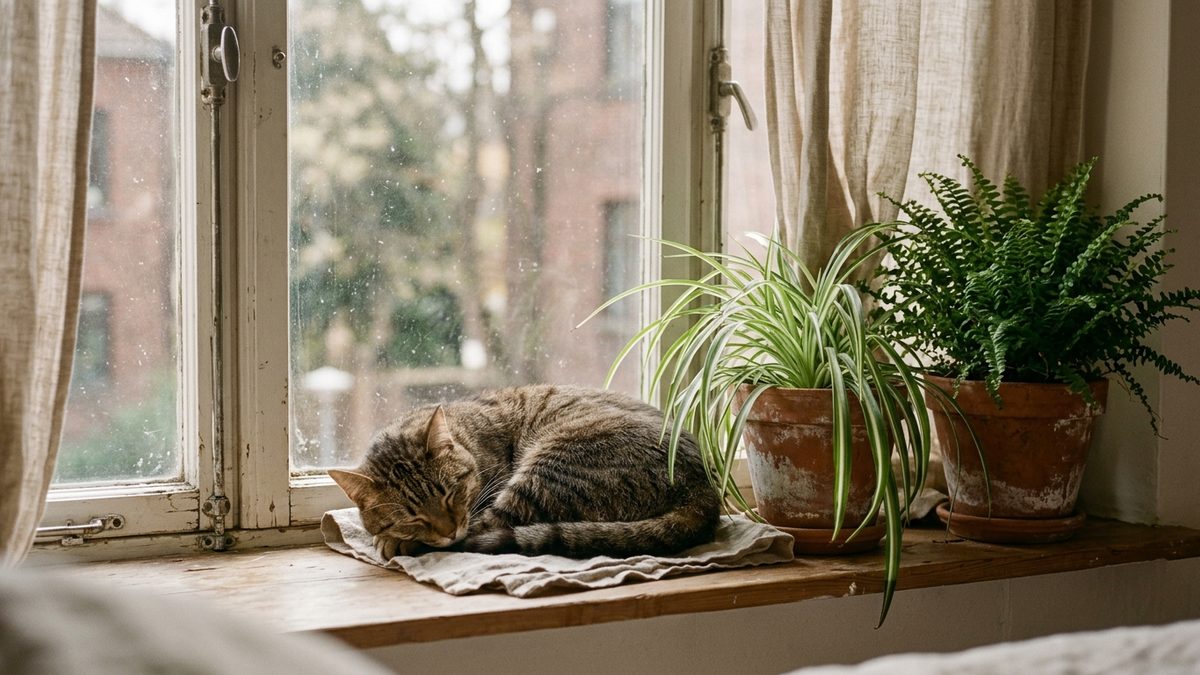
Short answer: houseplants the ASPCA lists as non-toxic to cats include spider plant, Boston fern, areca palm, parlor palm, ponytail palm, calathea, prayer plant, baby rubber plant (peperomia), cast iron plant, haworthia, Christmas cactus, money tree, moth orchid, African violet, polka dot plant, friendship plant, hoya and staghorn fern. "Non-toxic" means the plant isn't expected to poison a cat. It doesn't mean the plant is cat food. The plant to keep out of a cat's home entirely is the lily. The FDA warns that every part of a true lily or daylily is dangerous to cats, including the pollen and the water in the vase.
Lists of cat-safe plants copy each other, and mistakes get copied too. This one was built the other way round: we started from the ASPCA's own cat list and kept only common houseplants that appear in its non-toxic section, under the names the ASPCA uses.
Two things to know before the list:
- Common names are unreliable. "Rubber plant" can mean a safe peperomia or a toxic ficus. "Palm" covers safe areca palms and deadly sago palms. Check the Latin name on the label.
- Cats still shouldn't graze. Fertilizer and leaf-shine sprays aren't food. If your cat is a chewer, hang plants or put them on high shelves, and offer cat grass.
The 18 houseplants safe for cats
1. Spider plant (Chlorophytum comosum)
Arching striped leaves and dangling baby plants. Tolerates low to bright indirect light and missed waterings. Cats love to chew it, so hang it if you want it to stay intact.
2. Boston fern (Nephrolepis exaltata)
Lush and feathery. Needs humidity and evenly moist soil, so a bright bathroom suits it. Not to be confused with asparagus fern, which is toxic and not a true fern.
3. Areca palm (Dypsis lutescens)
A soft, clumping floor palm that grows to 1.5 to 2 m indoors. Bright indirect light; water when the top of the soil dries.
4. Parlor palm (Chamaedorea elegans)
Small, slow and tolerant of dim rooms. The ASPCA lists it under both "parlor palm" and "bamboo palm."
5. Ponytail palm (Beaucarnea recurvata)
Not a true palm. A swollen trunk stores water, so it needs watering only every two to three weeks. Likes bright light. The long leaves are tempting to bat at.
6. Calathea (Calathea spp.)
Patterned leaves in green, purple and silver. Wants humidity, filtered water and no direct sun. Fussy, but safe.
7. Prayer plant (Maranta leuconeura and relatives)
Leaves fold upward at night. Medium to low light and moist soil. The ASPCA lists prayer plant as non-toxic.
8. Baby rubber plant (Peperomia obtusifolia)
Thick, glossy leaves on a compact plant. Water sparingly. This is the safe "rubber plant." The ASPCA's toxic list includes "Fig (Weeping Fig, Indian Rubber Plant)", Ficus benjamina, so treat ficus trees sold as rubber plants with caution and check the Latin name.
9. Cast iron plant (Aspidistra elatior)
The toughest plant here. Survives low light, cool rooms and neglect.
10. Haworthia (Haworthia species)
Small striped succulents often sold as "zebra plant." They look like miniature aloe, but the ASPCA lists aloe as toxic to cats and haworthia as non-toxic. A sunny windowsill and very little water.
11. Christmas cactus (Schlumbergera)
Flowers in winter in pink, red or white. Bright indirect light; let the top of the soil dry between waterings. A safe seasonal alternative to amaryllis and poinsettia.
12. Money tree (Pachira aquatica)
Braided trunk, glossy leaves. Bright indirect light, water every week or two. Don't confuse it with the jade plant, sometimes also called "money plant," which is toxic.
13. Moth orchid (Phalaenopsis)
The supermarket orchid. Flowers last for months. Water about once a week and keep out of direct sun.
14. African violet (Saintpaulia)
Compact, fuzzy leaves and flowers most of the year. Bright indirect light; water from below to keep the leaves dry.
15. Polka dot plant (Hypoestes phyllostachya)
Pink, red or white speckled leaves. Pinch the tips to keep it bushy. Medium light.
16. Friendship plant (Pilea involucrata)
Quilted, bronze-green leaves on a small trailing plant. Likes humidity; good in terrariums.
17. Hoya (Hoya carnosa)
A trailing vine with thick, waxy leaves and clusters of scented flowers. The ASPCA lists it as "honey plant." Bright light, infrequent watering.
18. Staghorn fern (Platycerium bifurcatum)
Antler-shaped fronds, usually mounted on a board and hung on a wall, which also puts it out of reach.
Quick reference
| Plant | Light | Watering | Difficulty |
|---|---|---|---|
| Spider plant | Low to bright indirect | Weekly | Easy |
| Boston fern | Bright indirect, humid | Keep moist | Medium |
| Areca palm | Bright indirect | When top dries | Medium |
| Parlor palm | Low to medium | When top dries | Easy |
| Ponytail palm | Bright | Every 2–3 weeks | Easy |
| Calathea | Medium, no direct sun | Keep moist | Hard |
| Prayer plant | Low to medium | Keep moist | Medium |
| Baby rubber plant | Medium | Sparingly | Easy |
| Cast iron plant | Low | When dry | Easy |
| Haworthia | Bright | Every 2–3 weeks | Easy |
| Christmas cactus | Bright indirect | When top dries | Easy |
| Money tree | Bright indirect | Every 1–2 weeks | Easy |
| Moth orchid | Bright indirect | Weekly | Medium |
| African violet | Bright indirect | From below | Medium |
| Polka dot plant | Medium | Keep lightly moist | Medium |
| Friendship plant | Medium, humid | Keep lightly moist | Medium |
| Hoya | Bright | Every 2 weeks | Easy |
| Staghorn fern | Bright indirect | Soak weekly | Medium |
For which of these cope with dark rooms, see our list of low light indoor plants.
9 common houseplants that are toxic to cats
All nine appear in the toxic section of the ASPCA's cat list.
1. Lilies (Lilium and Hemerocallis)
The one true emergency. The FDA says true lilies and daylilies are the dangerous ones, and that the whole plant is toxic: stem, leaves, flowers, pollen and the water in the vase. A small bite of a leaf or petal, a few pollen grains licked off the fur or a drink of vase water can cause fatal kidney failure in under three days. If treatment is delayed by 18 hours or more, the cat will generally have irreversible kidney failure. Easter, Asiatic, Oriental, tiger and stargazer lilies and daylilies are all on the FDA's list. If you have a cat, don't bring lilies indoors, including in bouquets.
2. Sago palm (Cycas revoluta)
The ASPCA lists the signs as vomiting, jaundice, bruising, liver damage, liver failure and death.
3. Pothos (Epipremnum aureum)
Also sold as devil's ivy. Contains insoluble calcium oxalates, which cause mouth irritation, drooling, vomiting and trouble swallowing.
4. Philodendron and monstera
Heartleaf philodendron and Monstera deliciosa (the ASPCA calls it cutleaf philodendron) are both on the ASPCA's toxic list for cats.
5. Snake plant (Dracaena trifasciata, formerly Sansevieria)
Causes nausea, vomiting and diarrhea.
6. Dieffenbachia (dumb cane)
On the ASPCA's toxic list for cats.
7. Peace lily (Spathiphyllum)
Not a true lily. It contains insoluble calcium oxalates that irritate the mouth and cause drooling and vomiting. The FDA says the signs usually resolve on their own, and it doesn't describe kidney failure from this plant.
8. Aloe vera
Toxic to cats: vomiting, lethargy and diarrhea.
9. Jade plant, dracaena, English ivy and kalanchoe
Four more that turn up in most garden centers and on the ASPCA's toxic list.
A review of plant poisonings in European pets attributes the rise in indoor cases mainly to pets spending more of their time indoors, alongside their owners' houseplants. It notes that lilies damage the kidneys in cats, while dogs typically show only stomach upset.
What to do if your cat eats a toxic plant
- Take the plant away and note its name. Photograph it if you aren't sure.
- Call your vet, or in the US the ASPCA Animal Poison Control Center (888-426-4435, a fee may apply).
- Don't induce vomiting unless a vet tells you to.
- If it's a lily, treat it as an emergency and go immediately, even if the cat seems fine. The FDA says early treatment greatly improves the outlook.
Do houseplants clean the air for you and your cat?
Not in any meaningful way. The data are in our article on houseplants and air quality. Buy plants because you like them.
Questions people ask
What houseplants are safe for cats? Spider plant, Boston fern, areca and parlor palms, ponytail palm, calathea, prayer plant, baby rubber plant, cast iron plant, haworthia, Christmas cactus, money tree, moth orchid, African violet, polka dot plant, friendship plant, hoya and staghorn fern are all on the ASPCA's non-toxic list for cats.
Are spider plants toxic to cats? No. The ASPCA lists spider plant as non-toxic to cats.
Are succulents safe for cats? Some are. Haworthia, echeveria and burro's tail are on the ASPCA's non-toxic list. Aloe, jade plant and kalanchoe are toxic.
Is pothos toxic to cats? Yes. It contains insoluble calcium oxalates that cause mouth irritation, drooling and vomiting.
Are snake plants toxic to cats? Yes. The ASPCA lists snake plant as toxic to cats, with nausea, vomiting and diarrhea as the signs.
Are ferns safe for cats? True ferns such as Boston, staghorn and rabbit's foot fern are listed as non-toxic. Asparagus fern isn't a true fern and is toxic.
Are orchids safe for cats? Phalaenopsis (moth) orchids are on the ASPCA's non-toxic list.
Which plant is most dangerous to cats? Lilies. The FDA says every part of a true lily or daylily, including pollen and vase water, can cause fatal kidney failure in cats.
Is a money tree safe for cats? Yes. Pachira aquatica is listed as non-toxic. Jade plant, which is sometimes also called money plant, is toxic.
How do I stop my cat from eating my plants? Hang plants or use high shelves, offer cat grass as an alternative, and move plants away from favourite perches.
This article is general information, not veterinary advice. If a pet eats a plant and shows symptoms, call your vet or a poison control line. Toxicity listings are a guide; individual reactions vary.
References
- ASPCA Animal Poison Control. Toxic and Non-Toxic Plant List: Cats. aspca.org
- US Food and Drug Administration. Lovely Lilies and Curious Cats: A Dangerous Combination. fda.gov
- Fitzgerald KT. Lily toxicity in the cat. Topics in Companion Animal Medicine 2010;25(4):213–217. doi:10.1053/j.tcam.2010.09.006
- Bertero A, Fossati P, Caloni F. Indoor companion animal poisoning by plants in Europe. Frontiers in Veterinary Science 2020;7:487. doi:10.3389/fvets.2020.00487
The weekly readout
One email each Thursday: what we tested, which claim collapsed under a closer look, and the one number worth paying attention to.