
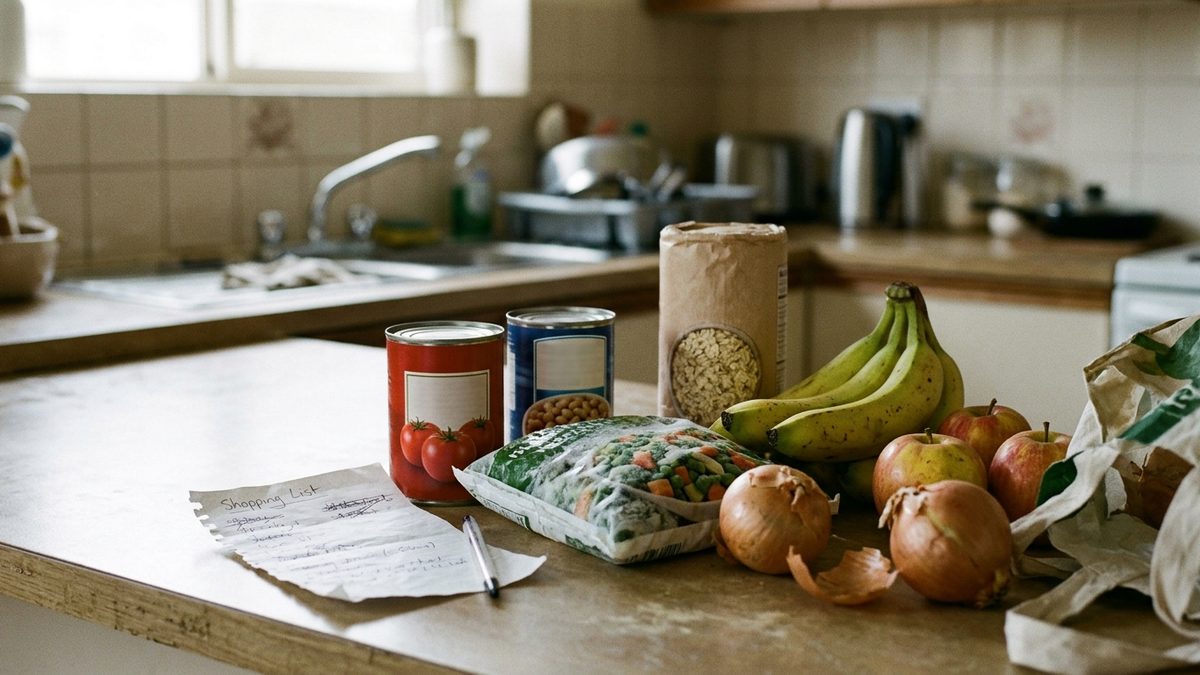
Short answer: the ways to save money on groceries with the most evidence are wasting less of what you buy, switching to store brands, comparing unit prices, and shopping from a list based on planned meals. Americans waste about 27% of what they spend on food, roughly $1,300 a person each year. Shoppers taught to use unit prices cut their bills by 11 to 18% in a field experiment. And chefs, who know food best, buy far fewer national brands of pantry staples than everyone else. Coupons, warehouse clubs and cashback apps help less than those four and sometimes cost money.
Most grocery-saving advice is a list of 50 tips with no sense of which ones matter. This list is ordered by how much each habit is likely to be worth, with the research behind the big ones. For a benchmark, the USDA publishes the monthly cost of a healthy diet cooked at home at four spending levels. In October 2026 the cheapest, the Thrifty Food Plan, came to $1,024.60 a month ($236.50 a week) for two adults and two children aged 6 to 8 and 9 to 11.
The big four
1. Waste less of what you already buy
The largest saving for most households isn't in the shop. A study using national dietary data for nearly 40,000 US adults estimated that people spend $13.27 a day on food, of which 27% ($3.62) is wasted and another 14% is inedible parts such as peel and bones. That's about $1,300 a year per person on food thrown away. At home, the biggest loss was fruit and vegetables.
What works: buy perishables for three or four days, not seven. Put older food at the front of the fridge. Plan one "use it up" meal a week (soup, stir-fry, omelette, fried rice). Freeze bread, meat and leftovers before they turn. See how long leftovers are good for.
2. Switch to store brands for staples
Economists compared what experts buy with what everyone else buys. Pharmacists chose national-brand headache remedies only about 9% of the time, against 26% for the average shopper, because they know the active ingredient is identical. In food, chefs devoted 12 percentage points less of their pantry-staple purchases (salt, sugar, baking soda and similar) to national brands than comparable non-chefs. The authors put the potential saving, if everyone shopped like the experts, in the tens of billions of dollars a year.
Start with single-ingredient basics: flour, sugar, salt, rice, oats, tinned tomatoes, beans, frozen vegetables, milk, butter. If you can't tell the difference, keep the saving.
3. Compare unit prices
The unit price is the small figure on the shelf label: price per ounce, per 100 g, per sheet. In an Australian field experiment, shoppers sent in their real grocery receipts for 20 weeks. Those taught to use unit prices cut their spending by 17 to 18% at the peak, around the sixth week, settling at 11 to 13% by the end. Savings were seen at all income levels.
One caution: a later paper by the same researchers looked at how unit-price use changes brand switching and spending. The saving is real only if you take it out of the trolley and don't spend it on extra items.
4. Plan meals and shop from a list
A list works because it moves decisions out of the shop, where everything is designed to add to your basket. Consumer researchers call the part of a shopper's mental budget that isn't assigned to planned items "in-store slack": room for unplanned purchases. Plan five dinners, check what you already have, write the list from the gap, and treat anything not on it as a "next time."
Ten more that add up
5. Buy frozen fruit and vegetables
Frozen produce doesn't spoil in the fridge drawer, which makes it a direct answer to the waste problem in number 1. A 2017 study analysed selected nutrients in fresh, fresh-stored and frozen fruits and vegetables side by side.
6. Eat meat a little less often
Compare the unit price of meat with dried or tinned beans, lentils and eggs on your own shelf labels. Two meatless dinners a week changes the bill without changing how you eat the rest of the time.
7. Buy in bulk only what you'll finish
A lower unit price is a saving only if none of it gets thrown away. Bulk works for rice, oats, tinned goods, toilet paper and things you freeze. It fails for fresh produce and sauces in small households. Our look at whether a Costco membership is worth it runs the numbers, including the cost of waste.
8. Don't shop hungry
The folk rule has some support: a 2015 paper in PNAS is titled "Hunger promotes acquisition of nonfood objects." Eat first, or at least have a snack.
9. Shop less often
Each trip is another chance for unplanned buying. One main shop a week, with a short top-up for fresh items if needed, beats four small visits.
10. Learn what date labels mean
In the US, federal rules don't require dates on food, with one exception: infant formula. According to the USDA, the dates indicate quality, not safety, and "Best if Used By" means the product should have its best flavour and quality by then. Food that has been handled properly and shows no signs of spoilage can usually still be eaten after the date.
11. Use loyalty prices and digital coupons for things already on your list
Store apps and loyalty cards give real discounts. The trap is buying something because it's discounted. Check the app after writing the list, not before.
12. Cook the same base twice
Roast chicken becomes soup. Chilli becomes baked-potato topping. Cooked rice becomes fried rice. Cooking once and eating twice saves time and makes takeaway less tempting on a tired evening.
13. Look high and low on the shelf
Compare unit prices across the whole shelf, top and bottom included, not only what's at eye level.
14. Track one month of receipts
Keep every grocery receipt for a month and add them up by category. You may find one or two categories (snacks, drinks, ready meals) that take a bigger share than you expected. That's where to start. If the budget is tight across the board, a no spend challenge can reset habits.
Where the money is
| Habit | Evidence | Rough size of saving |
|---|---|---|
| Waste less | National data (Conrad 2020) | Up to 27% of food spending is waste |
| Store brands | Purchase data on experts (Bronnenberg 2015) | Varies by product; largest on staples |
| Unit prices | Field experiment (Weeks 2016) | 11–18% of the bill |
| List and meal plan | Consumer research | Cuts unplanned purchases |
| Frozen produce | Nutrient analysis (Li 2017) | Less waste |
| Less meat | Your own unit prices | Depends on how often |
| Don't shop hungry | Experiments (Xu 2015) | Not quantified here |
What doesn't save as much as it seems
- Driving to several shops for individual deals. Count the fuel and time.
- Coupons for things you wouldn't otherwise buy. A discount on an unplanned purchase is still spending.
- Big packs of perishables. See number 7.
- Packaged snacks. Check the unit price.
Questions people ask
What is the best way to save money on groceries? Waste less of what you buy, switch to store brands for staples, compare unit prices, and shop from a list based on planned meals. Those four have the most evidence.
How much should a family of four spend on groceries? The USDA's Thrifty Food Plan, the lowest of its four official plans, was $1,024.60 a month in October 2026 for two adults and two school-age children. The Low-Cost, Moderate-Cost and Liberal plans are higher.
Are store brands as good as name brands? For basic staples, usually yes. Chefs buy national brands of pantry staples far less often than other shoppers, which suggests they see little difference.
What is a unit price? The price per standard unit, such as per ounce or per 100 g, shown on the shelf label. It lets you compare different pack sizes and brands directly.
Does meal planning save money? It reduces waste and unplanned purchases, which are the two biggest leaks. There's no reliable average figure.
Is it cheaper to buy in bulk? Only for things you'll use before they spoil. For perishables, a bigger pack with a lower unit price can cost more once waste is counted.
Are frozen vegetables as healthy as fresh? A 2017 study compared nutrients in fresh, fresh-stored and frozen produce; this article doesn't quote its figures. For the budget, the point is that frozen vegetables don't get thrown away.
Do coupons save money? They do when they're for items you'd buy anyway. They cost money when they lead you to buy something you hadn't planned to.
How much food does the average person waste? One US study estimated that 27% of daily food spending is on food that is wasted, about $1,300 a year per person.
Is food safe after the "best by" date? Usually, if it has been handled properly and shows no signs of spoilage. The USDA says date labels indicate quality, not safety. Infant formula is the exception.
This article is general information, not financial advice. If you're struggling to afford food, SNAP, WIC and local food banks can help. In the US, call 211 to find services near you.
References
- Conrad Z. Daily cost of consumer food wasted, inedible, and consumed in the United States, 2001–2016. Nutrition Journal 2020;19:35. doi:10.1186/s12937-020-00552-w
- Bronnenberg BJ, Dubé JP, Gentzkow M, Shapiro JM. Do pharmacists buy Bayer? Informed shoppers and the brand premium. Quarterly Journal of Economics 2015;130(4):1669–1726. doi:10.1093/qje/qjv024
- Weeks CS, Mortimer G, Page L. Understanding how consumer education impacts shoppers over time: a longitudinal field study of unit price usage. Journal of Retailing and Consumer Services 2016;32:198–209. ideas.repec.org
- Mortimer G, Weeks CS. How unit price awareness and usage encourages grocery brand switching and expenditure. Journal of Retailing and Consumer Services 2019;49:346–356. doi:10.1016/j.jretconser.2019.04.010
- Stilley KM, Inman JJ, Wakefield KL. Planning to make unplanned purchases? The role of in-store slack in budget deviation. Journal of Consumer Research 2010;37(2):264–278. doi:10.1086/651567
- Xu AJ, Schwarz N, Wyer RS. Hunger promotes acquisition of nonfood objects. PNAS 2015;112(9):2688–2692. doi:10.1073/pnas.1417712112
- Li L, Pegg RB, Eitenmiller RR, Chun JY, Kerrihard AL. Selected nutrient analyses of fresh, fresh-stored, and frozen fruits and vegetables. Journal of Food Composition and Analysis 2017;59:8–17. doi:10.1016/j.jfca.2017.02.002
- USDA Food and Nutrition Service. USDA Food Plans: Monthly Cost of Food Reports. usda.gov
- USDA Food Safety and Inspection Service. Food Product Dating. fsis.usda.gov
The weekly readout
One email each Thursday: what we tested, which claim collapsed under a closer look, and the one number worth paying attention to.