
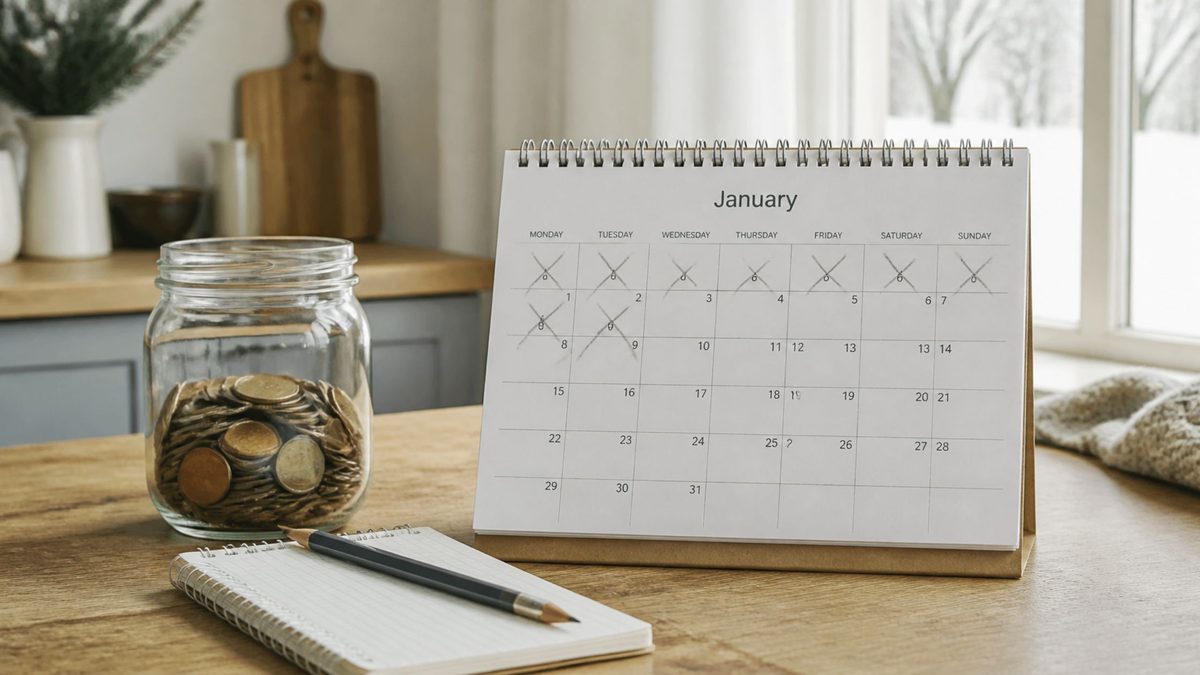
Short answer: a no spend challenge means buying only essentials (housing, utilities, groceries, transport, medicine, debt payments) for a set period, usually a week or a month, and nothing else. To make it stick, write the rules and the essentials list before you start, delete saved cards, cancel or pause subscriptions, plan meals, use cash or a debit card for the essentials, track every day, and decide in advance where the money goes. The research behind this is about self-control, not willpower: in an MIT experiment, people asked to pay by credit card bid about twice as much for the same basketball tickets as people paying cash.
No spend challenges are popular every January, and most of the advice online is a list of "free things to do." That's useful, but it isn't why challenges fail. They fail because the rules are vague ("only necessities"), the money saved has no job, and the month ends in a February splurge. The rules below fix those three problems.
If you're doing this because the numbers don't work, it pairs well with two other pieces: how much of your paycheck to save and sinking funds for irregular costs.
Rule 1: Write your essentials list before day one
Decide, on paper, exactly what you'll still pay for. A typical list:
- Rent or mortgage, utilities, phone, internet
- Groceries (from a list; see rule 5)
- Fuel or transit
- Medicine and health costs
- Minimum debt payments and insurance
- Childcare and school costs
- Gifts or events already committed to
Everything not on the list is "no." The list matters because the hardest moment isn't the big purchase. It's the $14 lunch on a stressful Tuesday, when "is this essential?" suddenly has a flexible answer.
Rule 2: Pick one length and one exception rule
Choose 7, 14 or 30 days. Start shorter if you've never done one. Then write one exception rule, for example: "If something breaks that I need for work or safety, I can replace it with the cheapest option." Having a rule for exceptions stops one surprise from ending the whole challenge.
Rule 3: Remove saved cards and one-click buying
Friction works. In a 2023 study, a 10-second pause before opening social apps cut actual openings by more than half. The same principle applies to shopping. Delete saved cards from online stores and food delivery apps, log out of Amazon, and turn off one-click. You're not banning yourself from buying; you're making it slow.
Rule 4: Pay essentials with cash or debit, not credit
Paying by card, especially credit, feels less painful than handing over cash. In Prelec and Simester's experiment at MIT, students in a real auction for sold-out Celtics tickets bid an average of $29 when told they'd pay cash and $61 when told they'd pay by credit card. For a month, take out cash for groceries and fuel, or use a debit card linked to a separate account with only the essentials budget in it.
Rule 5: Plan meals and shop from a list
Food is where most no spend months succeed or fail. Plan a week of meals, cook from what's already in the freezer and pantry first, and shop once a week from a list. Takeout and coffee shops aren't essentials. Groceries are.
Rule 6: Pause or cancel subscriptions for the month
Subscriptions are spending you don't feel. Before the challenge, list every recurring charge and pause or cancel anything you won't use this month. Our subscription audit walks through how to find them.
Rule 7: Unsubscribe from shopping emails and mute shopping apps
Sales emails and app notifications are designed to create "need" out of nothing. Unsubscribe, delete the apps for a month, and unfollow influencers whose posts send you to checkout pages.
Rule 8: Keep a "want list" instead of buying
When you want something, write it down with the date and price. Don't buy it during the challenge. At the end, look at the list. Many items won't seem worth it anymore; anything that still is, you can buy on purpose.
Rule 9: Track every day
Mark each no spend day on a calendar or in an app, and note every essential purchase. Seeing a streak helps, and so does seeing exactly where essentials money goes. That record is the most useful thing the month gives you, more than the savings themselves.
Rule 10: Give the money a job before you start
Decide now where the saved money goes: an emergency fund, a debt, a sinking fund for next year's holidays. Move it on day 31. If the money sits in checking, it tends to be spent in February. In 2025, 63% of US adults said they could cover a $400 surprise expense with cash or its equivalent. A no spend month is a realistic way to get into that group.
Rule 11: Plan the exit, not just the start
The "rebound" is the biggest risk: after a month of restriction, people often splurge. Plan the first week after the challenge. Set a small, specific budget for the things on your want list, and keep one or two of the habits that were easy (for example, no saved cards, or one takeout night a week instead of three).
What a no spend month can realistically save
There's no reliable average, because it depends on what you usually spend outside essentials. A practical way to estimate: look at last month's bank and card statements and add up everything that wouldn't be on your essentials list. Restaurants, takeout, coffee, shopping, entertainment and impulse online orders usually make up most of it. That total, minus whatever slips through, is your realistic saving.
| Category (typical non-essentials) | Where to look |
|---|---|
| Restaurants, takeout, coffee | Card statements, delivery apps |
| Clothes, home goods, gadgets | Online order history |
| Entertainment and subscriptions | Recurring charges |
| Impulse buys under $20 | Card statements (these add up) |
No spend challenge ideas: what to do instead
- Food: cook through the freezer, batch-cook soups and grains, host a potluck instead of eating out.
- Fun: library books and films, free museum days, hiking and parks, game nights at home.
- Fitness: running, bodyweight workouts, free online yoga or strength videos.
- Social: walks with friends instead of drinks, coffee at home before meeting up.
- Home: declutter and sell things you don't use, which turns the month into earnings.
Who shouldn't do a strict no spend challenge
If you're already cutting essentials to get by, a no spend challenge isn't the tool. The issue is income or fixed costs, not discretionary spending. And if restricting spending tends to make you feel anxious or leads to binge spending afterward, a softer version (one "no spend category" for a month) may work better.
Questions people ask
What is a no spend challenge? A set period, often a week or a month, when you buy only essentials like housing, utilities, groceries, transport and medicine, and nothing else.
What are the rules of a no spend challenge? Write an essentials list and an exception rule before you start, remove saved cards, pay essentials in cash or debit, plan meals, pause subscriptions, keep a want list instead of buying, track every day, and decide in advance where the saved money goes.
What counts as essential in a no spend month? Rent or mortgage, utilities, phone and internet, groceries, transport, medicine, insurance, minimum debt payments, childcare and already-committed costs. Restaurants, takeout, clothes and entertainment usually don't count.
What is No Spend January? A no spend challenge done in January, often after holiday spending, to reset habits at the start of the year.
How much can you save on a no spend challenge? It depends on what you normally spend outside essentials. Add up last month's restaurants, takeout, shopping and entertainment; that's roughly what's at stake.
Can I buy groceries during a no spend challenge? Yes. Groceries are essential. Shop from a list and plan meals so the grocery budget doesn't become a loophole.
Is a no spend challenge good for you? For many people it's a useful reset that shows where money goes. It's not a fix if the problem is low income or high fixed costs.
How do I avoid overspending after a no spend month? Plan the first week after: a small budget for items still on your want list, and keep one or two habits that were easy during the month.
Should I use cash during a no spend challenge? It helps. Paying with cash feels more painful, and research shows people spend more when paying by card.
What do I do with the money I save? Decide before you start: emergency fund, debt, or a sinking fund. Move it on the last day so it doesn't get spent.
This article is general information, not financial advice. If you're struggling to cover essentials, a nonprofit credit counselor (for example, through the NFCC in the US) can help you look at options.
References
- Prelec D, Simester D. Always leave home without it: a further investigation of the credit-card effect on willingness to pay. Marketing Letters 2001;12(1):5–12. doi:10.1023/A:1008196717017
- Board of Governors of the Federal Reserve System. Economic Well-Being of U.S. Households in 2025 (May 2026). federalreserve.gov
- Grüning DJ, Riedel F, Lorenz-Spreen P. Directing smartphone use through the self-nudge app one sec. PNAS 2023;120(8):e2213114120. doi:10.1073/pnas.2213114120
- Allcott H, Gentzkow M, Song L. Digital addiction. American Economic Review 2022;112(7):2424–2463. doi:10.1257/aer.20210867
The weekly readout
One email each Thursday: what we tested, which claim collapsed under a closer look, and the one number worth paying attention to.