

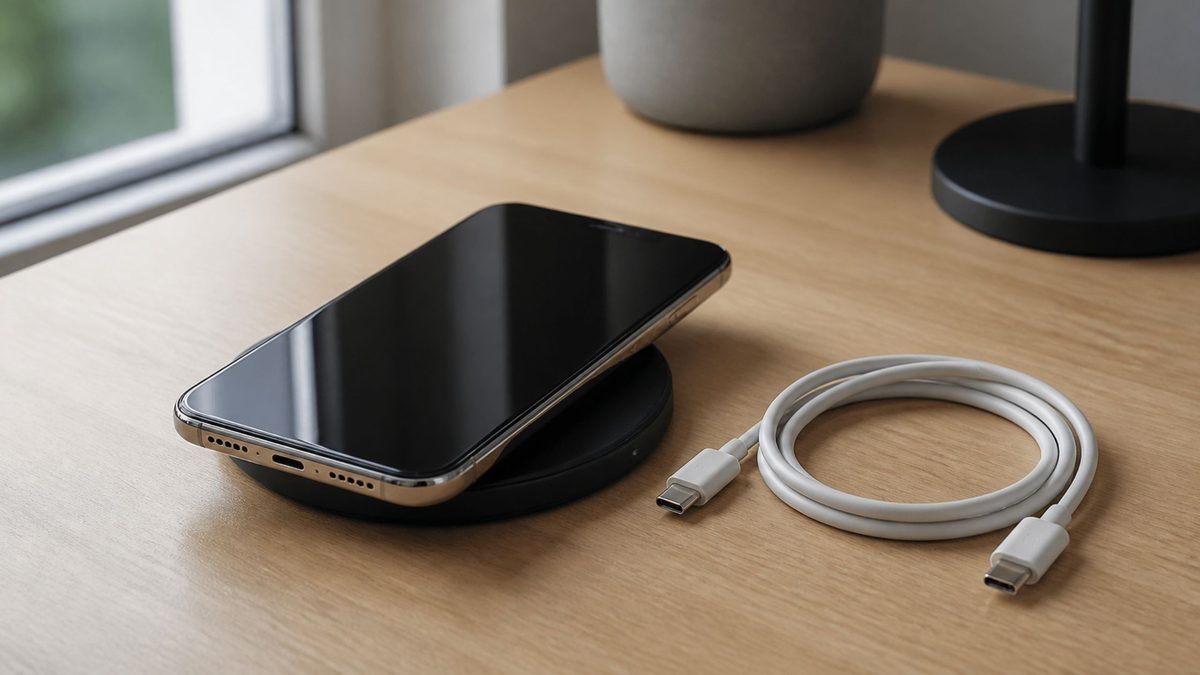
Short answer: wireless charging is not bad for a battery in the way the warnings imply. There is no mechanism by which a magnetic field harms a lithium-ion cell. What the measurements do show is heat. In the one peer-reviewed comparison that imaged a phone while charging, the handset averaged no more than 27 °C on a cable but peaked at 30.5 °C on an aligned wireless pad, and held that peak more than twice as long when the coils were misaligned. iFixit's 2024 test found an iPhone 15 Pro battery topped out near 30 °C on a cable and close to 40 °C on Apple's own MagSafe puck. Lithium-ion cells age faster at higher temperatures and at a full charge, so a phone that lives on a warm pad at 100% will lose capacity sooner than one charged by cable to 80%. The difference is real but modest for most people; it is large if the pad is cheap, misaligned, in a hot car, or under a thick case.
What "bad for the battery" would actually mean
A lithium-ion battery loses capacity in two ways. Cycle aging is wear from charging and discharging. Calendar aging is wear from simply existing at a given temperature and state of charge, whether or not the phone is in use. Both run through the same chemistry: a film called the solid electrolyte interphase grows on the graphite anode and consumes lithium that can no longer carry charge. Heat accelerates the reaction. So does holding the cell near full.
Two laboratory studies put numbers on the second mechanism. Keil and colleagues stored three types of 18650 cells at 16 states of charge for months and found that capacity fade does not rise smoothly with charge level; it steps up in plateaus, with the fastest loss once the graphite anode is more than about half lithiated, which in practice means the upper part of the gauge. Werner and colleagues aged pouch cells across a range of temperatures and charge levels and found that fade and resistance growth followed an Arrhenius relationship with temperature, that storage at 100% had a large effect, and that the effect of state of charge was small below 80%.
Those two findings are the whole argument. A charger can hurt a battery only by making it hotter or by keeping it fuller for longer. Wireless charging does the first and, through slower charging and longer time on the pad, often the second. Nothing else about induction matters to the cell.
How much hotter a wireless pad runs
Induction moves energy across an air gap by driving an alternating current through a transmitter coil at roughly 130 to 140 kHz and letting the receiver coil in the phone pick up the changing field. Some of the energy never arrives: it heats the coils, the power electronics in the pad, and the metal in the phone through eddy currents. Because the receiver coil sits directly under the back glass, close to the battery, that waste heat has nowhere useful to go.
The clearest published measurement comes from WMG at the University of Warwick. The team charged the same phone three ways while thermal-imaging it: by cable, on an aligned inductive base, and on a base with the coils deliberately offset. On the cable the phone's maximum average temperature stayed under 27 °C across three hours. On the aligned pad it peaked at 30.5 °C and then fell during the second half of the charge. With the coils misaligned the peak was similar, but it arrived sooner and lasted roughly 125 minutes rather than 55, and the pad drew more input power (11 W against 9.5 W) as it compensated for the poor coupling. The charging base itself reached 33 °C aligned and 35.3 °C misaligned. The authors concluded that inductive charging will likely shorten battery life, that misalignment is the worst case, and that cable charging remains the choice for anyone trying to maximize lifespan.
A 30 °C reading sounds trivial. The point is where it sits relative to the thresholds in the aging literature, which treat storage above about 30 °C as elevated, and relative to the baseline: a phone on a cable in the same room simply did not get there.
iFixit's 2024 test used an iPhone 15 Pro and a battery-temperature readout rather than a thermal camera. On a 65 W wired charger the battery did not exceed about 30 °C. On Apple's 15 W MagSafe charger it approached 40 °C. On a generic 15 W pad with the coils slightly misaligned it stayed above 40 °C for most of a charge that took nearly four hours. None of the wireless cases exceeded 45 °C, which is well inside the operating range manufacturers allow, but every one of them was 10 °C or more above the wired baseline.
| Charging method (iFixit, iPhone 15 Pro) | Energy to charge 0–100% | Peak battery temperature | Charge time |
|---|---|---|---|
| USB-C cable, 65 W GaN charger | 18.25 Wh | ~30 °C | 2 h 10 min |
| Apple MagSafe, 15 W | 23.33 Wh | ~40 °C | longer, not stated |
| Generic 15 W pad, misaligned | 33.93 Wh | >40 °C for most of the charge | nearly 4 h |
The energy column is the other half of the story, and it explains the heat. Every watt-hour that does not end up in the battery ends up as warmth somewhere in the pad or the phone.
The efficiency gap, in watt-hours
Three independent measurements agree on the size of the loss. The International Energy Agency's 4E programme estimated in 2019 that wireless charging consumes about a third more energy than wired for the same device. OneZero's 2020 test on a Pixel 4 with a wall-side power meter found a full charge took 14.26 Wh by cable and 21.01 Wh on a flat pad, 47% more, with the figure climbing to 80% when the phone was set down slightly off-centre. iFixit's 2024 numbers above come out at 24% more for MagSafe and 86% more for the misaligned generic pad.
Those are per-charge figures. Two further draws push the daily total higher. A pad keeps pulling power after the phone reaches 100%: iFixit logged 1.5 W for nearly five hours overnight on MagSafe against 1.1 W on the cable, and 14 Wh over three hours on the generic pad. And the pad draws a trickle with nothing on it at all, about 0.2 W for MagSafe and a constant 1.4 W for a Tesla car-style platform. Over a year iFixit put MagSafe at roughly 12 kWh of total draw against about 6 kWh for the cable. On a US electricity bill that is a few dollars, in the range of the small appliances in our cost-to-run table. On your battery it is the warmth you can feel on the back glass every morning.
Magnetic alignment is the single biggest lever. The Qi2 standard, which the Wireless Power Consortium built on Apple's MagSafe magnet ring, exists largely to fix the misalignment problem that produced the worst numbers in every test above. A snapped-on Qi2 or MagSafe charger will not be as efficient as a cable, but it will reliably avoid the 80% to 100% energy penalties of a flat pad used carelessly.
What the numbers mean for battery lifespan
Here the honest answer is that nobody has run the decisive experiment: two groups of identical phones, one charged only by cable and one only by pad, for three years, with capacity measured at the end. What exists is the temperature data above and the aging chemistry, and they have to be combined.
Werner's cells followed an Arrhenius curve, which for lithium-ion roughly means a given rise of 10 °C doubles the rate of calendar aging. A phone that charges at 40 °C for two hours a day and otherwise sits at room temperature is spending a small fraction of each day at an elevated rate. That is why engineers who work on this tend to say the same two things at once: wireless charging measurably accelerates aging, and for a typical owner the difference over the life of the phone is a few percentage points of capacity, not a dead battery.
The scenarios where it stops being modest are the ones where the phone spends long periods hot and full:
- A pad on a nightstand that holds the phone at 100% and 35 to 40 °C for seven hours, every night.
- A car mount in summer, where cabin heat and induction heat stack.
- A thick case, which Apple specifically warns may generate excess heat while charging, and which also worsens coupling.
- A cheap, uncertified pad with poor coil geometry.
The scenarios where it is close to irrelevant are short top-ups on a certified magnetic charger in a cool room, which is how a MagSafe stand on a desk is usually used.
Two caveats cut the other way. First, wired fast charging at 30 W or more also warms the battery and is also, by cycle, slightly harder on the cell than slow charging; a 5 W wireless pad is gentler per minute than a 45 W cable, it just takes much longer. Second, Apple and Samsung both throttle charging when the battery is warm. iOS will pause above 80% if temperatures exceed its limits and resume when the phone cools, which is why a phone left on a hot pad sometimes shows 80% in the morning. The throttling protects the cell; it does not remove the heat the pad produced to trigger it.
Overnight on a wireless charger
The overnight question combines both aging mechanisms, which is why it gets its own section. The phone reaches 100% within two to three hours and then sits there, warm, for the rest of the night. Optimized Battery Charging on iPhone and Adaptive Charging on Pixel and Samsung exist to address exactly this: the phone learns your routine, holds at 80% for most of the night, and finishes the last 20% shortly before your usual wake time. Apple's feature works on wireless and wired charging alike. On iPhone 15 and later you can instead set a hard Charge Limit between 80% and 100% in 5% steps; the phone then stops within a few points of your chosen limit and will occasionally run to 100% to recalibrate its gauge.
With one of those features on, the overnight penalty from a wireless pad shrinks to its thermal component. With them off, you are combining the two conditions Werner's data flag as worst: full charge and elevated temperature, for a third of every day. Our article on charging your phone overnight covers the rest of that question, including why the "overcharging" fear itself is a myth on any modern phone.
MagSafe and Qi2 versus a flat pad
| Flat Qi pad | MagSafe (Apple) | Qi2 / Qi2.2 | |
|---|---|---|---|
| Coil alignment | Manual; millimetres matter | Magnet ring, self-aligning | Magnet ring (Qi2 "Magnetic Power Profile") |
| Typical power to iPhone | 7.5 W | 15 W (25 W on iPhone 16 and later with the 2024 charger) | 15 W; 25 W under Qi2.2 |
| Misalignment loss | Up to +80–100% energy in tests | Low | Low |
| Heat | Highest when misaligned | Elevated but consistent | Elevated but consistent |
| Certification | Qi logo | MFi "Made for MagSafe" | Qi2 logo |
Faster is not automatically worse here. A 15 W magnetic charger that finishes in two and a half hours can expose the battery to less total heat than a 7.5 W pad that runs for five, especially if the pad is slightly off-centre. Alignment and certification matter more than wattage.
What is not worth doing
- Buying a wireless charger because it is "gentler" than a cable. It is slower, not gentler.
- Removing wireless charging from your life over battery health if you use a certified magnetic charger in a cool room. The gain is small.
- Charging through a thick or metal-backed case. It raises heat and cuts efficiency, and Apple says to remove such cases if the phone gets hot while charging.
- Leaving the phone on a pad in direct sun or on a car dash. Apple's limit is 35 °C ambient, and a pad adds to whatever the air is doing.
- Trusting the percentage on a cheap pad's box. Measured efficiencies in every published test are far below the marketing figure.
What to actually do
- If battery longevity is your priority, charge by cable and let Optimized Battery Charging or an 80% Charge Limit manage the top end.
- If you want wireless convenience, use a Qi2-certified or MFi MagSafe charger so the coils align. That removes the worst case in every measurement above.
- Keep the pad somewhere cool and take the case off if the phone feels warm.
- Turn on Optimized Battery Charging (or set an 80% limit) if the phone sleeps on a pad. This matters more than the pad itself.
- Do not play games or stream video on the pad. A loaded processor plus induction heat is how phones hit the thermal throttle. Dimming the screen helps more than dark mode does; the display is the other big heat source.
- Check Settings > Battery > Battery Health once a season. If capacity is falling faster than about 1% a month in the first two years, your charging routine is the first thing to change; our article on how long iPhones last covers what a worn battery means for the phone's useful life.
Questions people ask
Is wireless charging bad for your battery? Not directly. It runs the battery several degrees warmer and wastes a quarter to half more energy than a cable, and heat accelerates lithium-ion aging. The effect is modest with a certified magnetic charger in a cool room and larger with a misaligned pad, a thick case, or a hot environment.
Is wireless charging bad for iPhone battery health? The same answer applies. iFixit measured an iPhone 15 Pro battery near 40 °C on MagSafe against 30 °C on a cable. iOS throttles charging when the battery is warm, which limits the harm, and Optimized Battery Charging or an 80% Charge Limit reduces it further.
Is MagSafe bad for your battery? MagSafe is the better kind of wireless charging because the magnets align the coils, which avoids the worst heat and energy penalties. It still runs warmer than a cable. Apple's own guidance is to keep the phone below 35 °C ambient and to remove cases that trap heat.
Does wireless charging damage the battery over time? It accelerates normal aging rather than causing a distinct kind of damage. Over a two- or three-year ownership the measurable difference is a few points of capacity for typical use, more if the phone spends every night hot and full.
Is it OK to leave your phone on a wireless charger overnight? Yes, if Optimized Battery Charging or a Charge Limit is enabled and the pad is not in a hot spot. The phone will not overcharge; the concern is hours at 100% while warm, which those features address.
Does wireless charging use more electricity? Yes. Measurements range from about 24% more (MagSafe, iFixit 2024) to 47% more (flat pad, OneZero 2020) and up to roughly double when the coils are misaligned. The pad also draws power when idle.
Is wireless charging slower than wired? Almost always. A 15 W MagSafe charger delivers less to the battery than its rating after conversion losses, and most phones accept far more by cable. Speed, not battery health, is the main practical trade-off.
Does wireless charging cause the phone to overheat? It raises the temperature by roughly 3 to 10 °C depending on the pad and alignment. Modern phones throttle or pause charging before temperatures become unsafe. Overheating in the sense of damage is rare; sustained warmth is the norm.
Is charging to 80% better for battery health? The calendar-aging data say yes: the effect of state of charge on fade is small below 80% and largest at 100%. Whether the trade in daily runtime is worth it depends on how much you use the phone.
Is Qi2 better for battery than Qi? Qi2 adds magnetic alignment, which is the main thing separating a good wireless charger from a bad one in every published test. It does not change the chemistry; it keeps the pad out of its worst-case mode.
This article summarizes published research for general information and is not medical, legal or financial advice. Figures describe how groups in studies differed, not guaranteed effects for an individual.
References
- Loveridge, M.J., Tan, C.C., Maddar, F.M., Remy, G., Abbott, M., Dixon, S., McMahon, R., Curnick, O., Ellis, M., Lain, M., Barai, A., Amor-Segan, M., & Bhagat, R. (2019). Temperature Considerations for Charging Li-Ion Batteries: Inductive versus Mains Charging Modes for Portable Electronic Devices. ACS Energy Letters, 4(5), 1086–1091. doi:10.1021/acsenergylett.9b00663
- Keil, P., Schuster, S.F., Wilhelm, J., Travi, J., Hauser, A., Karl, R.C., & Jossen, A. (2016). Calendar Aging of Lithium-Ion Batteries: I. Impact of the Graphite Anode on Capacity Fade. Journal of The Electrochemical Society, 163(9), A1872–A1880. doi:10.1149/2.0411609jes
- Werner, D., Paarmann, S., & Wetzel, T. (2021). Calendar Aging of Li-Ion Cells—Experimental Investigation and Empirical Correlation. Batteries, 7(2), 28. doi:10.3390/batteries7020028
- Mokhtari, S., Ritter, C., & Shi, A. (2024). Wireless Charging: Trading Efficiency for Convenience. iFixit, 18 April 2024. ifixit.com
- Rubin, E., Kido, C., May-Ostendorp, P., Mercier, C., & Dayem, K. (2019). Global Forecast of Energy Use for Wireless Charging. Prepared for the Electronic Devices and Networks Annex (EDNA) of the IEA 4E Technology Collaboration Programme, July 2019. iea-4e.org
- Apple Inc. Batteries — Maximizing Performance. apple.com
- Apple Inc. About Charge Limit and Optimized Battery Charging on iPhone. Apple Support. support.apple.com
- Ravenscraft, E. (2020). Here's Exactly How Inefficient Wireless Charging Is. OneZero, 6 August 2020. onezero.medium.com
The weekly readout
One email each Thursday: what we tested, which claim collapsed under a closer look, and the one number worth paying attention to.