

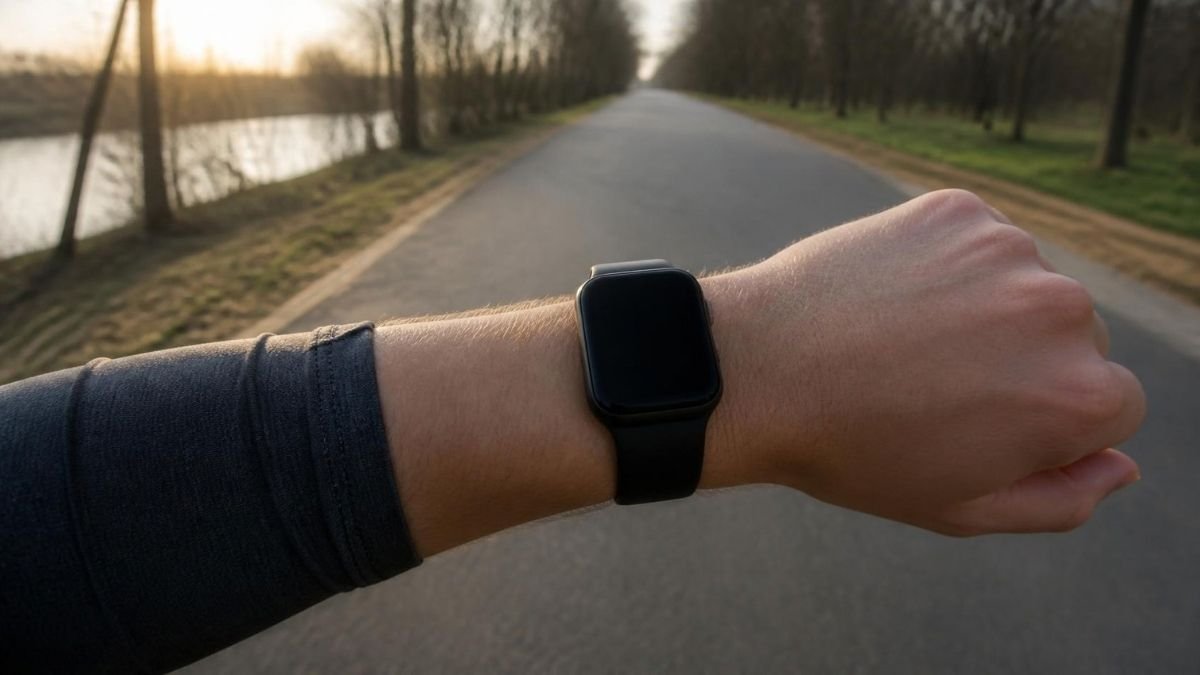
Short answer: not accurate enough to treat as a lab result. The watch does not measure oxygen; it estimates VO2 max from heart rate and pace during outdoor walks, runs and hikes. In the two independent studies that compared it with a metabolic cart, the average error was 13.3% (28 adults, Series 9 and Ultra 2) and 15.8% (19 adults, Series 7), and the watch read low by 6.1 and 4.5 ml/kg/min on average. In one of them the fittest group was underestimated by 12 points while the least fit were overestimated by about 4. Apple's own testing, in an older and larger group, reports an average error of 1.4 ml/kg/min with a standard deviation of 4.7. The direction of the number over months is more trustworthy than the number.
What the validation studies found
VO2 max is the largest volume of oxygen the body can use per minute, per kilogram of body weight, during all-out exercise. The reference method is indirect calorimetry: a mask, a metabolic cart that analyses every breath, and a treadmill or bike test continued to exhaustion. Every study below compared a watch estimate with that kind of test.
| Device | Study | n | Mean bias (ml/kg/min) | MAPE | Limits of agreement |
|---|---|---|---|---|---|
| Apple Watch Series 9 / Ultra 2 | Lambe et al. 2025, PLOS ONE | 28 | Watch 6.07 lower than lab | 13.31% | Lab minus watch: −6.11 to +18.26 |
| Apple Watch Series 7 | Caserman et al. 2024, JMIR Biomed Eng | 19 | Watch 4.51 lower than lab | 15.79% | Not given as numbers in the paper; RMSE 8.85, ICC 0.47 |
| Apple Watch Series 3 and later | Apple white paper 2021, validation cohort | 221 | 1.4 (SD 4.7); direction not stated | Not reported | Not reported; ICC 0.86 |
| Garmin fēnix 6 with chest strap | Carrier et al. 2025, Sensors | 19 | Watch 0.75 higher than lab (30-second lab average) | 7.05% | Not extracted; CCC 0.73 |
| Garmin Forerunner 920XT | Passler et al. 2019, IJERPH | 24 | Watch 2.1 lower than lab | 7.3% | ±8.6; ICC 0.82 |
| Polar V800 (resting test) | Passler et al. 2019, IJERPH | 24 | Watch 3.0 higher than lab | 13.2% | ±15.1; ICC 0.67 |
| Exercise-based wearables, pooled | Molina-Garcia et al. 2022, Sports Medicine | 14 studies, 403 people | −0.09 | Not pooled | −9.92 to +9.74 |
| Resting-based wearables, pooled | Molina-Garcia et al. 2022, Sports Medicine | Same review | +2.17 | Not pooled | −13.07 to +17.41 |
MAPE is the mean absolute percentage error: the average size of the miss, ignoring direction. Bias is the average miss with direction kept. Limits of agreement are the range inside which about 95% of individual differences fall.
Three things stand out. The independent Apple Watch studies are small, 28 and 19 people. Both found the watch reading low on average, by 4.5 to 6 ml/kg/min. And Apple's own figures, from a much larger sample, are several times better than either. Those are not necessarily in conflict, for reasons that come down to who was tested.
How the Apple Watch calculates VO2 max
Apple's 2021 white paper describes the method in general terms and does not publish the algorithm. The estimate is "based on measuring a user's heart rate response to physical activity", using the optical heart rate sensor, accelerometer, gyroscope, barometer and GPS. In plain terms: the watch knows how fast a person is moving over the ground and how hard the heart is working to do it, and it extrapolates from that sub-maximal relationship to a maximum the person never actually reaches during the workout.
That extrapolation leans on several things the watch does not measure:
- Maximum heart rate. It is not observed during a brisk walk. It has to be assumed from age or other profile data, and real maximum heart rates vary widely between people of the same age.
- Movement economy. Two people running at the same pace can use quite different amounts of oxygen. The watch sees pace, not oxygen.
- Body weight, height, age and sex, taken from the Health profile. A stale weight changes the result, because the figure is expressed per kilogram.
The conditions under which an estimate is produced are specific. According to the white paper, estimates are generated after walking, running or hiking outdoors on relatively flat ground, defined as a grade of less than 5% up or down, with adequate GPS, adequate heart rate signal quality and enough exertion. Indoor and treadmill workouts lack GPS pace and are not listed. In Apple's own data, 78% of workouts longer than 5.75 minutes in the validation cohort produced an estimate, which means roughly one in five did not.
| Condition (per Apple's white paper) | Effect on the estimate |
|---|---|
| Heart rate–limiting medication, such as beta blockers or calcium channel blockers, not declared in Health | Reads higher than actual |
| Dehydration, caffeine, extreme heat, recent move to high altitude | Reads lower than actual |
| Carrying significant extra weight, walking on sand, pushing a stroller, using an assistive device | Less accurate |
| Arrhythmia, pacemaker, chronotropic incompetence, inefficient gait | Less accurate |
| Grade of 5% or more, poor GPS, poor heart rate signal, low exertion | No estimate produced |
The logic behind each row is the same. Anything that raises heart rate for a given pace, such as heat, a loaded pack or soft ground, makes the wearer look less fit than they are. Anything that holds heart rate down, such as a beta blocker, makes them look fitter. The quality of the underlying wrist heart rate reading matters too, since it is the main input.
The 2021 white paper states a supported range of 14 to 60 ml/kg/min; Apple's current support page gives 14 to 65 and confirms that indoor workouts do not count. A ceiling of either kind has a direct consequence for well-trained people: a value above it cannot be displayed, whatever the lab says.
Why Apple's numbers and the independent numbers differ
Apple's validation used 221 people with a mean age of 55, after developing the algorithm on a separate group of 534 with a mean age of 53. It reports an average error of 1.4 ml/kg/min with a standard deviation of 4.7, and a reliability intraclass correlation of 0.86. The paper does not say in which direction the 1.4 runs. Its reference value was also not a measured maximum in the usual sense: Apple describes it as the "mean submaximal VO2 max projection" from each participant's cardiopulmonary exercise tests.
The independent studies tested different people. In Lambe et al., the mean age was about 32 and 21 of the 30 people enrolled were classified as having superior or excellent cardiorespiratory fitness. In Caserman et al., the mean age was about 28 and the mean lab VO2 max was 45.9 ml/kg/min. The 14 studies pooled in the Sports Medicine review had a mean participant age of 24.6.
So the manufacturer tested mostly middle-aged and older adults across a broad fitness range, and the academic studies tested mostly young, fit volunteers, the kind of people who sign up for a maximal treadmill test at a university. An algorithm tuned on the first population and tested on the second will tend to look worse, and the pattern in the next section explains which way it misses.
There are also caveats about the independent studies themselves. In Lambe et al., participants generated their own estimate outdoors, uncontrolled, and each contributed a single reading. In Caserman et al., the reference test was done on a cycle ergometer with a portable gas analyser while the watch estimate came from running, so the two numbers were not produced by the same kind of exercise. Neither study is the last word, but they point the same direction.
Apple's own figure is not small either. A standard deviation of 4.7 implies, if errors are roughly normally distributed, that about one reading in twenty is more than 9 ml/kg/min from the average error. That arithmetic is ours, not Apple's.
Fit people are underestimated, unfit people overestimated
Caserman et al. split their 19 participants by fitness category. The groups are very small, so the exact values should be held loosely, but the pattern is clear:
| Fitness level | n | Lab VO2 max | Watch VO2 max | Bias | MAPE |
|---|---|---|---|---|---|
| Poor | 3 | 35.1 | 38.9 | +3.8 | 10.7% |
| Good | 11 | 44.8 | 41.4 | −3.4 | 14.6% |
| Excellent | 5 | 54.7 | 42.7 | −12.0 | 21.5% |
The lab values span almost 20 points from the poor group to the excellent group. The watch values span fewer than 4. Across the full sample the same compression shows: lab results ranged from 32 to 64, watch estimates from 29 to 52. The authors' summary was that the watch "tends to overestimate VO2max for participants with a poor fitness level while underestimating it for those with a higher fitness level".
This is what estimation models generally do. A model that predicts from indirect signals pulls its answers towards the middle of the population it was built on, because that is the safest guess when the signal is noisy. The result is a figure that is most accurate for people of average fitness and least accurate at the ends, which is where the people most interested in the figure tend to be. Lambe et al., with most of the sample in the top fitness categories, found the same average underestimate from the other direction.
For anyone comparing a watch reading with VO2 max norms by age, the practical reading is: a fit person's watch number is more likely to be too low than too high, and a low reading in someone who is sedentary may be slightly flattering.
Why the error for one person is larger than the error for a group
The most misread number in this literature is the bias. The Sports Medicine meta-analysis found that wearables using exercise data had a pooled bias of −0.09 ml/kg/min, which is essentially zero. It is tempting to read that as "accurate". The same analysis found limits of agreement of −9.92 to +9.74.
Both are true at once. Bias is an average of misses in both directions, and overestimates cancel underestimates. A device can be 8 points high for one person, 8 points low for the next, and report a bias of zero. Limits of agreement and MAPE do not allow that cancelling, which is why they are the figures that matter to a single wearer. The review's authors put it directly: exercise-based estimation "seems to be optimal for measuring VO₂max at the population level, yet the estimation error at the individual level is large".
What that means for a single reading of 40 on the wrist:
| Basis | Plausible true value behind a watch reading of 40 |
|---|---|
| Lambe et al. 2025, Apple Watch, limits of agreement | About 34 to 58 |
| Molina-Garcia et al. 2022, pooled exercise-based wearables | About 30 to 50 |
| Passler et al. 2019, Garmin Forerunner 920XT | About 33.5 to 50.7, taking ±8.6 around the 2.1-point underestimate |
These ranges are simple arithmetic on the published limits and assume the study populations resemble the wearer, which they may not. They are wide enough to span several fitness categories on any age-graded chart. A watch reading can place a person in roughly the right region. It cannot tell a 42 from a 47.
Garmin vs Apple Watch VO2 max
On the figures in the table, Garmin's estimates look better: a MAPE of about 7% in two separate studies against 13 to 16% for the Apple Watch. Passler et al. tested the Forerunner 920XT in 24 young adults with a mean lab VO2 max of 50.3 and found the watch reading 2.1 low on average, with an intraclass correlation of 0.82. Carrier et al. tested the fēnix 6 in 19 adults and found a MAPE of 7.05% and the watch reading 0.75 above a 30-second-averaged lab value.
Three cautions before treating that as a ranking. None of these studies tested the two brands on the same people, so the comparison is across different samples and protocols. The fēnix 6 study paired the watch with a chest strap, which removes wrist-sensor error from the heart rate input, and used a structured outdoor run of 10 to 15 minutes above 70% of maximum heart rate; that is a more controlled input than a casual walk. And the result depended on how the lab value itself was averaged: against a one-minute average the MAPE rose to 8.53% and the agreement statistic dropped below the authors' own threshold.
Garmin's individual error is still substantial. Limits of ±8.6 mean a single reading can be well off, and Passler et al. concluded that the trackers they tested were "most likely not accurate enough" for sports or healthcare use.
On cycling: we did not find, and could not open, an independent validation of Garmin's cycling VO2 max estimate against indirect calorimetry for this article. The studies above are all running or walking. Any confidence in the cycling figure rests on the manufacturer's description rather than on independent data we can cite.
What is not worth doing
Comparing the number with someone else's. The fitness-dependent bias means two people with the same true VO2 max can get different readings, and two people with different true values can get the same one. Cross-brand comparison is worse still.
Reacting to a one- or two-point change. Heat, a hilly route, a pushchair, a poor night, a coffee, a new medication and a changed body weight in the Health app all move the estimate without any change in fitness. In Apple's own data, among participants with at least five estimates, the median person's readings had a standard deviation of 1.2 ml/kg/min, and for one in ten it was 2.6 or more.
Buying a new watch for a more accurate figure. Lambe et al. reported no trend in accuracy by model between the Series 9 and Ultra 2. The limitation is the method, estimating a maximum from sub-maximal effort, not the hardware generation.
Assuming a documented improvement. Apple's white paper records that watchOS 7 extended estimates to lower ranges and that iOS 14.3 added low cardio fitness notifications. We could not open an official Apple source describing any later change to the method, so none is claimed here. The same scepticism applies to the watch's other derived figures, such as calories burned, and to estimates from other consumer devices, from sleep-tracking rings to body fat scales.
What to actually do
Read the trend, in months. A person's individual bias, the part that comes from their own maximum heart rate and running economy, is likely to be fairly stable. A stable bias cancels out when the same watch is compared with itself over time. This is an inference, not a tested result: Lambe et al. noted that they collected one estimate per person and could not analyse within-person variability. But it is the use the data best support. A rise from 38 to 42 over six months of training on the same routes is informative. Whether the true figure is 42 is not something the watch can settle.
Keep the inputs consistent. Same sort of route, flat, with open sky for GPS; similar effort; similar conditions. Compare spring with spring where heat is a factor.
Keep the Health profile current. Weight, height, age and sex feed the estimate. Heart rate–limiting medication should be declared in the Health app, since Apple states that undeclared use produces higher-than-actual estimates.
Use a field test as a cross-check. A timed mile or a fixed local loop at a steady effort measures performance directly, with a stopwatch rather than a model. If the watch says fitness is rising and the mile time is falling, the two agree. If they disagree, the stopwatch is the better witness.
Get a lab test if the absolute number matters. For training zones, research, or a clinical question, a cardiopulmonary exercise test is the only way to get a measured value. Repeating a low watch reading is not a substitute, and a persistently low figure alongside symptoms is a matter for a clinician.
Questions people ask
How accurate is Apple Watch VO2 max? In two independent lab comparisons the average error was 13.3% (28 adults) and 15.8% (19 adults), with the watch reading 4.5 to 6 ml/kg/min low on average. Apple's own validation in 221 older adults reported an average error of 1.4 with a standard deviation of 4.7.
Is Apple Watch cardio fitness accurate? Cardio Fitness is Apple's name for the same VO2 max estimate. It is accurate enough to place most people in roughly the right region and to show direction over time. It is not accurate enough to distinguish values a few points apart or to replace a lab test.
How does Apple Watch calculate VO2 max? It does not measure oxygen. It uses heart rate, GPS pace, motion sensors and the barometer during outdoor walks, runs and hikes on ground with less than 5% grade, and extrapolates from the heart rate response at sub-maximal effort to an estimated maximum. Apple has not published the algorithm.
Why is my Apple Watch VO2 max so low? Common reasons are that the watch tends to underestimate fit people, and that anything raising heart rate at a given pace lowers the reading: heat, dehydration, caffeine, altitude, soft ground, carrying weight or pushing a stroller. An outdated body weight in the Health profile also shifts the figure.
How accurate is Garmin VO2 max? Two studies found an average error of about 7%: 7.3% for the Forerunner 920XT in 24 adults and 7.05% for the fēnix 6 with a chest strap in 19 adults. Individual readings still varied by up to about ±8.6 ml/kg/min in the first study.
Garmin vs Apple Watch VO2 max: which is more accurate? Published error figures favour Garmin, about 7% against 13 to 16%. No study we opened tested both on the same people, and one Garmin study used a chest strap and a structured run, so the comparison is suggestive, not settled.
Is Garmin VO2 max accurate for cycling? We could not find an independent validation of Garmin's cycling estimate against a metabolic cart to cite. The published validation studies reviewed here used running or walking. The cycling figure should be treated as less well tested than the running one.
How to improve VO2 max on Apple Watch? The estimate rises when heart rate at a given pace falls, which is what regular aerobic training produces over weeks and months. Keeping routes, conditions and profile data consistent makes real change easier to see. Choosing easier conditions raises the reading without changing fitness.
Should I trust the trend or the number? The trend. A person's own bias is likely to stay fairly constant, so it largely cancels when comparing the same watch over months under similar conditions. The absolute number carries an individual uncertainty of several points in every study reviewed here.
This article summarises published validation studies and manufacturer documentation for general information and is not medical advice. A wearable VO2 max estimate is not a diagnostic test; anyone with symptoms on exertion, a heart or lung condition, or questions about medication should speak to a clinician and should not rely on a watch reading.
References
- Lambe, R., O’Grady, B., Baldwin, M., & Doherty, C. (2025). Investigating the accuracy of Apple Watch VO2 max measurements: A validation study. PLOS ONE, 20(5), e0323741. doi:10.1371/journal.pone.0323741
- Caserman, P., Yum, S., Göbel, S., Reif, A., & Matura, S. (2024). Assessing the Accuracy of Smartwatch-Based Estimation of Maximum Oxygen Uptake Using the Apple Watch Series 7: Validation Study. JMIR Biomedical Engineering, 9, e59459. doi:10.2196/59459
- Apple Inc. (May 2021). Using Apple Watch to Estimate Cardio Fitness with VO2 max. apple.com
- Apple Inc. Track your cardio fitness levels. Apple Support. support.apple.com
- Molina-Garcia, P., Notbohm, H.L., Schumann, M., Argent, R., Hetherington-Rauth, M., Stang, J., Bloch, W., Cheng, S., Ekelund, U., Sardinha, L.B., Caulfield, B., Brønd, J.C., Grøntved, A., & Ortega, F.B. (2022). Validity of Estimating the Maximal Oxygen Consumption by Consumer Wearables: A Systematic Review with Meta-analysis and Expert Statement of the INTERLIVE Network. Sports Medicine, 52(7), 1577–1597. doi:10.1007/s40279-021-01639-y
- Passler, S., Bohrer, J., Blöchinger, L., & Senner, V. (2019). Validity of Wrist-Worn Activity Trackers for Estimating VO2max and Energy Expenditure. International Journal of Environmental Research and Public Health, 16(17), 3037. doi:10.3390/ijerph16173037
- Carrier, B., Marten Chaves, S., & Navalta, J.W. (2025). Validation of Aerobic Capacity (VO2max) and Pulse Oximetry in Wearable Technology. Sensors, 25(1), 275. doi:10.3390/s25010275
The weekly readout
One email each Thursday: what we tested, which claim collapsed under a closer look, and the one number worth paying attention to.