

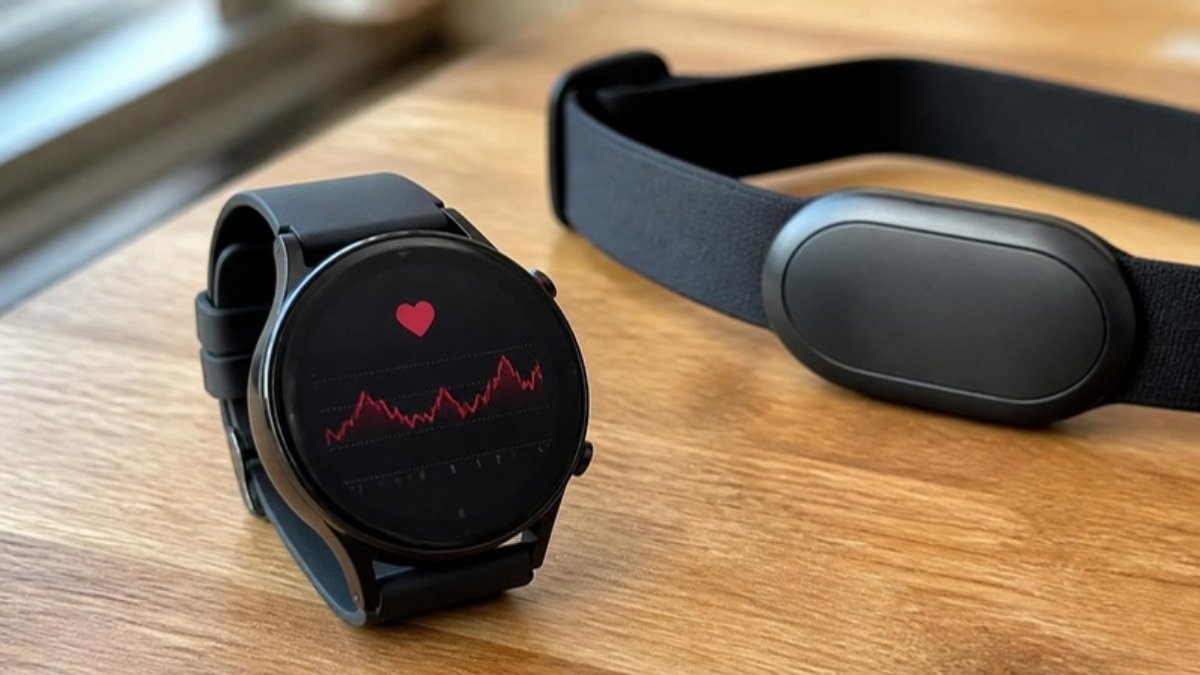
Short answer: good, with a specific failure mode. Choe and Kang's 2025 meta-analysis of 56 validation studies put the Apple Watch's heart-rate error at 4.43% against reference ECG or chest straps, which is the best of any metric the watch reports and a number most clinicians would accept for a resting pulse. But the error is not spread evenly. A 24-hour comparison against a wearable ECG found the watch within 3% during running and sleep and off by 13.7% during ordinary daily activities. Wrist movement, gripping, cold skin, tattoos and darker skin tones all degrade the optical signal, and during weight training or anything with a bent wrist the watch can miss by 20 beats or more and take a minute to catch up.
So the honest answer depends on what you are doing when you look. Sitting, sleeping, walking, steady running: trust it. Lifting, rowing, cycling on the hoods, washing dishes, HIIT with arm work: check it against how you feel, or wear a strap.
The numbers, by study
| Study | Reference | Setting | Apple Watch error |
|---|---|---|---|
| Choe & Kang 2025, meta-analysis of 56 studies | ECG, chest strap | All | MAPE 4.43% for heart rate; the most accurate of the watch's metrics, ahead of steps (8.17%) and far ahead of calories (27.96%) |
| Nelson & Allen 2019 | Ambulatory ECG, 24 hours | Real life, one participant | MAPE 5.86% overall; 3.01% running, 3.12% sleeping, 4.64% walking, 7.21% sitting, 13.70% daily activities |
| Wang et al. 2017, JAMA Cardiology | ECG during treadmill | 50 adults, rest to hard effort | Apple Watch among the best of four wrist devices; error grew with intensity; chest strap far better than all wrist devices |
| Shcherbina et al. 2017 | ECG | 60 adults, diverse, walking, running, cycling | Apple Watch the most accurate of seven wrist devices for heart rate; median error about 2%; energy expenditure error above 20% in every device |
| Bent et al. 2020 | ECG | 53 adults, six devices, activities and skin tones | Optical sensors accurate at rest; error rose with activity type, especially with wrist movement; small but measurable effect of skin tone; large effect of motion |
Two things are consistent across all of that. The Apple Watch is usually at or near the top of the wrist devices tested. And every wrist device, including it, is worse than a chest strap, and worse during movement than at rest.
Heart rate error was 3.01% during running and 3.12% during sleep but 13.70% during daily activities.
Nelson & Allen, JMIR mHealth and uHealth, 2019 — Apple Watch Series 3 against ambulatory ECG
The Nelson and Allen result is a single participant over one day, so it is a case study rather than a population estimate. It is included because it is the only study that ran a consumer watch against a proper ECG through a whole ordinary day, and its pattern, best when the wrist is still or moving rhythmically, worst when the hands are doing things, matches what the larger lab studies found.
Why a wrist sensor gets it wrong
The watch does not detect heartbeats. It shines green light into the skin and measures how much comes back, which varies with the blood volume in the capillaries under it. Each pulse of blood is a dip in reflected light. The watch counts the dips. The technique is called photoplethysmography, and it is the same one the calorie estimate and the VO2 max estimate are eventually built on, which is why those inherit its errors and add their own.
Everything that changes the light signal without being a heartbeat is a source of error:
| Source of error | Mechanism | When it bites |
|---|---|---|
| Wrist and hand movement | Tendons and the watch itself shift, changing the light path; the algorithm can lock onto the movement rhythm instead of the pulse | Weight training, rowing, cycling, kettlebells, typing, dishes |
| Loose or high fit | Ambient light leaks in; the sensor moves relative to skin | Any exercise with a loose band |
| Cold skin | Capillaries constrict, weakening the pulse signal | Winter runs, cold water, air conditioning |
| Tattoos and darker skin | Melanin and ink absorb green light, reducing signal | Measurable in Bent et al.; the watch compensates partly with infrared |
| Wrist flexion | Compresses the tissue under the sensor | Push-ups, planks, holding handlebars |
| Sudden intensity changes | The algorithm smooths over seconds; a real jump lags behind | Intervals, sprints |
| Arrhythmia | Irregular beats confuse the counting; the ECG feature exists for this reason | Atrial fibrillation, ectopics |
The failure that people most often notice is cadence lock: during running or cycling the algorithm picks up the rhythm of the arm swing or pedal stroke and reports that as the heart rate. It usually reads plausibly, 160 during a run, and is simply the step rate.
When the number is trustworthy
Resting heart rate, measured in the background. The watch samples while you are still, which is the condition it is best at. The resting figure it reports each day is one of the more reliable numbers on the device and a reasonable trend to watch, in the same way HRV is: the day-to-day value is noisy, the month-to-month trend is informative.
Sleep. Around 3% error against ECG, and the wrist is still. The overnight average and the overnight low are close to what a strap would show.
Walking and steady running. Rhythmic, moderate, wrist swinging freely. Errors of 3 to 5% here are the same as many chest straps from a decade ago.
Steady cycling on an indoor trainer, hands relaxed, is usually fine. Cycling outdoors with weight on the hands and road vibration is not.
When it is not
Strength training. Gripping a bar flexes the wrist and compresses the tissue under the sensor; the watch often reads 20 to 40 beats low during a set and then overshoots as it catches up. Several validation studies exclude resistance training because the wrist optical signal is unreliable enough to be uninformative.
High-intensity intervals. Lag of 10 to 30 seconds behind a real change, plus movement noise. The peak heart rate shown is often not the peak reached.
Anything with the hands busy: rowing, boxing, climbing, gardening, cooking. This is the 13.7% "daily activities" figure.
Cold hands. A winter run can start with the watch reading 20 beats low for the first ten minutes until the skin warms.
Arrhythmias. If the pulse is irregular, the optical count is unreliable; this is precisely why the watch has an ECG mode, and why the Apple Heart Study (Perez et al. 2019, NEJM) found that among the 0.5% of 419,297 participants who received an irregular-rhythm notification, 84% of subsequent notifications coincided with atrial fibrillation on a patch ECG. That is useful screening, and it is also a reminder that the optical sensor needed a separate technology to confirm what it suspected.
How to get a better reading
Wear it snug, a finger-width above the wrist bone. Loose and low is the most common cause of a bad reading and the easiest to fix. The band should not slide; the sensor should not see daylight.
Warm up before trusting the number. Give a cold-weather session ten minutes before reading anything into it.
Use a chest strap for intervals and strength. Most watches will pair with one and use its data in place of the optical sensor. A strap measures the heart's electrical signal directly and is not fooled by the wrist.
Watch the trend, not the reading. Resting heart rate over weeks, sleep heart rate over weeks. A single elevated number during a workout is more likely to be the sensor than your heart.
Cross-check when it matters. Two fingers on the wrist or neck for fifteen seconds, multiplied by four, is a validation method that has never failed.
Do not diagnose from the optical number. A persistently high resting rate, a low one with symptoms, or an irregular rhythm alert are reasons to see a doctor, who will use an ECG. The watch is a screening tool and a very good one; it is not the test.
Questions people ask
How accurate is Apple Watch heart rate? Around 4 to 5% error on average against ECG across 56 studies, and about 3% during sleep and steady running. During activities with wrist movement, such as weight training or daily chores, error rises to 10 to 15% or more.
Is Apple Watch heart rate accurate during exercise? For walking and steady running, yes, within a few percent. For strength training, intervals, rowing or cycling with weight on the hands, no; wrist motion and grip degrade the optical signal and the watch can read 20 or more beats low.
Is Apple Watch heart rate accurate for sleep? Yes; the wrist is still and the 24-hour ECG comparison found about 3% error overnight. The sleeping heart rate and its trend over weeks are among the more reliable figures the watch produces.
Why is my Apple Watch heart rate so high or so low? Usually the sensor rather than your heart: a loose band, cold skin, wrist flexion, or the algorithm locking onto your step or pedal cadence. Check the fit, warm up, and compare with a manual pulse count.
Is a chest strap more accurate than Apple Watch? Yes, in every comparison. A strap reads the heart's electrical signal directly and is unaffected by wrist movement. For intervals and strength training, pairing a strap with the watch is the fix.
Does skin tone affect Apple Watch heart rate accuracy? A little. Studies of optical sensors find a small, measurable reduction in signal with darker skin and tattoos, much smaller than the effect of movement. The watch uses infrared alongside green light partly for this reason.
Is Apple Watch heart rate more accurate than Fitbit or Garmin? In head-to-head studies the Apple Watch is usually at or near the top for heart rate, with all wrist devices showing the same pattern of good accuracy at rest and worse accuracy with wrist movement.
Can Apple Watch detect a heart problem? It can flag an irregular rhythm suggestive of atrial fibrillation. In the Apple Heart Study, 84% of subsequent alerts coincided with AF on a medical ECG patch. It is a screening prompt to see a doctor, not a diagnosis.
How accurate is Apple Watch resting heart rate? Good. It is measured while you are still, the condition the sensor handles best, and the daily figure tracks ECG closely. Treat single-day changes as noise and multi-week trends as signal.
Why does my Apple Watch heart rate lag behind? The algorithm averages over several seconds to filter noise, so a sudden real change, such as the start of a sprint, shows up 10 to 30 seconds late. The peak recorded during short intervals is often lower than the true peak.
This article covers consumer wearable accuracy for general information and is not medical advice. Symptoms such as palpitations, chest pain, fainting or breathlessness need medical assessment regardless of what any device shows.
References
- Choe, J.-P., & Kang, M. (2025). Apple Watch accuracy in monitoring health metrics: a systematic review and meta-analysis. Physiological Measurement, 46(4), 04TR01. doi:10.1088/1361-6579/adca82
- Nelson, B.W., & Allen, N.B. (2019). Accuracy of Consumer Wearable Heart Rate Measurement During an Ecologically Valid 24-Hour Period: Intraindividual Validation Study. JMIR mHealth and uHealth, 7(3), e10828. doi:10.2196/10828
- Wang, R., Blackburn, G., Desai, M., et al. (2017). Accuracy of Wrist-Worn Heart Rate Monitors. JAMA Cardiology, 2(1), 104–106. doi:10.1001/jamacardio.2016.3340
- Shcherbina, A., Mattsson, C.M., Waggott, D., et al. (2017). Accuracy in Wrist-Worn, Sensor-Based Measurements of Heart Rate and Energy Expenditure in a Diverse Cohort. Journal of Personalized Medicine, 7(2), 3. doi:10.3390/jpm7020003
- Bent, B., Goldstein, B.A., Kibbe, W.A., & Dunn, J.P. (2020). Investigating sources of inaccuracy in wearable optical heart rate sensors. npj Digital Medicine, 3, 18. doi:10.1038/s41746-020-0226-6
- Perez, M.V., Mahaffey, K.W., Hedlin, H., et al. (2019). Large-Scale Assessment of a Smartwatch to Identify Atrial Fibrillation. New England Journal of Medicine, 381(20), 1909–1917. doi:10.1056/NEJMoa1901183
The weekly readout
One email each Thursday: what we tested, which claim collapsed under a closer look, and the one number worth paying attention to.