
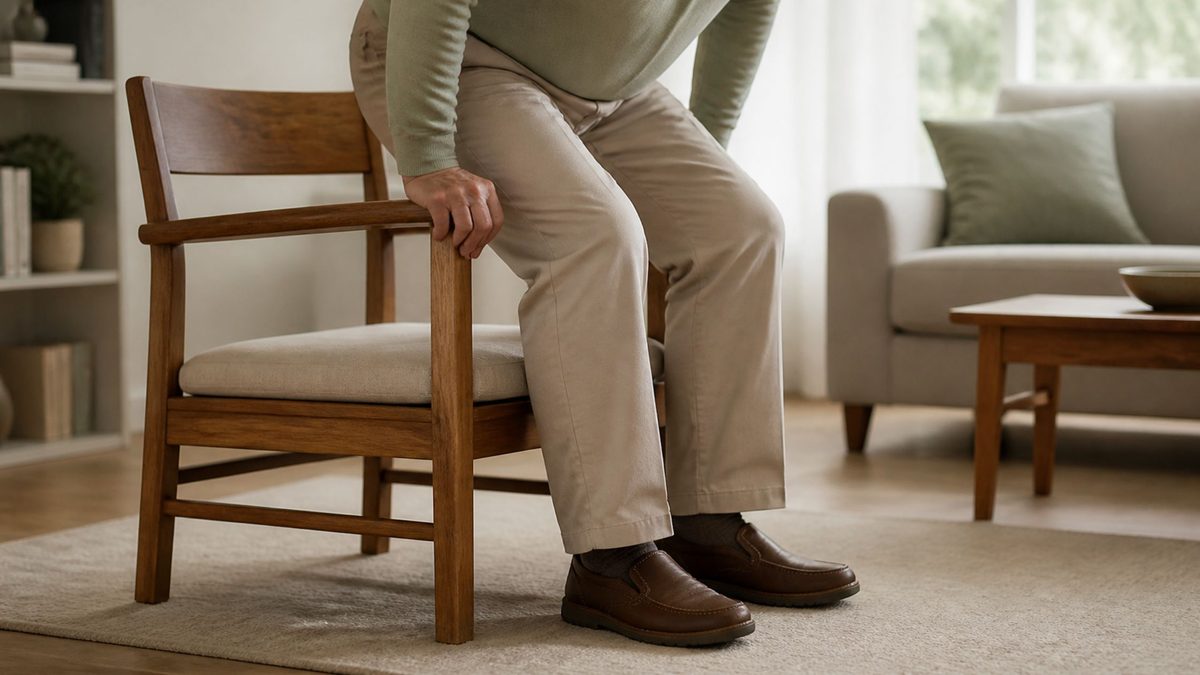
Short answer: the best leg strengthening exercises for seniors are the ones that copy daily life under load: sit-to-stands, step-ups, heel raises, wall squats and side leg raises, done 2–3 days a week, 1–3 sets of 8–15 slow reps, made harder as they get easier. A Cochrane review of 121 trials found that this kind of progressive training gives older adults a large gain in strength and a moderate-to-large improvement in getting out of a chair. For falls, strength alone is not enough: the programs that cut falls by about a quarter add balance work.
Most lists of "leg exercises for seniors" are a grab bag. Leg swings sit next to squats, and nothing says which one does more. This list is ranked. The question for each move is simple: how directly does it train the things that go wrong first with age? Those are standing up, climbing, carrying and catching yourself before a fall.
That ranking matters because leg strength drops faster than arm strength with age, and the loss shows up in everyday tasks long before it shows up on a scale. The 30-second sit-to-stand test is a good way to see where you are before you start, and again after eight weeks.
How we ranked these exercises
Three questions, in order:
- Does it look like a daily task? Getting out of a chair, onto a step or up on your toes to reach a shelf. Exercises that copy these tasks transfer best to real life. That is the main finding behind "functional" training in the fall-prevention trials.
- Can you add load over time? Strength only keeps coming if the work gets harder. The Cochrane review is about progressive resistance training, and the "progressive" part is the point.
- Is it safe to do alone at home? Every move here can be done next to a counter or a sturdy chair.
What this list is not: a rehab plan after surgery, or advice for someone with a recent fracture, uncontrolled blood pressure or a joint replacement in the last few months. If that is you, start with a physiotherapist.
1. Sit-to-stand (chair stand)
Why it is first: it is the single movement older adults lose that costs them the most independence. It trains the quads, glutes and the timing of standing up, all at once. It is also the test clinicians use to judge leg strength and fall risk, so you are training exactly what gets measured.
How: sit near the front of a firm chair without wheels, feet flat and hip-width apart. Lean your chest forward over your toes, then push through your heels to stand fully. Sit back down slowly, taking about 3 seconds. That slow lowering is where much of the strength comes from.
Dose: 2–3 sets of 8–12. Easiest version: use your hands on the armrests. Harder: arms crossed. Harder still: a lower chair, a 3-second pause just above the seat, or holding a weight at your chest.
2. Step-ups
Why: stairs are where weak legs show up first. A step-up trains one leg at a time, so it also exposes and fixes the gap between your stronger and weaker side.
How: stand facing the bottom stair, with a hand on the rail. Place one whole foot on the step, push through that heel and bring the other foot up. Step down slowly with the same leg you led with. Do all reps on one side, then switch.
Dose: 2 sets of 8–10 per leg. Start with a 10–15 cm step; move to a full stair (about 18 cm) when 10 reps feel easy.
3. Heel raises (calf raises)
Why: the calves push you forward with every step, and weak calves mean a shorter, shuffling stride. Strong ankles also help you recover when you trip. Gait speed (how fast you walk) is linked to survival in older adults, and the calves drive much of it. Our article on average walking speed by age has the numbers.
How: stand behind a chair with both hands on the backrest. Rise onto the balls of your feet as high as you can, hold one second, lower over 3 seconds.
Dose: 2–3 sets of 12–15. Harder: one leg at a time, or stand with the front of your feet on a step so your heels drop below it.
4. Wall squat (partial)
Why: a squat against the wall lets you load the thighs with no balance demand at all. That makes it a good bridge for people who are not yet steady enough for free squats.
How: stand with your back flat against a wall, feet about 30–45 cm in front of you. Slide down until your knees are bent to roughly 45 degrees. Hold, then slide back up. Keep your knees in line with your second toe.
Dose: 3–5 holds of 10–30 seconds, or 8–12 slow slides. Go deeper only if your knees are comfortable.
5. Side leg raise (standing hip abduction)
Why: the muscles on the outside of the hip (gluteus medius) keep your pelvis level when you stand on one leg. That happens every time you walk. When they are weak, people sway sideways and are more likely to fall to the side, which is the kind of fall that breaks hips.
How: stand tall holding a counter. Lift one straight leg out to the side about 20–30 cm without leaning your trunk. Lower slowly.
Dose: 2 sets of 10–12 per side. Harder: a light ankle weight or a resistance band around both ankles.
6. Standing knee bend (hamstring curl)
Why: most home routines overtrain the front of the thigh and ignore the back. The hamstrings help with walking and with braking when you go downhill or down stairs.
How: hold a chair back. Bend one knee to bring your heel toward your buttock, keeping your thighs side by side. Lower over 3 seconds.
Dose: 2 sets of 10–12 per leg. Harder: ankle weight.
7. Seated knee extension
Why: a gentle way to load the quads when standing work is still hard, for example after illness or a long stay in bed. Our piece on how fast you lose muscle explains why even two weeks of rest costs older adults a lot of leg strength.
How: sit tall in a chair. Straighten one knee until the leg is level, squeeze the thigh for 2 seconds, lower slowly.
Dose: 2–3 sets of 10–15 per leg. Harder: ankle weight, building up in small steps.
8. Marching in place (high knees, slow)
Why: it trains the hip flexors that lift your feet. Weak hip flexors lead to toe-catching, one of the most common causes of trips. It also adds a little single-leg balance to every rep.
How: hold a counter. Lift one knee toward hip height, pause, lower, switch. Keep the pace slow and the trunk upright.
Dose: 2–3 sets of 20 total lifts.
9. Tandem and single-leg stand (the balance finisher)
Why it is on a strength list: because strength alone does not prevent falls. In the Cochrane fall-prevention review, programs built mainly on balance and functional exercises cut the rate of falls by about 24%. Programs that combined those with resistance exercise probably cut it by about 34%. The review could not say whether resistance training without balance work prevents falls at all.
How: next to a counter, stand with one foot directly in front of the other (heel to toe) for 30 seconds, then switch. When that is easy, stand on one leg, lightly touching the counter, then not touching it.
Dose: 3–4 holds per position, most days of the week.
What the research says about results
| Study | Who | What they did | Result |
|---|---|---|---|
| Liu & Latham, Cochrane 2009 | 121 trials, 6,700 older adults | Progressive resistance training, usually 2–3×/week | Large gain in strength; moderate-to-large improvement in getting out of a chair; small gain in walking speed (about 0.08 m/s) |
| Fiatarone et al., JAMA 1990 | 10 frail nursing home residents, average age 90 | 8 weeks of high-intensity leg training | Strength +174%; mid-thigh muscle +9%; walking speed in a gait test +48% |
| Sherrington et al., Cochrane 2019 | 108 trials, 23,407 people aged 60+ | Exercise programs of different types | Falls down 23% overall; balance and functional exercise had high-certainty evidence; resistance-only programs were uncertain |
Two honest caveats. The Fiatarone study had only ten people, nine of whom finished; it showed what is possible, not what a typical person will get. And the Cochrane review notes that most trials did not follow people long enough to know how long the gains last once training stops. In practice, strength fades within weeks to months if you quit.
How often, how hard, and how to progress
- Frequency. The WHO's 2020 guidelines recommend muscle-strengthening work on at least 2 days a week for all adults. For people 65 and over, they add varied activity that emphasizes balance and strength on 3 or more days a week.
- Intensity. The last 2–3 reps of each set should feel hard but doable with good form. If 15 reps feel easy, the exercise is too easy. Make it harder (lower chair, one leg, small weight) rather than adding more reps forever.
- Speed. Lower slowly (3 seconds). Stand up at normal speed, or a bit faster once you are confident. Rising power, not just strength, is what helps you recover from a stumble.
- A simple week. Monday and Thursday: exercises 1–7, two sets each. Most other days: a few minutes of exercises 8 and 9.
When to stop and get help
Stop and talk to your doctor if you feel chest pain, unusual shortness of breath, dizziness or new joint pain that lasts more than a day or two. Muscle soreness for 24–48 hours after a new exercise is normal; sharp pain is not. If you have fallen in the last year, or are afraid of falling, ask about a supervised program first. The Cochrane review found that programs run by a physiotherapist or trained leader worked, whether in groups or at home.
Questions people ask
What is the single best leg exercise for seniors? The sit-to-stand. It trains the quads and glutes together, it copies the movement older adults most need, and it is also how clinicians test leg strength. If you only have time for one exercise, do 2–3 sets of slow chair stands.
How long does it take to strengthen legs after 60? Strength often improves within 4–8 weeks of training 2–3 times a week. Much of the early gain comes from the nervous system learning to use muscle better; muscle growth follows over months. In the Fiatarone study, 90-year-olds more than doubled their leg strength in 8 weeks.
Is walking enough to strengthen legs for seniors? Walking is good for the heart and for endurance, but it does not load the legs enough to build much strength once you can walk comfortably. The Cochrane fall-prevention review was uncertain whether walking programs on their own prevent falls. Add 2 days of strength work.
Can seniors build muscle in their 70s and 80s? Yes. The muscle-building response is smaller and slower than in young adults, but trials in people in their 80s and 90s show real gains in strength and muscle size. Enough protein spread through the day helps.
Are squats safe for seniors? For most people, yes, if the depth is comfortable and the knees track over the toes. Start with wall squats or chair stands, which control the depth for you. People with recent knee or hip surgery should follow their surgeon's limits.
Should seniors use weights for leg exercises? Once body weight is easy, yes: small ankle weights, a backpack with a few books, or holding a water jug. The Cochrane review covered training with machines, free weights and elastic bands. All of them worked as long as the load went up over time.
How many reps should a senior do? A typical starting range is 1–3 sets of 8–15 reps, where the last few reps feel hard. Fewer reps with more load builds more strength; more reps with less load is a gentler start.
What leg exercises help prevent falls? The ones that combine strength with balance: sit-to-stands, step-ups, heel raises, side leg raises and tandem or single-leg stands. Programs built on balance and functional exercises reduced falls by about a quarter in the Cochrane review.
How do I know if my legs are getting stronger? Repeat the 30-second chair stand test every 4–8 weeks. More stands in 30 seconds means stronger legs. A gain of 2 or more stands is a meaningful change.
Can I do leg exercises every day? Balance work and gentle moves like marching can be done daily. For the harder strength moves, leave a day between sessions for the same muscles so they can recover and adapt.
This article is general information, not medical advice. If you have heart disease, a recent fall, joint replacement, osteoporosis with fractures or any condition that limits activity, ask a doctor or physiotherapist before starting a new exercise program.
References
- Liu CJ, Latham NK. Progressive resistance strength training for improving physical function in older adults. Cochrane Database of Systematic Reviews 2009;(3):CD002759. doi:10.1002/14651858.CD002759.pub2
- Sherrington C, Fairhall NJ, Wallbank GK, et al. Exercise for preventing falls in older people living in the community. Cochrane Database of Systematic Reviews 2019;1:CD012424. doi:10.1002/14651858.CD012424.pub2
- Fiatarone MA, Marks EC, Ryan ND, et al. High-intensity strength training in nonagenarians: effects on skeletal muscle. JAMA 1990;263(22):3029–3034. doi:10.1001/jama.1990.03440220053029
- Bull FC, Al-Ansari SS, Biddle S, et al. World Health Organization 2020 guidelines on physical activity and sedentary behaviour. British Journal of Sports Medicine 2020;54:1451–1462. doi:10.1136/bjsports-2020-102955
- Centers for Disease Control and Prevention. STEADI — Assessment: 30-Second Chair Stand. cdc.gov
The weekly readout
One email each Thursday: what we tested, which claim collapsed under a closer look, and the one number worth paying attention to.