
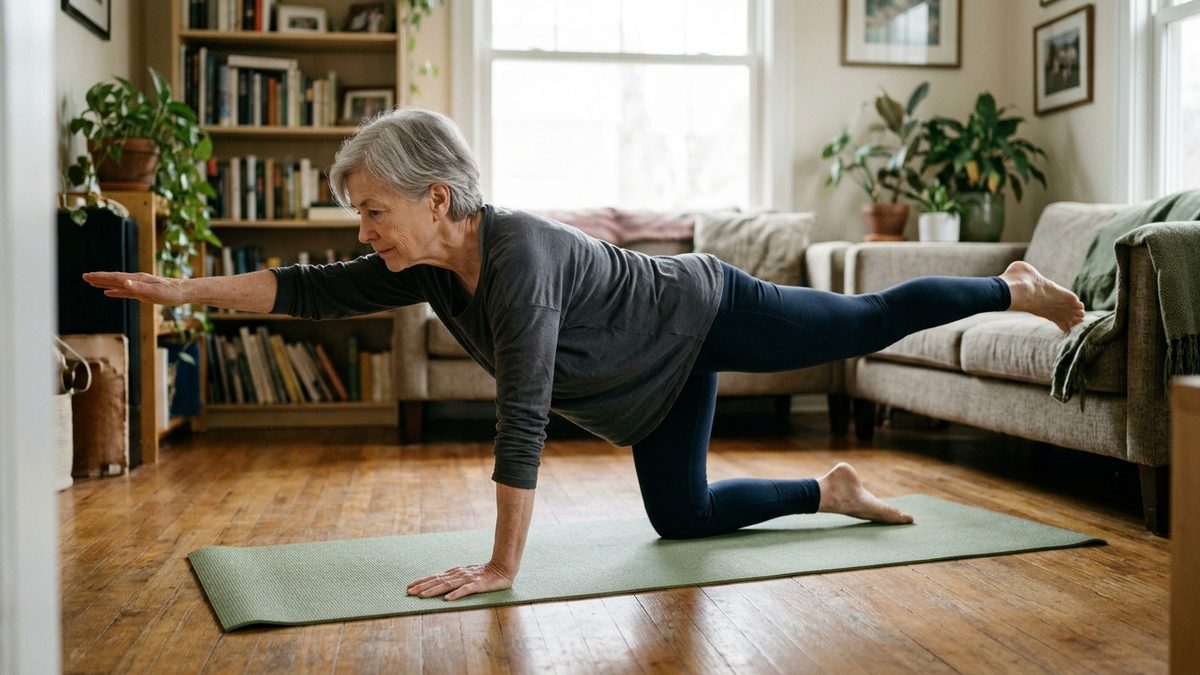
Short answer: the best core exercises for seniors are the ones that train the trunk to stay still while the arms and legs move: seated marches, pelvic tilts, dead bugs, glute bridges, bird dogs, modified side planks, wall or counter planks, sit-to-stands, suitcase carries and standing wood chops. Do them two or three days a week. A Cochrane review of 108 trials found that exercise programs cut the rate of falls in older adults by 23%, and the programs that worked best were built on balance and functional training, which is what these exercises are. Sit-ups and crunches aren't on the list, for reasons explained below.
Most core workouts online are written for 30-year-olds who want visible abs. For older adults the job of the core is different. The muscles around the trunk (abdominals, obliques, the muscles along the spine, the glutes and the deep hip muscles) hold the body upright when you catch a toe on a rug, carry shopping on one side or get up from a low chair.
A 2013 systematic review in Sports Medicine looked at this directly. In the studies it covered, trunk muscle strength showed small to medium correlations with balance, functional performance and falls in older adults. In nine core strength training studies, strength improved by 30% on average and balance and functional performance by 23%. The authors concluded that core training can be used as an adjunct or even an alternative to traditional balance and resistance training, while noting that the studies were of modest quality.
If you want the lower-body half of this, see our list of leg strengthening exercises for seniors.
How this list is ordered
Easiest first. Items 1 to 4 can be done by most people on day one. Items 5 to 8 need a bit more control. Items 9 and 10 add load and rotation. Move on when you can do the suggested amount without holding your breath or losing position.
One rule applies to all of them: keep breathing normally.
1. Seated march
How: sit tall near the front of a firm chair, hands resting on the seat. Lift one knee a few inches, lower it slowly, then the other. Don't lean back.
Amount: 10 lifts per leg, 2 sets.
Why it's here: it's the safest way to wake up the deep abdominal and hip flexor muscles, and it works for people who can't get down to the floor.
2. Pelvic tilt
How: lie on your back with knees bent and feet flat. Gently flatten your lower back toward the floor by tightening your stomach, hold for 3 to 5 seconds, release.
Amount: 10 repetitions.
Why it's here: it teaches you to find and control the position of your pelvis, which every other exercise on the list depends on.
3. Dead bug (bent-knee version)
How: lie on your back, arms pointing at the ceiling, knees bent above your hips. Slowly lower one heel to tap the floor while the opposite arm reaches overhead. Return and switch. Your lower back shouldn't arch.
Amount: 6 to 8 per side.
Why it's here: the abdominals work to stop the spine from moving, with the back fully supported by the floor.
4. Glute bridge
How: on your back, knees bent, feet hip-width apart. Squeeze your buttocks and lift your hips until shoulders, hips and knees form a line. Pause, lower slowly.
Amount: 10 repetitions, 2 sets.
Why it's here: the glutes are core muscles. They stabilize the pelvis with every step. Bridges also strengthen the muscles used to stand up from a chair.
5. Bird dog
How: on hands and knees, extend one leg straight back and the opposite arm forward. Hold 5 to 8 seconds without letting your hips rotate, return, switch sides. If wrists or knees complain, do it standing with hands on a counter.
Amount: 5 per side.
Why it's here: it's one of the three stabilization exercises (curl-up, side bridge and bird dog) analysed in a 2009 study of spine stabilization progressions for clinical use.
6. Modified side plank
How: lie on your side, propped on your forearm, knees bent. Lift your hips so your body is straight from knees to shoulders. Hold. A standing version against a wall works too.
Amount: 3 holds of 8 to 10 seconds per side.
Why it's here: the side bridge is the second of the three exercises in that study. It trains the muscles along the side of the trunk, which resist tipping sideways.
7. Wall or counter plank
How: place your forearms on a wall or your hands on a sturdy kitchen counter. Walk your feet back until your body is a straight line. Hold without letting your hips sag.
Amount: 3 holds of 10 to 20 seconds. Lower the surface (counter, then a bench) to make it harder.
Why it's here: it gives you the benefits of a plank without getting on the floor or loading the wrists and shoulders heavily.
8. Sit-to-stand without hands
How: sit in a firm chair, arms crossed over your chest. Stand up fully, then sit down slowly, taking about 3 seconds to lower.
Amount: 8 to 10 repetitions.
Why it's here: it's the most functional exercise on the list and it's also a test. See how you score on the 30-second sit-to-stand test.
9. Suitcase carry
How: hold a weight in one hand (a dumbbell, a kettlebell or a full shopping bag). Stand tall and walk 10 to 20 steps without leaning toward or away from the weight. Switch hands.
Amount: 3 walks per side.
Why it's here: it's real life. The trunk has to resist bending sideways with every step, and grip gets trained as a bonus. See our article on grip strength by age.
10. Standing wood chop
How: hold a light weight or a resistance band with both hands. Start with hands near one hip, then lift diagonally across your body to above the opposite shoulder, turning your feet and hips with the movement. Control the way back.
Amount: 8 per side.
Why it's here: it trains rotation while standing, which is how you reach into a cupboard or a car boot.
Quick reference
| Exercise | Position | Level | Main job |
|---|---|---|---|
| Seated march | Chair | Easy | Deep abdominals, hip flexors |
| Pelvic tilt | Floor or bed | Easy | Pelvic control |
| Dead bug | Floor | Easy | Stop the back arching |
| Glute bridge | Floor | Easy | Glutes, pelvis stability |
| Bird dog | Hands and knees | Medium | Back extensors, balance |
| Modified side plank | Floor or wall | Medium | Obliques, side stability |
| Wall or counter plank | Standing | Medium | Whole front of the trunk |
| Sit-to-stand | Chair | Medium | Legs, trunk control |
| Suitcase carry | Walking | Harder | Resisting side bend, grip |
| Standing wood chop | Standing | Harder | Controlled rotation |
What to skip: sit-ups and fast crunches
Sit-ups and crunches work by bending the spine over and over. This list is built the other way, on exercises that hold the trunk still while the limbs move, like the three in the stabilization study above. You don't need sit-ups to train the trunk. If you have osteoporosis, ask your doctor or physiotherapist which movements to avoid.
Also skip anything that makes you hold your breath.
How often
The World Health Organization's 2020 guidelines recommend that adults 65 and older do muscle-strengthening activity on two or more days a week and varied, multicomponent activity that emphasizes balance and strength on three or more days a week. A practical plan: pick five exercises from the list and do them on Monday, Wednesday and Friday. It takes about 15 minutes.
Progress slowly. Add a few seconds to holds or two repetitions each week. Our article on how long it takes to lose muscle covers what happens when you stop.
When to check with a doctor first
Talk to a doctor or physiotherapist before starting if you have osteoporosis with a previous spine fracture, recent abdominal or back surgery, a hernia, uncontrolled high blood pressure, or pain that shoots down a leg. Stop any exercise that causes sharp pain, dizziness or chest discomfort.
Questions people ask
What is the best core exercise for seniors? There isn't a single one. If you only do three, choose bird dog, modified side plank and sit-to-stand. Together they cover the back, the sides and the legs.
How often should seniors do core exercises? Two or three days a week on non-consecutive days. The WHO recommends strength work on at least two days and balance-focused activity on three.
Are planks safe for seniors? Yes, when scaled. Start against a wall or kitchen counter and hold for 10 to 20 seconds while breathing normally. Floor planks aren't necessary.
Can seniors do core exercises sitting in a chair? Yes. Seated marches, seated knee extensions and sit-to-stands all train the trunk. Chair exercises are a good start, but standing and floor work add more balance training.
Are sit-ups bad for seniors? They aren't needed. Dead bugs, planks and bird dogs train the trunk while it stays still. If you have osteoporosis, ask your doctor which movements to avoid.
Do core exercises help prevent falls? They help as part of a program. Exercise programs reduced the rate of falls by 23% across 108 trials, and trunk strength is linked to better balance in older adults.
Do core exercises help with lower back pain? They may. Bird dog and side bridge are standard spine stabilization exercises used by clinicians. See a professional if pain is severe or travels down a leg.
How long does it take to strengthen your core? Weeks of regular training, not days. In the core training studies reviewed in 2013, strength improved by 30% on average over the training programs.
Can I do core exercises with osteoporosis? Ask your doctor or physiotherapist first. They can tell you which movements suit your bones and which to avoid.
Is walking enough for core strength? Walking counts toward aerobic activity. The WHO recommends muscle strengthening on two or more days a week on top of it, and balance and strength work on three or more days for people over 65.
This article is general information, not medical advice. If you have a medical condition or have had a recent fall, ask a doctor or physiotherapist which exercises suit you.
References
- Granacher U, Gollhofer A, Hortobágyi T, Kressig RW, Muehlbauer T. The importance of trunk muscle strength for balance, functional performance, and fall prevention in seniors: a systematic review. Sports Medicine 2013;43(7):627–641. doi:10.1007/s40279-013-0041-1
- Sherrington C, Fairhall NJ, Wallbank GK, et al. Exercise for preventing falls in older people living in the community. Cochrane Database of Systematic Reviews 2019;(1):CD012424. doi:10.1002/14651858.CD012424.pub2
- McGill SM, Karpowicz A. Exercises for spine stabilization: motion/motor patterns, stability progressions, and clinical technique. Archives of Physical Medicine and Rehabilitation 2009;90(1):118–126. doi:10.1016/j.apmr.2008.06.026
- Bull FC, Al-Ansari SS, Biddle S, et al. World Health Organization 2020 guidelines on physical activity and sedentary behaviour. British Journal of Sports Medicine 2020;54(24):1451–1462. doi:10.1136/bjsports-2020-102955
- Centers for Disease Control and Prevention. Older Adult Falls Data. cdc.gov
The weekly readout
One email each Thursday: what we tested, which claim collapsed under a closer look, and the one number worth paying attention to.