

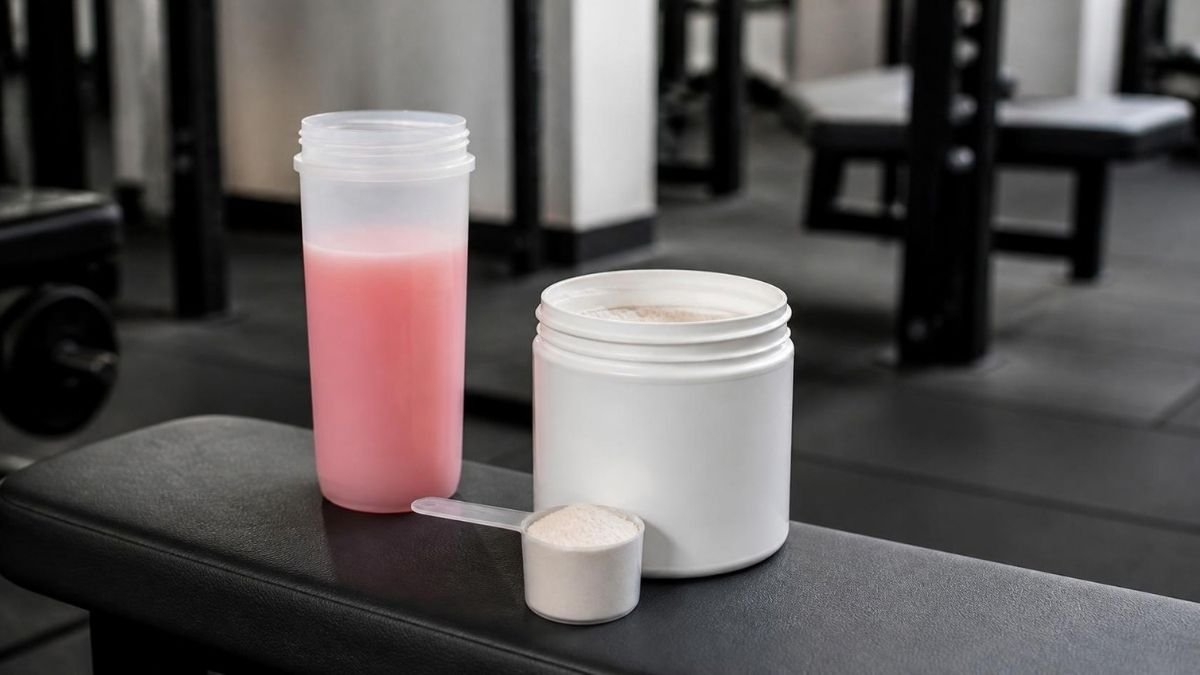
Short answer: pre-workout is a mixture, so it lasts as long as each ingredient does. The part you feel is mostly caffeine, which reaches peak blood levels 30 to 120 minutes after swallowing and has an average half-life of 4 to 6 hours, so roughly half the dose is still circulating five hours later. The tingling is beta-alanine and generally resolves within 60 to 90 minutes. The average best-selling product lists about 254 mg of caffeine per serving. In practice the noticeable lift covers a workout and an hour or two after it, while the caffeine keeps acting on sleep long after the feeling has gone: 400 mg taken six hours before bed still measurably disturbed sleep in a controlled trial.
Pre-workout by ingredient: onset, peak and duration
There is no pharmacokinetic study of "pre-workout", because there is no standard formula. An analysis of the 100 best-selling products found an average of 18.4 ingredients each. The table below covers the four that appear most often and have a position stand from the International Society of Sports Nutrition (ISSN) or a review behind them.
| Ingredient | Onset | Peak | How long you feel it | How long it is in the body |
|---|---|---|---|---|
| Caffeine | No single onset figure in the position stand | Blood levels peak 30–120 min after an oral dose | A few hours; fades gradually rather than switching off | Half-life averages 4–6 h, range 1.5–10 h in adults; a full night or longer to clear |
| Beta-alanine | Tingling is commonly reported with single doses above 800 mg | Not stated in the position stand | Tingling generally gone within 60–90 min | The effect that matters is stored muscle carnosine, which takes 6–15 weeks to return to baseline after stopping |
| Citrulline | No reliable sensation | Not established in the sources used here | Usually nothing to feel | Not established in the sources used here |
| Creatine | No acute sensation | Plasma creatine peaks about 60 min after a dose | Nothing to feel | Muscle stores, once raised, take about 4–6 weeks to fall back to baseline |
Two things stand out. Only one row, caffeine, describes an acute drug effect that lasts for hours. And for beta-alanine and creatine the column that matters is the last one, measured in weeks, which has nothing to do with when the scoop was taken.
The gaps in the table are deliberate. The beta-alanine position stand does not give an onset time for tingling, and the reviews consulted for this article do not give a time course for citrulline. Figures for both circulate widely online; they are not repeated here because they could not be traced to a source that was opened.
Caffeine is the part with a clock
The ISSN position stand on caffeine, published in 2021, is the best single summary of how the main active ingredient behaves. Its figures:
- Caffeine taken by mouth is almost completely absorbed, and blood levels peak somewhere between 30 and 120 minutes later.
- The average half-life is generally 4 to 6 hours, but in healthy adults it may range from 1.5 to 10 hours.
- More than 95% of caffeine is broken down by a single liver enzyme, CYP1A2, and common genetic variants make some people fast metabolisers and others slow.
- Doses that reliably improve exercise performance are 3 to 6 mg per kg of body mass, and the most common timing in the studies is 60 minutes before exercise.
A half-life is not a duration. It is the time taken for the amount in the blood to fall by half, and the process then repeats. A dose with a five-hour half-life is at 50% after five hours, 25% after ten and 12.5% after fifteen. This is why the question "how long does pre-workout last" has two honest answers. The subjective lift tracks the period around peak concentration and is over within a few hours. The pharmacological presence continues for most of a day. The longer piece on how long caffeine lasts goes through the factors that stretch or shorten the half-life.
How much caffeine is in pre-workout
Jagim and colleagues read the supplement facts panels of the top 100 pre-workout products on a large US retail site in 2018. Their figures are label values, not laboratory tests, and they describe one retailer at one point in time, but they are the best available picture of what is in the category.
| Ingredient | Share of products containing it | Average listed amount per serving | Dose the authors treated as effective | Products meeting that dose, where the amount was disclosed |
|---|---|---|---|---|
| Beta-alanine | 87% | 2.0 g | 4.0 g | 1.8% |
| Caffeine | 86% | 254 mg | 210 mg | 77.2% |
| Citrulline | 71% | 4.0 g | 6.0 g | 37.5% |
| Creatine | 49% | 2.1 g | 3.0 g | 29.0% |
The pattern is consistent. Caffeine is the one ingredient that most products dose at a level the literature supports. The others are, on average, listed at about half to 70% of the dose the authors treated as effective. Only one product in the sample listed beta-alanine at the 4 g mark.
For context on the caffeine figure: the FDA cites 400 mg a day as an amount not generally associated with negative effects in most adults, and lists ordinary brewed coffee at 113 to 247 mg per 12 fl oz. One average serving of pre-workout is therefore slightly above the top of the FDA’s range for a 12 fl oz brewed coffee, and about two-thirds of the 400 mg figure in a single drink. Two scoops of an average product is 508 mg, which is over it before any coffee is counted.
The label problem: proprietary blends
The same analysis found that 58 of the 100 products contained at least one proprietary blend, a group of ingredients listed with a combined weight but no individual amounts. Across the whole sample, 44.3% of all ingredients were inside such blends. In the 58 products that used them, the blends held an average of 14 ingredients at undisclosed quantities.
This matters for the duration question in a plain way. If the caffeine is inside a blend, the dose is unknown, and so is everything downstream of it: the size of the effect, how much remains at bedtime, and how it adds up with the rest of the day's coffee. The Harty review of multi-ingredient pre-workout supplements makes the same point: labelling rules require the ingredients of a blend to be listed in descending order of weight, which still leaves it hard to tell whether the key ones are present at an effective dose.
The review adds a second caution. Formulations may contain banned substances, either deliberately or as contaminants, and competitive athletes are advised to investigate a product's ingredients thoroughly before using it.
The tingles: beta-alanine, and why the feeling is not the effect
The prickling in the face, ears and hands that many people take as the sign that pre-workout has "kicked in" is paraesthesia from beta-alanine. The ISSN position stand describes it as the most widely reported side effect, commonly experienced with single doses above 800 mg of a non-sustained-release form, and generally disappearing within 60 to 90 minutes. It notes there is no evidence to date that the sensation is harmful. Splitting the intake into smaller doses of 1.6 g, or using a sustained-release formula, reduces it.
The sensation and the benefit are separate things. Beta-alanine works by raising the amount of carnosine stored in muscle, which helps buffer acid during hard efforts. That store builds slowly:
| Beta-alanine intake | What the position stand reports |
|---|---|
| 4–6 g a day for at least 2 weeks | Muscle carnosine up about 20–30% |
| 4–6 g a day for 4 weeks | Muscle carnosine up about 40–60% |
| After stopping | 6–15 weeks to return to baseline |
| Where it helps most | Efforts lasting roughly 1 to 4 minutes |
So a single scoop taken before a session produces the tingle and essentially none of the performance effect, and someone who has taken it daily for a month has the performance effect on a day they skip it. Timing beta-alanine before a workout is a convention of the product format, not something the mechanism requires. And with the average product listing 2.0 g per serving, one scoop a day on training days only is well under the 4 to 6 g a day used in the loading studies.
Citrulline and creatine: little or nothing to feel
Citrulline is included for blood flow, the "pump". The Harty review cites effective chronic intakes of 6 to 8 g a day and observes that the amounts in multi-ingredient products are generally far lower; studies in its table used anywhere from 200 mg to 6,000 mg. The Jagim average of 4.0 g sits in between. There is no dependable sensation by which to time it.
Creatine has no acute effect at all. The ISSN creatine position stand describes two ways to raise muscle stores: about 5 g four times a day for 5 to 7 days, or 3 g a day for 28 days, which gets to the same place more gradually. Stores rise by roughly 20 to 40% and then take about 4 to 6 weeks to fall back after stopping. The position stand gives no recommendation for timing relative to exercise. At the 2.1 g average found in pre-workout products, taken only on training days, saturation would be slow at best; the article on how long creatine takes to work covers the loading arithmetic.
How long before a workout to take it
The trials reviewed by Harty and colleagues gave pre-workout between 10 and 60 minutes before exercise, and the review does not single out one best timing. The caffeine position stand reports 60 minutes before exercise as the most common protocol, which fits a peak that arrives 30 to 120 minutes after swallowing.
A reasonable reading is that 30 to 60 minutes beforehand puts the caffeine peak inside the session for most people. Taking it in the car park five minutes before the first set means the peak arrives during the cool-down or the drive home, and extends further into the evening than intended.
The bedtime cut-off, worked through
The one controlled trial that tested this directly is Drake and colleagues, 2013. Participants took 400 mg of caffeine at bedtime, three hours before or six hours before, against placebo, with sleep measured at home by a portable monitor as well as by diary. All three timings significantly disturbed sleep. The authors concluded that the loss of total sleep time at the six-hour mark supports avoiding substantial caffeine for at least six hours before bed. The ISSN position stand reaches a compatible conclusion from the sports literature: caffeine worsens sleep latency, time awake during the night, efficiency and duration, and in one study a 6 p.m. dose caused insomnia in 6 of 13 athletes.
Two caveats. The trial used 400 mg, more than an average scoop. And six hours was the longest gap tested, so the study shows that six hours is not enough for that dose, not that seven is safe.
The table below is a calculation, not a measurement. It applies simple half-life decay to the average 254 mg serving, using the 5-hour midpoint of the average half-life range. Remaining caffeine = 254 × 0.5^(hours ÷ 5).
| Hours since the dose | Share remaining | Caffeine left from 254 mg | Example: bedtime 11 p.m. means a dose at |
|---|---|---|---|
| 5 | 50% | ~127 mg | 6 p.m. |
| 6 | 44% | ~111 mg | 5 p.m. |
| 8 | 33% | ~84 mg | 3 p.m. |
| 10 | 25% | ~64 mg | 1 p.m. |
| 12 | 19% | ~48 mg | 11 a.m. |
| 15 | 12.5% | ~32 mg | 8 a.m. |
Read the six-hour row. An average scoop at 5 p.m. leaves something like 111 mg in circulation at 11 p.m., close to the low end of the FDA’s range for a 12 fl oz brewed coffee (113 mg), still in the body at bedtime.
The range matters more than the midpoint. With a 1.5-hour half-life the same dose is down to about 16 mg after six hours; with a 10-hour half-life about 168 mg is left. Nobody knows their own half-life without testing, which is why the practical rule is to observe the result. Someone who takes pre-workout at 6 p.m. and falls asleep in the usual 10 to 20 minutes and wakes rested has an answer for their own body. Someone who lies awake has one too.
Is pre-workout bad for you
The Harty review, which is the most direct source, concludes that multi-ingredient pre-workout supplements appear to be relatively safe, with a qualification that should be read as carefully as the conclusion: most of the safety studies lasted less than eight weeks, and more data are needed on long-term use. That is an absence of long-term evidence, not evidence of long-term safety.
The predictable problems are caffeine problems. The caffeine position stand lists fast heart rate, palpitations, anxiety, headache and insomnia as the commonly reported side effects and notes they increase with dose. The FDA states that toxic effects such as seizures can be observed with rapid consumption of around 1,200 mg, and that pure and highly concentrated caffeine products can have serious consequences including death. Those quantities are well beyond one scoop, but "dry scooping" and multiple servings narrow the gap, and a proprietary blend removes the ability to count.
The FDA also says medical experts advise against energy drinks for children and teens, and recommends that people who are pregnant, trying to become pregnant or breastfeeding talk to a health care provider about limiting caffeine. A pre-workout is a concentrated caffeine product and the same cautions reasonably apply.
On benefit, the review is measured. A single dose may improve muscular endurance and subjective mood, with mixed results for force and power. Used over weeks alongside resistance training, these products appear to add to lean mass gains, though most of what determines how long it takes to build muscle is the training and the eating.
What is not worth doing
Judging a product by how hard it tingles. The tingle is a side effect of one ingredient, unrelated to that day's performance, and easy for a manufacturer to turn up.
Taking a second scoop because the first "wore off". The feeling fades while most of the caffeine is still present. A second average serving puts the total at about 508 mg, above the FDA's 400 mg figure, and pushes the tail well into the night.
Relying on a pre-workout for creatine or beta-alanine. On the label data, the average product lists less than the dose treated as effective for each (2.0 g against 4 g of beta-alanine, 2.1 g against 3 g of creatine), and only on the days it is used. Both ingredients work by accumulation.
Buying proprietary blends. An undisclosed caffeine dose cannot be timed, counted or compared.
What to actually do
Read the caffeine line first. If the amount is not disclosed, treat the product as unknown. Compare the number with the 3 to 6 mg per kg range: for a 154 lb (70 kg) person that is 210 to 420 mg, and the position stand notes that lower doses can also be effective.
Add it to the rest of the day. The 400 mg FDA figure covers coffee, tea, soft drinks and the scoop together.
Take it 30 to 60 minutes before training, so that the peak lands in the session.
Count back from bedtime. Six hours is the minimum supported by the Drake trial; the half-life arithmetic suggests eight or more is a safer margin for an average dose, and slow metabolisers need longer still. For evening training, a stimulant-free product or nothing at all is the option that does not cost sleep.
Take creatine and beta-alanine separately and daily, if they are wanted, at the studied doses. Their timing is irrelevant.
Consider plain coffee. It supplies the one ingredient that is reliably dosed in these products, at a known and usually lower amount. The article on whether coffee helps you focus covers what that dose does for attention.
Questions people ask
How long does pre-workout last? The noticeable lift lasts a few hours, centred on the caffeine peak 30 to 120 minutes after drinking it. The tingling fades within 60 to 90 minutes. The caffeine itself has an average half-life of 4 to 6 hours, so a meaningful amount remains for most of the day.
How long does pre-workout take to kick in? Caffeine reaches peak blood levels 30 to 120 minutes after an oral dose, which is why studies most often give it 60 minutes before exercise. Beta-alanine tingling is a side effect of a different ingredient and says nothing about when the caffeine has peaked.
How long does pre-workout stay in your system? Caffeine's half-life averages 4 to 6 hours and ranges from 1.5 to 10 hours in adults, so clearing most of a dose takes roughly a day. Carnosine from beta-alanine and stored creatine persist much longer: about 6 to 15 weeks and 4 to 6 weeks respectively after regular use stops.
How long before a workout should you take pre-workout? Studies of these products dosed them 10 to 60 minutes before exercise, and caffeine research most often uses 60 minutes. Taking it 30 to 60 minutes beforehand places the caffeine peak inside the session for most people. Taking it later shifts the peak, and the tail, towards the evening.
How long do pre-workout tingles last? Generally 60 to 90 minutes, according to the sports nutrition position stand on beta-alanine. The sensation is commonly reported with single doses above 800 mg, is not known to be harmful, and is reduced by smaller divided doses or sustained-release forms.
Can pre-workout keep you awake? Yes. In a controlled trial, 400 mg of caffeine taken six hours before bed still significantly disturbed measured sleep. An average serving has about 254 mg. A simple half-life calculation leaves roughly 110 mg in the body six hours after an average scoop.
How much caffeine is in pre-workout? An analysis of the 100 best-selling products found an average of 254 mg per serving among those that listed it, with wide variation. That is about two-thirds of the 400 mg a day the FDA cites for most adults. Products using proprietary blends often do not disclose the amount.
Is pre-workout bad for you? A 2018 review concluded these products appear relatively safe in healthy adults, while noting that most safety studies ran for less than eight weeks. The foreseeable problems are those of caffeine: palpitations, anxiety, headache and poor sleep, increasing with dose and with stacked servings.
Does pre-workout expire? None of the studies used for this article examined shelf life, so there is no evidence-based figure to give. The date printed on the tub is the manufacturer’s own. Powder that has clumped from moisture is common and is not the same thing as being past its date.
This article summarises published research on common pre-workout ingredients for general information and is not medical advice. Caffeine tolerance varies widely; people who are pregnant or breastfeeding, under 18, taking medication, or living with a heart, blood pressure or anxiety condition should speak to a clinician before using stimulant supplements.
References
- Guest, N.S., VanDusseldorp, T.A., Nelson, M.T., et al. (2021). International society of sports nutrition position stand: caffeine and exercise performance. Journal of the International Society of Sports Nutrition, 18, 1. doi:10.1186/s12970-020-00383-4
- Trexler, E.T., Smith-Ryan, A.E., Stout, J.R., et al. (2015). International society of sports nutrition position stand: Beta-Alanine. Journal of the International Society of Sports Nutrition, 12, 30. doi:10.1186/s12970-015-0090-y
- Harty, P.S., Zabriskie, H.A., Erickson, J.L., Molling, P.E., Kerksick, C.M., & Jagim, A.R. (2018). Multi-ingredient pre-workout supplements, safety implications, and performance outcomes: a brief review. Journal of the International Society of Sports Nutrition, 15, 41. doi:10.1186/s12970-018-0247-6
- Jagim, A.R., Harty, P.S., & Camic, C.L. (2019). Common Ingredient Profiles of Multi-Ingredient Pre-Workout Supplements. Nutrients, 11(2), 254. doi:10.3390/nu11020254
- Kreider, R.B., Kalman, D.S., Antonio, J., et al. (2017). International Society of Sports Nutrition position stand: safety and efficacy of creatine supplementation in exercise, sport, and medicine. Journal of the International Society of Sports Nutrition, 14, 18. doi:10.1186/s12970-017-0173-z
- Drake, C., Roehrs, T., Shambroom, J., & Roth, T. (2013). Caffeine Effects on Sleep Taken 0, 3, or 6 Hours before Going to Bed. Journal of Clinical Sleep Medicine, 9(11), 1195–1200. doi:10.5664/jcsm.3170
- U.S. Food and Drug Administration (2024). Spilling the Beans: How Much Caffeine is Too Much? fda.gov
The weekly readout
One email each Thursday: what we tested, which claim collapsed under a closer look, and the one number worth paying attention to.