
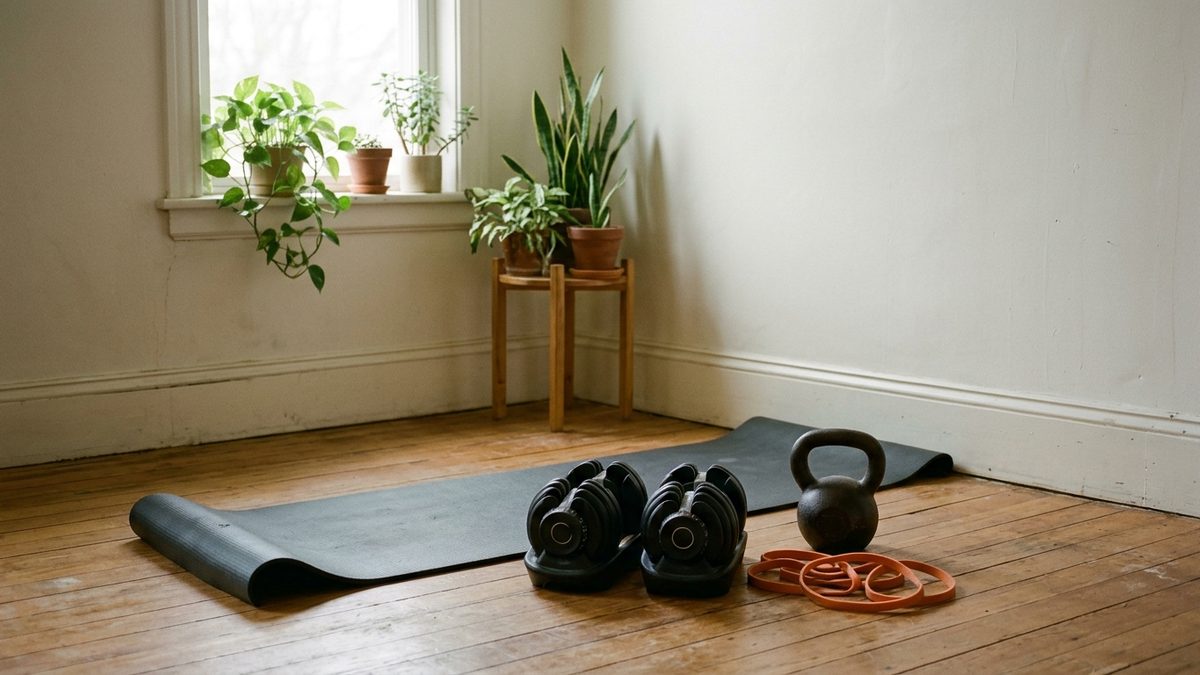
Short answer: the home gym essentials, in the order worth buying them, are a mat, resistance bands, adjustable dumbbells, a doorway pull-up bar, an adjustable bench, a kettlebell, a jump rope, a timer or training log, and a foam roller. The first four cover every major muscle group. Research supports starting small: a meta-analysis found muscle growth was similar with light and heavy loads and another found elastic bands produced strength gains similar to conventional weights and machines. A rack, a barbell and cardio machines can wait until you've trained consistently for a few months.
A lot of home gym equipment ends up as a clothes rack. The way to avoid that is to buy in stages. Start with the cheapest equipment that lets you train every muscle group, use it for eight weeks, then add the next item only when the current one is clearly limiting you.
Why you need less than you think
Three findings from the research make the case.
Light loads build muscle too. A 2017 meta-analysis of 21 studies compared training with light loads against heavy loads. Muscle growth was similar between the two. Maximum strength (one-repetition maximum) improved more with heavy loads, above 60% of the maximum. For a beginner training for health and muscle, that means a modest set of weights is enough.
Bands work. A 2019 meta-analysis of eight studies found no advantage for either method: elastic resistance training produced strength gains similar to conventional resistance training, in both the upper and lower body.
So does bodyweight. A 2017 study reported that a low-load bench press and push-ups produced similar muscle growth and strength gains. Our pages on how many push-ups and how many pull-ups you should be able to do give targets by age.
The 9 essentials, in buying order
1. Exercise mat
For floor work, planks, stretching and anything on your knees. A thicker mat is kinder on hard floors.
2. Resistance bands
A set of loop bands and a set of tube bands with handles and a door anchor covers rows, presses, pull-aparts, leg work and assisted pull-ups. They weigh almost nothing and fit in a drawer.
3. Adjustable dumbbells
The single most useful purchase. One pair replaces a rack of fixed weights and lets you add load in small steps, which is what drives progress. Choose a pair that goes up to at least 20 to 25 kg (45 to 55 lb) each if you can. Spin-lock sets are the cheaper kind and slow to change; selector-dial sets are faster and cost more.
4. Doorway pull-up bar
Pulling exercises are the hardest to do without equipment. A bar that hooks over a door frame handles pull-ups, chin-ups and hanging leg raises, and bands turn it into an assisted pull-up station. Check the weight rating and your door frame.
5. Adjustable bench
A bench that goes from flat to incline adds presses, supported rows, split squats and step-ups, and makes dumbbell work safer than lying on the floor. Check that its weight rating covers you plus the heaviest dumbbells you'll use.
6. One kettlebell
For swings, goblet squats, carries and deadlifts. Start with a weight you can swing with good form for 10 to 15 repetitions.
7. Jump rope
The cheapest cardio equipment there is, and it stores in a pocket. If jumping isn't for you because of joints or neighbours downstairs, brisk walking outside costs nothing.
8. A timer and a training log
A phone timer for rest periods and a notebook or app to record sets, repetitions and weights. Writing down what you did is how you make sure you do slightly more next time. It costs nothing.
9. Foam roller
Optional comfort after training. None of the research cited here covers it, so buy it last.
Three stages
| Stage | What you add | What you can train |
|---|---|---|
| 1 | Mat, band set, doorway pull-up bar, jump rope | Every muscle group with bands and bodyweight |
| 2 | Adjustable dumbbells and a kettlebell | Progressive loading |
| 3 | Adjustable bench | Presses, supported rows and step-ups |
Prices change too often to quote here. Check current listings, and buy stage 2 only after you've used stage 1 for a couple of months.
6 things you don't need yet
1. A treadmill or exercise bike
Not because they don't work. In an 18-month JAMA trial of 148 overweight women, the group given a home treadmill kept up more exercise and lost more weight (7.4 kg) than a group on the same short-bout plan without one (3.7 kg). But a machine is the most expensive item to buy and the bulkiest to regret. Walk or run outside for the first few months, and buy a machine when you know you'll use it.
2. A power rack, barbell and plates
Excellent equipment for someone who's been training for a year and wants to lift heavy. It needs floor space, ceiling height and a bigger budget. Dumbbells will take you a long way first.
3. An all-in-one multi-gym
Fixed movement paths and a lot of space.
4. Ab gadgets
Rollers, crunch frames and electrical belts. The floor is enough.
5. Ankle and wrist weights
They add a small load in an awkward place. Heavier dumbbells or a band do the job better.
6. Smart mirrors and subscription hardware
Good coaching content exists free. Don't lock yourself into a monthly fee before the habit is formed.
A first program for this equipment
Two or three days a week, with a day between sessions:
- Goblet squat or split squat
- Push-up or dumbbell press
- Band or dumbbell row
- Dumbbell Romanian deadlift or kettlebell swing
- Assisted pull-up or band pull-down
- Plank or suitcase carry
Do 2 to 3 sets of 8 to 15 repetitions each, stopping one or two short of failure. When you reach 15 with good form, add weight. For timelines, see how long it takes to build muscle.
That schedule meets the WHO recommendation of muscle-strengthening activity on at least two days a week. A pooled analysis of 16 cohort studies linked this kind of activity to a 10 to 17% lower risk of death from any cause, cardiovascular disease, cancer and diabetes, with the largest reduction at about 30 to 60 minutes a week.
Safety and space
You need enough clear floor to lie down with your arms stretched out. Check door frames before hanging from them, keep collars tight on adjustable dumbbells, and don't train to failure on overhead movements when you're alone. Rubber floor tiles protect floors and reduce noise.
Questions people ask
What equipment do I need for a home gym? To start: a mat, resistance bands, adjustable dumbbells and a doorway pull-up bar. Add a bench and a kettlebell later.
How much does a basic home gym cost? It depends on current prices, which this article doesn't quote. The cheapest tier is bands, a doorway bar, a mat and a rope. Adjustable dumbbells and a bench are the two larger purchases.
Can you build muscle with just dumbbells? Yes. In a meta-analysis of 21 studies, muscle growth was similar with light and heavy loads, so a modest set of dumbbells is enough to start.
Are resistance bands as good as weights? A meta-analysis of eight studies found similar strength gains from elastic and conventional resistance training.
How much space do I need for a home gym? Enough clear floor to lie down with your arms out covers bands, dumbbells and a bench. A rack and barbell need more.
Is a home gym worth it compared with a gym membership? Compare the one-off cost of the first tier with what you pay per month for a gym. It's worth it only if you'll actually train at home; in the JAMA trial, having a treadmill at home went with more exercise over 18 months.
Do I need a bench? Not at first. Floor presses and push-ups work. A bench becomes useful once you're pressing heavier dumbbells.
What's the best cardio equipment for home? For most people starting out, a jump rope or simply walking and running outdoors. Buy a machine after the habit is established.
How heavy should my dumbbells be? Adjustable ones, so the weight can go up in small steps as you get stronger.
How often should I train at home? Two or three strength sessions a week covering all major muscle groups meets WHO guidelines.
This article is general information, not medical advice. Check with a doctor before starting a new exercise program if you have a heart condition, are pregnant or have an injury. No products were supplied for this article and it contains no affiliate links.
References
- Schoenfeld BJ, Grgic J, Ogborn D, Krieger JW. Strength and hypertrophy adaptations between low- vs. high-load resistance training: a systematic review and meta-analysis. Journal of Strength and Conditioning Research 2017;31(12):3508–3523. doi:10.1519/JSC.0000000000002200
- Lopes JSS, Machado AF, Micheletti JK, de Almeida AC, Cavina AP, Pastre CM. Effects of training with elastic resistance versus conventional resistance on muscular strength: a systematic review and meta-analysis. SAGE Open Medicine 2019;7:2050312119831116. doi:10.1177/2050312119831116
- Kikuchi N, Nakazato K. Low-load bench press and push-up induce similar muscle hypertrophy and strength gain. Journal of Exercise Science & Fitness 2017;15(1):37–42. doi:10.1016/j.jesf.2017.06.003
- Momma H, Kawakami R, Honda T, Sawada SS. Muscle-strengthening activities are associated with lower risk and mortality in major non-communicable diseases: a systematic review and meta-analysis of cohort studies. British Journal of Sports Medicine 2022;56(13):755–763. doi:10.1136/bjsports-2021-105061
- Jakicic JM, Winters C, Lang W, Wing RR. Effects of intermittent exercise and use of home exercise equipment on adherence, weight loss, and fitness in overweight women: a randomized trial. JAMA 1999;282(16):1554–1560. doi:10.1001/jama.282.16.1554
- Bull FC, Al-Ansari SS, Biddle S, et al. World Health Organization 2020 guidelines on physical activity and sedentary behaviour. British Journal of Sports Medicine 2020;54(24):1451–1462. doi:10.1136/bjsports-2020-102955
The weekly readout
One email each Thursday: what we tested, which claim collapsed under a closer look, and the one number worth paying attention to.