
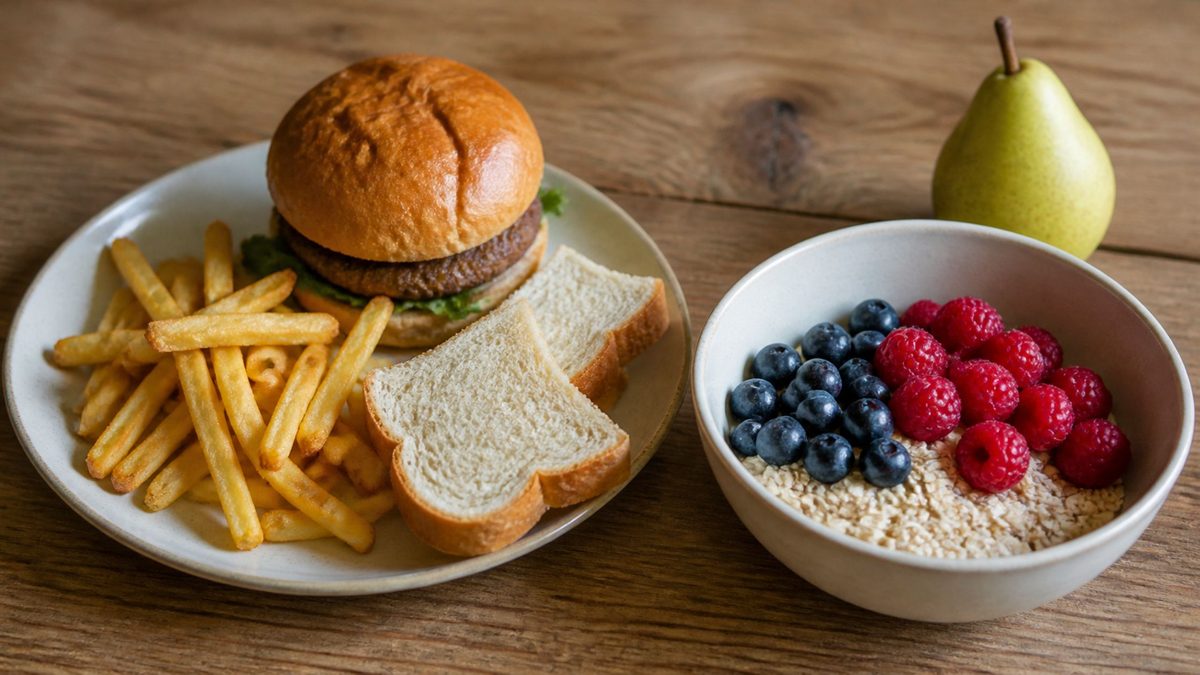
Short answer: the foods most linked to constipation are fast food, processed meat, large portions of red meat, white bread and other refined grains, chips and salty snacks, frozen ready meals, pastries and sweets, and cheese and other dairy in people sensitive to it. Most of them don't "block" anything. They are low in fiber and push fiber-rich food off the plate. The US National Institute of Diabetes and Digestive and Kidney Diseases (NIDDK) lists chips, fast food, meat and processed or prepared foods as foods to limit. On the other side, ripe bananas, coffee and modest amounts of chocolate get much more blame than the evidence supports.
Search for this topic and you get lists with 15 or 20 items, each with the same vague warning. The problem is that "causes constipation" is used for three very different things:
- Low fiber, high fat. The food has almost no fiber and often a lot of fat. It slows the gut a little and, more importantly, it replaces the beans, fruit and whole grains you would otherwise eat. This covers most of the list.
- A specific reaction. A few foods affect some people directly: cow's milk protein in some children, the tannins and starch of unripe bananas, persimmons eaten in large amounts.
- Folk blame. Foods that people believe constipate them, with weak or opposite evidence.
This article keeps the three apart. If you're already constipated, our guide to how long fiber takes to work covers the fix.
The 12 foods that tend to cause constipation
1. Fast food and fried meals
A burger, fries and a soda can add up to 1,000+ calories with only a few grams of fiber. Fat slows stomach emptying, and a fast-food meal fills you up so there is no room for anything with fiber in it. NIDDK names fast food among the foods to limit when you're constipated.
2. Processed meat
Hot dogs, sausages, bacon, deli meat. There is zero fiber, a lot of fat and salt, and they're often eaten in white buns. NIDDK lists processed foods such as hot dogs specifically.
3. Large portions of red meat
Meat has no fiber at all. The problem isn't the steak itself, it's the steak taking the place of vegetables and grains. A high-meat day is almost always a low-fiber day. NIDDK puts "meat" on its limit list for this reason.
4. White bread, white pasta and other refined grains
Milling removes the bran, which is where most of a grain's fiber is. Swapping whole wheat for white is one of the easiest ways to lose 5–10 g of fiber a day without noticing. Wheat bran is one of the best-studied fibers for adding bulk to stool, so removing it works in the opposite direction.
5. Chips and salty snacks
Low fiber, high fat, high salt, easy to eat in large amounts. NIDDK lists chips first among foods to limit.
6. Frozen ready meals and packaged snacks
"Prepared foods, such as some frozen meals and snack foods" are on NIDDK's list. They are usually built around refined starch, cheese and meat, with a token amount of vegetables. Check the label: under 3 g of fiber per meal is common.
7. Pastries, cakes and sweets
Refined flour, sugar and fat, with almost no fiber. They also tend to replace fruit as the "something sweet" of the day.
8. Cheese and other dairy (for some people)
Cheese has no fiber and a lot of fat, so it fits pattern 1. In some people there is also a direct effect. The strongest evidence is in young children. In a double-blind crossover trial of 65 children aged about 1 to 6 with chronic constipation that laxatives hadn't helped, 44 (68%) improved on soy milk and none improved on cow's milk. When those 44 were later given cow's milk again without knowing it, the constipation came back. That's a strong result, but it is about a specific group of children referred to a specialist clinic, many of whom had signs of milk hypersensitivity. It doesn't mean dairy constipates most adults.
9. Unripe (green) bananas
Green bananas are high in resistant starch and tannins, and many people find them binding. As bananas ripen, the starch turns to sugar and the effect fades (see the "blamed unfairly" list below).
10. Persimmons in large amounts
Unripe persimmons are rich in tannins that can clump together in the stomach. Eating a lot of them is a known cause of a rare blockage called a bezoar, mostly in people who have had stomach surgery. A persimmon or two is fine for most people; a bowlful of unripe ones is not.
11. Very low-carb, high-protein eating
Constipation is one of the most common side effects people report when they start a ketogenic or very low-carb diet. Cutting carbs usually means cutting grains, beans and fruit, which are the main sources of fiber. It's the same pattern as items 1–3, applied to the whole diet.
12. Iron and calcium supplements (not food, but often mistaken for it)
If constipation started when you began a supplement, this is the likely cause. Iron and calcium supplements are well-known causes of constipation, and so are some medicines (opioid painkillers, some antacids, some antidepressants). Don't stop a prescribed medicine on your own; ask whoever prescribed it about alternatives.
5 foods that get blamed unfairly
1. Ripe bananas
Bananas are one of the foods people most often say constipate them. In a German survey of people's beliefs about food and stool, bananas and chocolate topped the list (Müller-Lissner et al., 2005). But a ripe banana has about 3 g of fiber, some of it the soluble kind that softens stool. The binding reputation comes from green bananas and from the BRAT diet for diarrhea, where bananas are used for their gentle, easy-to-digest nature, not because they stop you up.
2. Coffee
Coffee is more likely to do the opposite. In a 1990 study in Gut, 29% of healthy young adults said coffee gives them the urge to go. In those who reacted, both regular and decaf coffee raised activity in the lower colon within four minutes, and the effect lasted at least 30 minutes. Hot water did nothing. And no, coffee doesn't dehydrate you enough to matter at normal amounts. Our article on whether coffee dehydrates you goes through the data.
3. Chocolate (mostly)
Chocolate's reputation is mostly folk belief from surveys. In a small randomized crossover trial in healthy adults, eating 100 g of dark chocolate a day for five days made stool a little firmer on the Bristol scale than the same amount of white chocolate (Fox et al., 2019). That's a large dose, about a full bar a day, and the effect was small. It's nowhere near the "chocolate blocks you up" story. A square or two isn't the problem; a diet built on sweets is (see item 7 above).
4. White rice
White rice is low in fiber (under 1 g per cup), so a diet heavy in it can fit pattern 1. But rice doesn't have any special binding effect, and plain rice is a staple of easy-to-digest diets for a reason. Swap some for brown rice if you want more fiber.
5. Eggs
Eggs show up on many lists, but there is no good evidence that they constipate people. Like meat, they have no fiber. If eggs come with white toast and bacon, the meal is low in fiber. If they come with vegetables and whole-grain bread, it isn't.
Quick reference
| Food | Why it's linked | How strong is the evidence? |
|---|---|---|
| Fast food, chips, prepared meals | Little fiber, lots of fat, replaces fiber-rich food | Strong (NIDDK guidance) |
| Processed and red meat | No fiber; crowds out plants | Strong for the pattern |
| White bread, refined grains | Bran removed | Strong for the pattern |
| Cheese and dairy | No fiber; cow's milk protein in some children | Strong in a subgroup of children, weak for most adults |
| Unripe bananas, persimmons | Resistant starch, tannins | Moderate; mostly mechanism and case reports |
| Iron and calcium supplements | Direct side effect | Strong |
| Ripe bananas | Popular belief | Weak; contain soluble fiber |
| Coffee | Popular belief | Opposite effect in about a third of people |
| Chocolate | Popular belief | Small firming effect in one trial |
What to eat instead
NIDDK's list of high-fiber foods is short and practical: whole grains (whole wheat bread and pasta, oatmeal, bran cereals), legumes (lentils, black beans, kidney beans, chickpeas), fruit (berries, apples with the skin, oranges, pears), vegetables (carrots, broccoli, green peas, collard greens) and nuts (almonds, peanuts, pecans). Add fiber gradually over a week or two, or you'll trade constipation for gas and bloating.
One more myth: drinking extra water doesn't help constipation unless you're actually low on fluids. A review of constipation myths in the American Journal of Gastroenterology found no evidence that adding fluid helps people who are already well hydrated (Müller-Lissner et al., 2005). Fluid does matter when you increase fiber, especially psyllium.
When it's not the food
See a doctor if constipation is new and lasts more than a few weeks, or if you notice blood in your stool, unexplained weight loss, severe pain, or a change in bowel habits after age 45–50. Those need checking regardless of diet.
Questions people ask
What foods cause constipation the most? Low-fiber, high-fat foods: fast food, chips, processed meat, frozen ready meals and pastries. NIDDK lists chips, fast food, meat and processed or prepared foods as the foods to limit.
Does cheese cause constipation? It can contribute because it has no fiber and a lot of fat. In young children with cow's milk hypersensitivity, dairy can cause constipation directly: 68% of the children in one trial improved on soy milk. For most adults, cheese matters mainly when it replaces fiber-rich food.
Do bananas cause constipation? Unripe green bananas can, because of resistant starch and tannins. Ripe bananas have about 3 g of fiber and are unlikely to constipate you.
Does rice cause constipation? Not directly. White rice is low in fiber, so a diet heavy in it can lack the bulk that keeps you regular. Brown rice has about three times the fiber.
Can eggs make you constipated? There is no good evidence that eggs cause constipation. They have no fiber, so what you eat with them matters more.
Does coffee cause constipation? Usually the opposite. In about 29% of people, coffee, even decaf, triggers the urge to go within minutes.
Does chocolate cause constipation? The evidence is weak. One small trial found dark chocolate made stool slightly firmer. That's a small effect compared with its reputation.
What should I avoid eating when constipated? NIDDK suggests limiting chips, fast food, meat, prepared foods and processed foods, and adding whole grains, beans, fruit, vegetables and nuts.
Can processed food cause constipation? Yes, mainly because it's low in fiber. Hot dogs, frozen dinners and packaged snacks are named in NIDDK's guidance.
Does drinking more water fix constipation? Only if you're dehydrated. In people who are already drinking enough, extra water doesn't improve constipation. It does help when you add fiber supplements.
This article is general information, not medical advice. Ongoing constipation, blood in the stool, weight loss or a change in bowel habits should be checked by a doctor.
References
- National Institute of Diabetes and Digestive and Kidney Diseases. Eating, Diet, & Nutrition for Constipation. niddk.nih.gov
- Iacono G, Cavataio F, Montalto G, et al. Intolerance of cow's milk and chronic constipation in children. New England Journal of Medicine 1998;339(16):1100–1104. doi:10.1056/NEJM199810153391602
- Brown SR, Cann PA, Read NW. Effect of coffee on distal colon function. Gut 1990;31(4):450–453. doi:10.1136/gut.31.4.450
- Müller-Lissner SA, Kamm MA, Scarpignato C, Wald A. Myths and misconceptions about chronic constipation. American Journal of Gastroenterology 2005;100(1):232–242. doi:10.1111/j.1572-0241.2005.40885.x
- Müller-Lissner SA, Kaatz V, Brandt W, et al. The perceived effect of various foods and beverages on stool consistency. European Journal of Gastroenterology & Hepatology 2005;17(1):109–112. doi:10.1097/00042737-200501000-00020
- Fox M, Meyer-Gerspach AC, Wendebourg MJ, et al. Effect of cocoa on the brain and gut in healthy subjects: a randomised controlled trial. British Journal of Nutrition 2019;121(6):654–661. doi:10.1017/S0007114518003689
The weekly readout
One email each Thursday: what we tested, which claim collapsed under a closer look, and the one number worth paying attention to.